Phyllanthus — 43 species
Botanical species in the genus Phyllanthus recorded in the PlantPeers database.

Phyllanthus acidus
Phyllanthus acidus
Family: Phyllanthaceae
Cultivation
Gooseberry tree grows well in the tropics at low and medium altitudes in places with a short or prolonged dry season. It prefers hot, humid tropical lowlands. It flourishes from sea-level up to an altitude of 1,500 - 1,800 metres.
Full cultivation guide →
Phyllanthus amarus
Phyllanthus amarus
Family: Phyllanthaceae
Cultivation
Requires a sunny position. Sandy loam and black soils with a pH of 7.5 - 8 are considered best. The plant has explosive seed capsules that propel the seeds some distance from the plant.
Full cultivation guide →
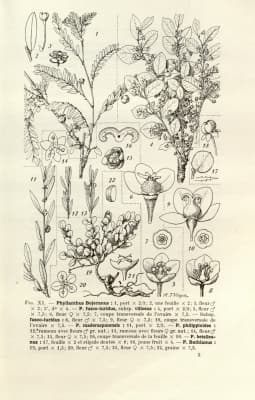
Phyllanthus bojerianus
Phyllanthus bojerianus
Family: Phyllanthaceae
Cultivation
A dioecious species, both male and female forms need to be grown if fruit and seed are required.
Full cultivation guide →

Phyllanthus emblica
Phyllanthus emblica
Family: Phyllanthaceae
Cultivation
Phyllanthus emblica is a plant mainly of the hot, tropical lowlands, succeeding in both humid and semi-arid areas. It can also be found at elevations up to 2,300 metres in southern China. It grows best in areas where annual daytime temperatures are within the range 20 - 29°c, but can tolerate 14 - 35°c.
Full cultivation guide →Phyllanthus engleri
Phyllanthus engleri
Family: Phyllanthaceae
Cultivation
Found in the wild particularly on drier and less arable soils. This species hybridizes in the wild with P. polyanthus to give rise to the hybrid P. fluminis-zambesi. A dioecious species, both male and female forms need to be grown if fruit and seed are required.
Full cultivation guide →
Phyllanthus fraternus
Phyllanthus fraternus
Family: Phyllanthaceae
Cultivation
The plant tolerates dry conditions but does not survive in waterlogged conditions. A widespread weed of roadsides, cultivated land and waste places.
Full cultivation guide →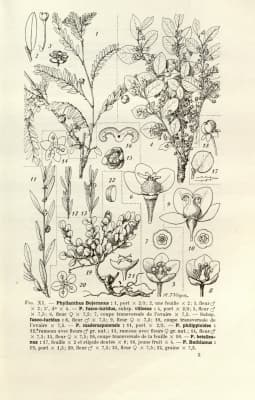
Phyllanthus fuscoluridus
Phyllanthus fuscoluridus
Family: Phyllanthaceae
Phyllanthus hutchinsonianus
Phyllanthus hutchinsonianus
Family: Phyllanthaceae
Cultivation
Plants are usually monoecious, but sometimes dioecious forms are found, in which case both male and female forms would need to be grown if seed was required.
Full cultivation guide →Phyllanthus indofischeri
Phyllanthus indofischeri
Family: Phyllanthaceae
Cultivation
Requires a sunny position in a well-drained soil. Established plants are very drought tolerant.
Full cultivation guide →Phyllanthus kaessneri
Phyllanthus kaessneri
Family: Phyllanthaceae
Cultivation
Plants are usually monoecious, but sometimes dioecious forms are found, in which case both male and female forms would need to be grown if seed was required.
Full cultivation guide →Phyllanthus leucanthus
Phyllanthus leucanthus
Family: Phyllanthaceae
Cultivation
Plants are usually monoecious, but sometimes dioecious forms are found, in which case both male and female forms would need to be grown if seed was required.
Full cultivation guide →

Phyllanthus maderaspatensis
Phyllanthus maderaspatensis
Family: Phyllanthaceae
Cultivation
It grows on a wide variety of soils, usually on heavy clay and alluvial soils of low-altitude river valleys, on river banks and in flood plains. Outside tropical Africa, the plant is often considered a weed. It shows a marked preference for calcareous sites in humid tropical areas.
Full cultivation guide →


Phyllanthus muellerianus
Phyllanthus muellerianus
Family: Phyllanthaceae
Cultivation
The plant is reported as a weed of rice fields in parts of Nigeria - this is plainly caused by a lack of timely cultivation. The plant can be coppiced.
Full cultivation guide →
Phyllanthus niruri
Phyllanthus niruri
Family: Phyllanthaceae
Cultivation
Succeeds in most soils in a position in full sun or partial shade.
Full cultivation guide →Phyllanthus niruroides
Phyllanthus niruroides
Family: Phyllanthaceae
Cultivation
As a weed it is especially frequent in sorghum on dark brown, heavy soils.
Full cultivation guide →
Phyllanthus nummulariifolius
Phyllanthus nummulariifolius
Family: Phyllanthaceae
Cultivation
Plants are usually monoecious, but dioecious forms also exist, in which case both male and female forms would need to be grown if fruit and seed were required.
Full cultivation guide →Phyllanthus ovalifolius
Phyllanthus ovalifolius
Family: Phyllanthaceae
Cultivation
Plants can be monoecious or dioecious. Dioecious forms will need both male and female plants if seed is required.
Full cultivation guide →

Phyllanthus profusus
Phyllanthus profusus
Family: Phyllanthaceae
Cultivation
A dioecious species, both male and female forms need to be grown if fruit and seed are required.
Full cultivation guide →
Phyllanthus pulcher
Phyllanthus pulcher
Family: Phyllanthaceae
Cultivation
Grows best in a sunny position, preferring a moist but well-drained, humus-rich soil. The plant occasionally escapes from cultivation and can be found naturalized in old forest clearings, or as a weed in fruit gardens and along rivers. Plants can produce flowers all year round.
Full cultivation guide →
Phyllanthus reticulatus
Phyllanthus reticulatus
Family: Phyllanthaceae
Cultivation
A plant of the moist tropics, it is found at elevations from 800 - 2,000 metres. Succeeds in most soils and a position in full sun or partial shade. Sometimes grows in low, brackish marshes in the wild.
Full cultivation guide →
Phyllanthus rotundifolius
Phyllanthus rotundifolius
Family: Phyllanthaceae
Phyllanthus sepialis
Phyllanthus sepialis
Family: Phyllanthaceae
Cultivation
Usually a dioecious species, both male and female forms need to be grown if fruit and seed are required.
Full cultivation guide →
Phyllanthus urinaria
Phyllanthus urinaria
Family: Phyllanthaceae
Cultivation
Grows in the wild on well-drained, fertile, sandy soils, sometimes on limestone, often in humid places or even in marshy ground. The plant has spread as a weed throughout the tropics. It is a prolific seed producer.
Full cultivation guide →
Phyllanthus virgatus
Phyllanthus virgatus
Family: Phyllanthaceae
Cultivation
The plant is a weed of roadsides, fields, waste places etc. It has been spread through human activity through much of the Pacific.
Full cultivation guide →Phyllanthus welwitschianus
Phyllanthus welwitschianus
Family: Phyllanthaceae
Cultivation
A dioecious species, both male and female forms need to be grown if fruit and seed are required. Occasional monoecious forms are known.
Full cultivation guide →