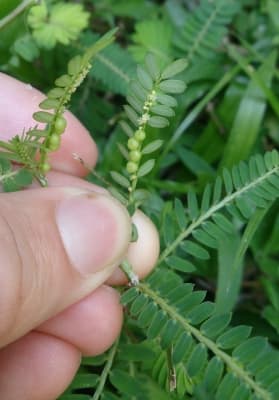
Phyllanthus urinaria
Phyllanthus urinaria
Safety & Hazards
The crushed plant is used as a fish poison[1].
Cultivation Details
Grows in the wild on well-drained, fertile, sandy soils, sometimes on limestone, often in humid places or even in marshy ground[2]. The plant has spread as a weed throughout the tropics[1]. It is a prolific seed producer. The seeds can remain dormant for an extended period of time. They germinate massively during the rainy season and the seedlings are very fast growing[1].
Propagation
Seed - requires light to germinate[1]. A germination rate of up to 80% was observed at temperatures of 25 - 35°c, but germination was poor at 20°c or 40°c. Germination of seed is also poor under moisture stress conditions[1]. Stratification significantly improved the germination of the seeds[1]. Cite as: Tropical Plants Database, Ken Fern. tropical.theferns.info. 2026-02-20. <tropical.theferns.info/viewtropical.php?id=Phyllanthus+urinaria>
Pollinators
Data unavailable
References
- [1]Protabase - Plant Resources of Tropical Africa. — http://www.prota.org ↩︎An excellent on-line database with detailed information on over 3,200 species of useful plants of Africa.
- [2]Plant Resources of Southeast Asia — http://proseanet.org/ ↩︎Lots of information on the uses of the plants of SE Asia.
- [3]Flora of China — Missouri Botanical Garden Press; St. Louis. · 1994 · http://flora.huh.harvard.edu/china/ ↩︎An excellent, comprehensive resource in 25 volumes. In addition to the botanical information the flora also gives basic information on habitat and some uses. An on-line version is also available.
- [4]Medicinal Plants in Vietnam — Nguyen Van Dan & Doan Thi Nhu · World Health Organisation · 1989 · ISBN 92 9061 101 4 ↩︎An excellent book, giving information on over 200 plants, their medicinal compounds and applications.