Hibiscus — 40 species
Botanical species in the genus Hibiscus recorded in the PlantPeers database.

Hibiscus acetosella
Hibiscus acetosella
Family: Malvaceae
Cultivation
Hibiscus acetosella is found over a large area of tropical Africa, usually being grown at low to moderate elevations. It can also be grown as an annual in warm temperate areas. It grows best in areas with good rainfall.
Full cultivation guide →
Hibiscus asper
Hibiscus asper
Family: Malvaceae
Cultivation
A locally selected type of Hibiscus asper with narrow leaves is cultivated on a small scale in Senegal.
Full cultivation guide →
Hibiscus bifurcatus
Hibiscus bifurcatus
Family: Malvaceae
Cultivation
Prefers a well-drained humus rich fertile soil in full sun. Plants are resistant to root-knot nematodes.
Full cultivation guide →
Hibiscus calyphyllus
Hibiscus calyphyllus
Family: Malvaceae
Cultivation
In Tanzania, the plant grows in areas where the mean annual rainfall is in the range 1,100 - 1,600mm. Succeeds in a variety of soils.
Full cultivation guide →
Hibiscus cannabinus
Hibiscus cannabinus
Family: Malvaceae
Cultivation
When cultivated, the plant is usually grown as an annual. It can be grown successfully in a wide range of climates from the temperate zone to the tropics, at elevations up to 1,000 metres. It grows best in areas where annual daytime temperatures are within the range 15 - 28°c, but can tolerate 10 - 35°c.
Full cultivation guide →

Hibiscus diversifolius
Hibiscus diversifolius
Family: Malvaceae
Cultivation
Hibiscus diversifolius is a plant of tropical regions in Africa, but widely spread by human activity through the tropical and subtropical regions of the world. A frost-tender shrub, it can be grown as an annual in temperate climates where it can flower and set seed in its first year of growth. Plants can also be overwintered in a cold greenhouse if the winter is fairly mild.
Full cultivation guide →
Hibiscus heterophyllus
Hibiscus heterophyllus
Family: Malvaceae
Cultivation
Hibiscus heterophyllus is native to eastern Australia, where it can be found from the tropics of northern Queensland to the warm temperate climate of southeastern New South Wales. It can tolerate short periods of frost with temperatures falling to around -5°c, but succumbs to longer periods of cold. In cooler temperate regions it might be possible to grow it as a half-hardy annual, to flower in its first year from seed.
Full cultivation guide →Hibiscus laevis
Hibiscus laevis
Family: Malvaceae
Cultivation
Hibiscus laevis is a very cold-hardy plant, able to tolerate temperatures down to around -30°c when fully dormant. Best grown in organically rich, medium to wet soils in full sun. Tolerates some light shade, but full sun produces best flowering.
Full cultivation guide →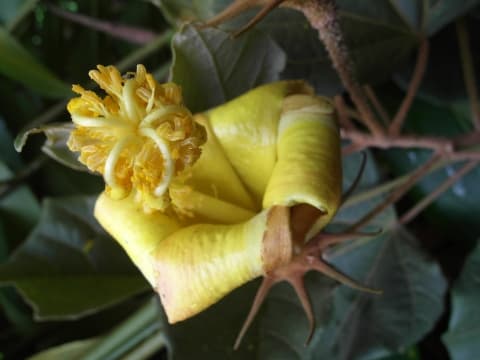
Hibiscus lasiococcus
Hibiscus lasiococcus
Family: Malvaceae
Cultivation
Fast growth has been observed in plantations, with 2-year-old plants reaching a height of 4 - 5 metres; 10-year-old plants a height of 10 - 12 metres with a bole diameter of 12 - 15cm; and 14-year-old trees a height of 16 - 18 metres with a bole diameter of 18 - 25cm.
Full cultivation guide →

Hibiscus micranthus
Hibiscus micranthus
Family: Malvaceae
Cultivation
Often found as a weed of cultivated crops within its native range, it has the potential to spread as a weed in other, suitable areas. The flowers only open when the plant is growing in direct sunlight.
Full cultivation guide →Hibiscus moscheutos
Hibiscus moscheutos
Family: Malvaceae
Cultivation
One report says that Hibiscus moscheutos is moderately cold-resistant, tolerating winter temperatures falling to around -25°c, then this same report also says that the plant succeeds outdoors in temperate zones only in those areas where winter temperatures do not fall below about -5°c. Prefers a well-drained humus rich fertile soil in a sheltered position in full sun. Well-suited to a water-side planting.
Full cultivation guide →
Hibiscus mutabilis
Hibiscus mutabilis
Family: Malvaceae
Cultivation
Hibiscus mutabilis is not a very cold-hardy plant, being able to tolerate short periods with temperatures falling to around -5°c when fully dormant. Top growth will be killed by even a slight frost, but the roots are somewhat hardier and the plant can resprout from the base after a few degrees of frost. An easily grown plant, requiring very little attention, it prefers a well-drained humus rich fertile soil in full sun.
Full cultivation guide →
Hibiscus panduriformis
Hibiscus panduriformis
Family: Malvaceae
Cultivation
Found in the wild on black cotton soil; alluvial clay flats; sandy-clayey soils. Often found as a weed of cultivated crops within its native range, it has the potential to spread as a weed in other, suitable areas.
Full cultivation guide →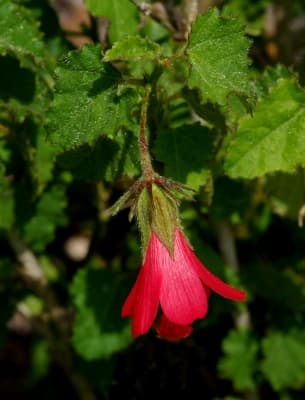

Hibiscus radiatus
Hibiscus radiatus
Family: Malvaceae
Cultivation
This species is often confused with H. cannabinus, but it is an allotetraploid hybrid of H. cannabinus and perhaps H. surattensis.
Full cultivation guide →
Hibiscus rosa-sinensis
Hibiscus rosa-sinensis
Family: Malvaceae
Cultivation
Hibiscus rosa-sinensis is cultivated as an ornamental plant throughout the tropics and subtropics and also in the warmer regions of the temperate zone. It is not a very cold-hardy plant, being able to tolerate short periods with temperatures down to around -4°c when fully dormant. Prefers a well-drained humus rich fertile soil in a warm, sheltered position in full sun.
Full cultivation guide →
Hibiscus sabdariffa
Hibiscus sabdariffa
Family: Malvaceae
Cultivation
Roselle is best suited to lowland, humid, tropical climates, where it is found from sea-level to elevations of about 600 metres. It grows best in areas with a well-distributed annual rainfall of 1,500 - 2,000 mm, though it can tolerate an annual rainfall of 640 - 4,290mm, and an annual temperature in the range of 12.5 - 27.5°c. It tolerates a warmer and more humid climate than the related kenaf (Hibiscus cannabinus), but is more susceptible to damage from frost and fog.
Full cultivation guide →Hibiscus scotellii
Hibiscus scotellii
Family: Malvaceae
Cultivation
Rather intermediate specimens between typical Hibiscus scotellii and typical Hibiscus cannabinus occur. Specimens from Mali and Burkina Faso need revision.
Full cultivation guide →Hibiscus sinosyriacus
Hibiscus sinosyriacus
Family: Malvaceae
Cultivation
Hibiscus sinosyriacus is a moderately cold-hardy plant, able to tolerate short periods with temperatures down to around -15°c when fully dormant. The plant flowers late in the growing season, however, and is thus subject to frost damage in areas with short growing seasons and autumn frosts. The new growth in spring can also be damaged by frosts.
Full cultivation guide →Hibiscus splendens
Hibiscus splendens
Family: Malvaceae
Cultivation
Hibiscus splendens is a native of eastern Australia, usually growing near the coast, and found from the tropics of northern Queensland to the warm temperate regions of southeastern New South Wales. It is not very cold hardy, tolerating short periods with temperatures down to around -8°c when fully dormant, though plants will often resprout from near the base if the stems are killed by winter cold. Requires a sunny position, tolerating some shade in warmer climates.
Full cultivation guide →
Hibiscus sterculiifolius
Hibiscus sterculiifolius
Family: Malvaceae
Cultivation
A better quality fibre is obtained if the trees are cut down and then allowed to resprout from the base.
Full cultivation guide →
Hibiscus surattensis
Hibiscus surattensis
Family: Malvaceae
Cultivation
A plant of moist tropical areas where it is found at elevations up to 1,700 metres. It is found in regions with an average annual rainfall of 1,000 - 1,600mm. Succeeds in a variety of soil types.
Full cultivation guide →
Hibiscus syriacus
Hibiscus syriacus
Family: Malvaceae
Cultivation
A plant of the tropics and subtropics, where it is found at elevations up to 1,500 metres. It grows best in areas where annual daytime temperatures are within the range 15 - 28°c, but can tolerate 11 - 41°c. A very hardy plant, it can often tolerate temperatures down to -20°c.
Full cultivation guide →
Hibiscus trionum
Hibiscus trionum
Family: Malvaceae
Cultivation
Hibiscus trionum is not a very cold-tolerant plant, being damaged or killed by a few degrees of frost. It can usually be grown successfully as an annual in cooler climates with a moderately long growing season, whilst it is more likely to become perennial in the tropics. Prefers a well-drained, humus-rich, fertile soil in a sheltered position in full sun.
Full cultivation guide →Hibiscus vitifolius
Hibiscus vitifolius
Family: Malvaceae
Cultivation
Often found as a weed of cultivated crops within its native range, it has the potential to spread as a weed in other, suitable areas.
Full cultivation guide →