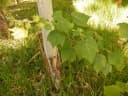
Hibiscus diversifolius
Hibiscus diversifolius
Safety & Hazards
Some caution should be observed by pregnant women when eating this plant because there is a report that the leaf juice might be used to procure abortion[1].
Cultivation Details
Hibiscus diversifolius is a plant of tropical regions in Africa, but widely spread by human activity through the tropical and subtropical regions of the world. A frost-tender shrub, it can be grown as an annual in temperate climates where it can flower and set seed in its first year of growth[2, PFAF]. Plants can also be overwintered in a cold greenhouse if the winter is fairly mild[PFAF]. In Tanzania the plant grows in areas where the mean annual rainfall is in the range 1,400 - 2,100mm[3]. Prefers a well-drained humus rich fertile soil in full sun[2]. Thrives in deep clay soils with permanent moisture[3]. As the specific name of this plant suggests, the leaves vary widely in shape. The first leaves to be produced are semi-circular in shape, but later leaves are distinctly three-lobed[PFAF]. Plants are self-fertile[PFAF].
Propagation
Seed - sow spring in a greenhouse[2]. The seed germinates inside 2 weeks and should be potted up into individual pots as soon as it is large enough to handle. Grow the plants on fast in a fairly rich compost and plant them out in late spring after the last expected frosts[PFAF]. Cuttings of half-ripe wood, mid summer in a frame. These will be difficult to overwinter unless kept in heated environment[PFAF]. Cite as: Temperate Plants Database, Ken Fern. temperate.theferns.info. 2026-02-21. <temperate.theferns.info/plant/Hibiscus+diversifolius>
Pollinators
Insects
References
- [1]The Useful Native Plants of Australia. — Maiden J.H. · Turner & Co.; London. · 1889 · http://www.biodiversitylibrary.org ↩︎Terse details of the uses of many Australian plants and other species naturalised, or at least growing, in Australia. It can be downloaded from the Internet.
- [2]The New RHS Dictionary of Gardening. 1992. — Huxley. A. · MacMillan Press · 1992 · ISBN 0-333-47494-5 ↩︎Excellent and very comprehensive, though it contains a number of silly mistakes. Readable yet also very detailed.
- [3]Edible Wild Plants of Tanzania — Ruffo, C.K.: Birnie, A. & Tengnas, B. · Regional Land Management Unit; Nairobi. · 2002 · ISBN 9966-896-60-0 ↩︎A very well presented, simple guide to growing and utilizing wild food plants in Tanzania, with line drawings of each plant, a description, habitat and range, non-food as well as food uses, plus basic information on growing the plants.
- [4]Flora of New South Wales — http://plantnet.rbgsyd.nsw.gov.au/floraonline.htm ↩︎An on-line resource giving a brief botanical description of all the native plants of New South Wales, their habitat and range, together with diagrams and photographs of the plants.
- [5]Australian Medicinal Plants. — Lassak. E. V. and McCarthy. T. · New Holland Publishers · 2001 · ISBN 1876334703 ↩︎A very good and readable guide to the subject.
- [6]Wild Food in Australia. — Cribb. A. B. and J. W. · Fontana · 1976 · ISBN 0-00-634436-4 ↩︎A very good pocket guide.
- [7]Cornucopia - A Source Book of Edible Plants. — Facciola. S. · Kampong Publications · 1990 · ISBN 0-9628087-0-9 ↩︎Excellent. Contains a very wide range of conventional and unconventional food plants (including tropical) and where they can be obtained (mainly N. American nurseries but also research institutes and a lot of other nurseries from around the world.
- [8]Plants for Human Consumption. — Kunkel. G. · Koeltz Scientific Books · 1984 · ISBN 3874292169 ↩︎An excellent book for the dedicated. A comprehensive listing of Latin names with a brief list of edible parts.
- [9]The Useful Plants of West Tropical Africa. — Burkil. H. M. · Royal Botanic Gardens; Kew. · 1985 - 2004 ↩︎Brief descriptions and details of the uses of over 4,000 plants. A superb, if terse, resource, it is also available electronically on the Web - see http://www.aluka.org/
- [PFAF]Plants for a Future — pfaf.org ↩︎