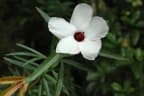
Hibiscus heterophyllus
Hibiscus heterophyllus
Safety & Hazards
The plant is often used as a food in Australia, and is a main species in the Australian Bush Food Industry, but there is also a report of kidney damage after drinking tea made from the leaves[1]. The hairs on the seed capsules can cause severe skin irritation to sensitive people, and need to be handled with care[2].
Cultivation Details
Hibiscus heterophyllus is native to eastern Australia, where it can be found from the tropics of northern Queensland to the warm temperate climate of southeastern New South Wales. It can tolerate short periods of frost with temperatures falling to around -5°c, but succumbs to longer periods of cold. In cooler temperate regions it might be possible to grow it as a half-hardy annual, to flower in its first year from seed. Prefers a well-drained humus rich fertile soil in full sun[3]. Suitable for waterside plantings[3]. Plants propagated from clones native to the southern part of the range of the species may prove to be more frost tolerant[2]. Frost-affected plants will often reshoot from the lower branches[2]. Plants can become sparsely foliaged with age but can be pruned back by about one-third if needed to maintain a bushy shape[2]. A fast-growing plant[1]. In common with most Hibiscus species, the individual flowers last for only 1 - 2 days, but new flowers continue to open over a long period, generally from spring through to summer[2].
Propagation
Seed - sow early spring in a warm greenhouse. Germination is usually fairly rapid and no special pretreatment is needed, although germination will be faster if the seed is abraded or soaked prior to sowing[2]. Prick out the seedlings into individual pots when they are large enough to handle. If growing them as annuals, plant them out into their permanent positions in early summer and protect them with a frame or cloche until they are growing away well. If hoping to grow them as perennials, then it is better to grow them on in the greenhouse for their first year and to plant them out in early summer of the following year. Cuttings of half-ripe wood, mid summer in a frame. They generally strike readily, particularly if cuttings are taken on an angle through a node and rooting hormone is applied to their ends[2].Overwinter them in a warm greenhouse and plant out after the last expected frosts. Cite as: Temperate Plants Database, Ken Fern. temperate.theferns.info. 2026-02-21. <temperate.theferns.info/plant/Hibiscus+heterophyllus>
Pollinators
Insects
References
- [1]Australian Tropical Rainforest Plants — http://www.anbg.gov.au/cpbr/cd-keys/rfk/index.html ↩︎An online resource giving botanical information, and a little bit about plant usage, for over 2,700 species of plants found in the Australian rainforest.
- [2]Australian Native Plants Society — http://anpsa.org.au/index.html ↩︎A series of fact sheets on Australian plants. Good photographs, brief description and information on uses, habitat, range, cultivation etc.
- [3]The New RHS Dictionary of Gardening. 1992. — Huxley. A. · MacMillan Press · 1992 · ISBN 0-333-47494-5 ↩︎Excellent and very comprehensive, though it contains a number of silly mistakes. Readable yet also very detailed.
- [4]Brisbane Rainforest Action and Information Network, — http://www.brisrain.webcentral.com.au ↩︎Information on plants in the Queensland Rainforests.
- [5]Wild Food in Australia. — Cribb. A. B. and J. W. · Fontana · 1976 · ISBN 0-00-634436-4 ↩︎A very good pocket guide.
- [6]Wild Food Plants of Australia. — Low. T. · Angus and Robertson. · 1989 · ISBN 0-207-14383-8 ↩︎Well presented, clear information and good photographs. An interesting read for the casual reader as well as the enthusiast
- [7]Plants for Human Consumption. — Kunkel. G. · Koeltz Scientific Books · 1984 · ISBN 3874292169 ↩︎An excellent book for the dedicated. A comprehensive listing of Latin names with a brief list of edible parts.
- [8]The Useful Native Plants of Australia. — Maiden J.H. · Turner & Co.; London. · 1889 · http://www.biodiversitylibrary.org ↩︎Terse details of the uses of many Australian plants and other species naturalised, or at least growing, in Australia. It can be downloaded from the Internet.
- [9]Australian Native Plants. — Wrigley. J. W. and Fagg. M. · Collins. (Australia) · 1988 · ISBN 0-7322-0021-0 ↩︎A lovely book, written in order to encourage Australian gardeners to grow their native plants. A little bit of information for the plant project.
- [10]Cornucopia II — Facciola. S. · Kampong Publications, California. · 1998 · ISBN 0-9628087-2-5 ↩︎The second edition of an excellent guide to the edible uses of plants, though it does not give any details of cultivation etc.
- [11]Protabase - Plant Resources of Tropical Africa. — http://www.prota.org ↩︎An excellent on-line database with detailed information on over 3,200 species of useful plants of Africa.
- [12]Useful Wild Plants in Australia. — Cribb. A. B. and J. W. · William Collins Pty Ltd. Sidney · 1981 · ISBN 0-00-216441-8 ↩︎A very readable book.
- [PFAF]Plants for a Future — pfaf.org ↩︎