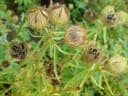
Hibiscus cannabinus
Hibiscus cannabinus
Safety & Hazards
None known
Cultivation Details
When cultivated, the plant is usually grown as an annual. It can be grown successfully in a wide range of climates from the temperate zone to the tropics, at elevations up to 1,000 metres. It grows best in areas where annual daytime temperatures are within the range 15 - 28°c, but can tolerate 10 - 35°c[1]. It is damaged by frosts[2]. It prefers a mean annual rainfall in the range 600 - 2,000mm, but tolerates 450 - 3,000mm[1]. Prefers a well-drained humus rich fertile soil in full sun[3]. Tolerates most soils but prefers a light sandy soil[4]. Plants are adapted to a wide range of soils and climatic conditions[5]. Prefers a pH in the range 6 - 7.5, tolerating 4.3 - 8.2[1]. The plant is damaged by heavy rains with strong winds[2]. A fast-growing plant, the first harvest of its leaves can take place within a month of sowing, whilst the fibre can be ready to harvest in 3 - 4 months[6, 7, 8]. Yields of fibre can be 1 - 6 tonnes per hectare[1]. Yields of leaves can be 20 - 30 tonnes per crop per hectare when the plants are uprooted, or up to 60 tonnes if the plants are harvested as cut and come again[8]. Annual seed yields can be about 350 - 400 kilos per hectare[1]. Plants are daylight sensitive, they remain vegetative and do not flower until the daylength is less than 12.5 hr/day. Two weeks of very cloudy days will induce flowering as daylength approaches 12.5 hr[2]. The plant has a deep-penetrating taproot with deep-seated laterals[2]. Plants are highly susceptible to root-knot nematodes[9]. Kenaf is mainly an out-breeding plant, but up to 30% self-pollination occurs[2, 8].
Propagation
Seed - sow early spring in a warm greenhouse. Germination is usually fairly rapid. Prick out the seedlings into individual pots when they are large enough to handle. If growing them as annuals, plant them out into their permanent positions in early summer and protect them with a frame or cloche until they are growing away well. If hoping to grow them as perennials, then it is better to grow them on in the greenhouse for their first year and to plant them out in early summer of the following year. Cuttings of half-ripe wood, mid summer in a frame. Overwinter them in a warm greenhouse and plant out after the last expected frosts. Cite as: Temperate Plants Database, Ken Fern. temperate.theferns.info. 2026-02-21. <temperate.theferns.info/plant/Hibiscus+cannabinus>
Pollinators
Insects, Bees
References
- [1]Ecocrop — http://ecocrop.fao.org/ecocrop/srv/en/home ↩︎Basic information on a wide range of useful plants, plus details of environmental needs where available.
- [2]Handbook of Energy Crops — Duke. J. · - · 1983 · https://hort.purdue.edu/newcrop/duke_energy/dukeindex.html · ISBN - ↩︎Published only on the Internet, excellent information on a wide range of both temperate and tropical plants.
- [3]The New RHS Dictionary of Gardening. 1992. — Huxley. A. · MacMillan Press · 1992 · ISBN 0-333-47494-5 ↩︎Excellent and very comprehensive, though it contains a number of silly mistakes. Readable yet also very detailed.
- [4]Encyclopaedia Britannica. 15th edition. — ? ↩︎It contains a few things of interest to the plant project.
- [5]Economic Botany. — Hill. A. F. · The Maple Press · 1952 · ISBN - ↩︎Not very comprehensive, but it is quite readable and goes into some detail about the plants it does cover.
- [6]Flora Europaea — ? · Cambridge University Press · 1964 · ISBN - ↩︎An immense work in 6 volumes (including the index). The standard reference flora for Europe, it is very terse though and with very little extra information. Not for the casual reader.
- [7]A Dictionary of Plants Used by Man. — Usher. G. · Constable · 1974 · ISBN 0094579202 ↩︎Forget the sexist title, this is one of the best books on the subject. Lists a very extensive range of useful plants from around the world with very brief details of the uses. Not for the casual reader.
- [8]Protabase - Plant Resources of Tropical Africa. — http://www.prota.org ↩︎An excellent on-line database with detailed information on over 3,200 species of useful plants of Africa.
- [9]Edible Leaves of the Tropics — Martin. F. W.; Ruberte. R. M. & Meitzner. L. S. · Echo. USA. · 1998 · ISBN 0-9653360-1-8 ↩︎A terse guide, giving reasonable detail on the more common leaf crops and brief information on a wide range of lesser known plants.
- [10]Revision of Hibiscus section Furcaria (Malvaceae) in Africa and Asia — Wilson F.D. · 1999 ↩︎
- [11]Mansfeld's Database of Agricultural and Horticultural Plants — http://mansfeld.ipk-gatersleben.de/pls/htmldb_pgrc/f?p=185:3:4292127278597336 ↩︎Terse details of a huge range of useful plants.
- [12]Invasive Species Compendium — http://www.cabi.org ↩︎An immense resource - in depth information on over 900 species of invasive plants (it also has information on animals, fungi etc).
- [13]Flora of the USSR. — Komarov. V. L. · Israel Program for Scientific Translation · 1968 · http://www.biodiversitylibrary.org · ISBN - ↩︎An immense (25 or more large volumes) and not yet completed translation of the Russian flora. Full of information on plant uses and habitats but heavy going for casual readers. It can be downloaded from the Internet.
- [14]Tanaka's Cyclopedia of Edible Plants of the World. — Tanaka. T. & Nakao S. · Keigaku Publishing; Tokyo · 1976 · ISBN - ↩︎The most comprehensive list of edible plants I've come across. Only the briefest entry for each species, though, and some of the entries are more than a little dubious. Not for the casual reader.
- [15]Plants for Human Consumption. — Kunkel. G. · Koeltz Scientific Books · 1984 · ISBN 3874292169 ↩︎An excellent book for the dedicated. A comprehensive listing of Latin names with a brief list of edible parts.
- [16]Cornucopia - A Source Book of Edible Plants. — Facciola. S. · Kampong Publications · 1990 · ISBN 0-9628087-0-9 ↩︎Excellent. Contains a very wide range of conventional and unconventional food plants (including tropical) and where they can be obtained (mainly N. American nurseries but also research institutes and a lot of other nurseries from around the world.
- [17]Sturtevant's Edible Plants of the World. — Hedrick. U. P. · Dover Publications · 1972 · ISBN 0-486-20459-6 ↩︎Lots of entries, quite a lot of information in most entries and references.
- [18]Food Plants in the Americas: A Survey of the Domesticated, Cultivated, and Wild Plants Used for Human Food in North, — Kermath B.M.; Bennett B.C.' Pulsipher L.M. · 2014 ↩︎A pre-publication draft of an amazing, on-going work first started in 1985. It contains information on more than 3,900 taxa from the Americas - from Arctic regions to the Tropics
- [19]Wild Food in Australia. — Cribb. A. B. and J. W. · Fontana · 1976 · ISBN 0-00-634436-4 ↩︎A very good pocket guide.
- [20]The National Non-Food Crops Centre Crop Database — http://www.nnfcc.co.uk/crops/pd.cfm ↩︎An excellent on-line information source, with information on over 100 species (as of 2006) of plants being investigated as bio-crops.
- [21]Flora of China — Missouri Botanical Garden Press; St. Louis. · 1994 · http://flora.huh.harvard.edu/china/ ↩︎An excellent, comprehensive resource in 25 volumes. In addition to the botanical information the flora also gives basic information on habitat and some uses. An on-line version is also available.
- [22]Glossary of Indian Medicinal Plants (Including the Supplement). — Chopra. R. N., Nayar. S. L. and Chopra. I. C. · Council of Scientific and Industrial Research, New Delhi. · 1986 · ISBN - ↩︎Very terse details of medicinal uses of plants with a wide range of references and details of research into the plants chemistry. Not for the casual reader.
- [23]RHS Dictionary of Plants plus Supplement. 1956 — F. Chittendon. · Oxford University Press · 1951 · ISBN - ↩︎Comprehensive listing of species and how to grow them. Somewhat outdated, it has been replaced in 1992 by a new dictionary (see [ 200 ]).
- [24]Dictionary of Economic Plants. — Uphof. J. C. Th. · Weinheim · 1959 · ISBN - ↩︎An excellent and very comprehensive guide but it only gives very short descriptions of the uses without any details of how to utilize the plants. Not for the casual reader.
- [25]CosIng — http://ec.europa.eu/growth/tools-databases/cosing/ ↩︎CosIng is the European Commission database for information on cosmetic substances and ingredients.