Morus — 12 species
Botanical species in the genus Morus recorded in the PlantPeers database.
Morus alba
Morus alba
Family: Moraceae
Cultivation
A plant of the subtropics and warm temperate zones, it can also be cultivated in the tropics at elevations between 300 - 3,300 metres. It grows best in areas where annual daytime temperatures are within the range 20 - 28°c, but can tolerate 13 - 45°c. The plant becomes dormant below 13°c.
Full cultivation guide →
Morus cathayana
Morus cathayana
Family: Moraceae
Cultivation
Prefers a warm well-drained loamy soil in a sunny position. Two trees at Kew in mid-July 1994 had reasonable crops of fairly long thin fruits with a pleasant flavour. Mulberries have brittle roots and so need to be handled with care when planting them out.
Full cultivation guide →Morus celtidifolia
Morus celtidifolia
Family: Moraceae
Cultivation
The inflorescence is usually dioecous, therefore both female and male forms of the plant need to be grown if fruit and seed are required. Occasional plants have both male and female flowers in the inflorescence.
Full cultivation guide →Morus indica
Morus indica
Family: Moraceae
Cultivation
Morus indica is a very cold-hardy plant, being able to tolerate short periods with temperatures down to around -20°c when fully dormant. Prefers a warm well-drained loamy soil in a sunny position. Mulberries have brittle roots and so need to be handled with care when planting them out.
Full cultivation guide →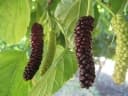
Morus macroura
Morus macroura
Family: Moraceae
Cultivation
A very adaptable species, it can be grown from the warm temperate zone through to the tropics. Trees can be very cold tolerant, with some dormant plants reported to tolerate temperatures down to -10°c. Grows best in a sunny position.
Full cultivation guide →
Morus mesozygia
Morus mesozygia
Family: Moraceae
Cultivation
Requires a well-drained soil. Growth is usually fast: a height increment of almost 2 metres in the first year has been recorded in unshaded nursery beds. A dioecious species, both male and female forms need to be grown if fruit and seed are required.
Full cultivation guide →Morus microphylla
Morus microphylla
Family: Moraceae
Cultivation
Prefers a warm well-drained loamy soil in a sunny position. This species was formerly cultivated for its edible fruit by the native North Americans. Mulberries have brittle roots and so need to be handled with care when planting them out.
Full cultivation guide →Morus mongolica
Morus mongolica
Family: Moraceae
Cultivation
Prefers a warm well-drained loamy soil in a sunny position. Closely allied to M. alba, and considered to be no more than part of that species by some botanists. Mulberries have brittle roots and so need to be handled with care when planting them out.
Full cultivation guide →
Morus nigra
Morus nigra
Family: Moraceae
Cultivation
A plant of the warm temperate zone and the subtropics, black mulberry only succeeds at higher elevations in tropical areas, generally above 1,000 metres. It grows best in areas where annual daytime temperatures are within the range 15 - 25°c, but can tolerate 10 - 38°c. When dormant, the plant can survive temperatures down to about -5°c, but young growth can be severely damaged at -1°c.
Full cultivation guide →Morus rubra
Morus rubra
Family: Moraceae
Cultivation
Prefers a warm well-drained loamy soil in a sunny position. The red mulberry is sometimes cultivated for its edible fruit, there are some named varieties. It is said to be of no value as a fruiting tree in Britain.
Full cultivation guide →Morus serrata
Morus serrata
Family: Moraceae
Cultivation
Prefers a warm well-drained loamy soil in a sunny position. Mulberries have brittle roots and so need to be handled with care when planting them out. Any pruning should only be carried out in the winter when the plant is fully dormant because mulberries bleed badly when cut.
Full cultivation guide →Morus wittiorum
Morus wittiorum
Family: Moraceae
Cultivation
Morus wittiorum is native to the warm temperate and subtropical regions of southern China, where it can be found a elevations up to 1,400 metres. A dioecious species.
Full cultivation guide →