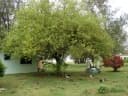
Morus alba
Morus alba
Safety & Hazards
One report suggests that the raw fruit contains hallucinogens[1]. This fruit is frequently eaten in various parts of the world, there are even some named varieties, and no such effects have been mentioned elsewhere, nor observed by the writer when he has eaten the fruit. Possibly the unripe fruit was being referred to in the report, though even this would be surprising[PFAF].
Cultivation Details
A plant of the subtropics and warm temperate zones, it can also be cultivated in the tropics at elevations between 300 - 3,300 metres[2]. It grows best in areas where annual daytime temperatures are within the range 20 - 28°c, but can tolerate 13 - 45°c[2]. The plant becomes dormant below 13°c[2]. When dormant, the plant can survive temperatures down to about -5°c, but young growth can be severely damaged at 1°c[2]. It prefers a mean annual rainfall in the range 700 - 2,500mm, but tolerates 300 - 5,100mm[2]. Grows best in a sunny position, tolerating light shade[3, 4, 2]. Succeeds in a variety of soils ranging from sandy loam to clayey loam, but it prefers a deep, alluvial, loamy soil with sufficient moisture[3, 4, 5, 2]. Prefers a pH in the range 5.5 - 7.5, tolerating 4.3 - 8.3[2]. Plants are fairly wind-resistant[6], though the branches are often killed back when growing in strong maritime exposure[PFAF]. The species is not drought resistant, though at least some cultivars are - the form 'Tatarica' has been especially mentioned[7]. Mulberries have brittle roots and so need to be handled with care when planting them out[8]. Any pruning should only be carried out when the plant is fully dormant because mulberries bleed badly when cut[8]. Ideally prune only badly placed branches and dead wood[8]. This is a good tree for growing grapes into[9]. The grapes are difficult to pick but always seem to be healthier and free from fungal diseases[10]. Plants in this genus are notably resistant to honey fungus[6].
Propagation
The seed germinates best if given 2 - 3 months cold stratification[11, 12]. Sow the seed as soon as it is ripe if possible, otherwise in late winter in a cold frame. The seed usually germinates in the first spring, though it sometimes takes another 12 months. Prick out the seedlings into individual pots when they are large enough to handle and grow them on in the cold frame for their first winter. Plant them out in late spring or early summer after the last expected frosts. Cuttings of half-ripe wood, 7 - 10cm with a heel, mid summer in a frame. Plant out in spring. A good percentage take, though they sometimes fail to thrive[13, 14]. Cuttings of mature wood of the current season's growth, 25 - 30cm with a heel of 2 year old wood, autumn or early spring in a cold frame or a shady bed outside[13, 14, 6]. Bury the cuttings to threequarters of their depth. Layering in autumn[6]. Cite as: Temperate Plants Database, Ken Fern. temperate.theferns.info. 2026-02-21. <temperate.theferns.info/plant/Morus+alba>
Pollinators
Data unavailable
References
- [1]A Field Guide to N. American Edible Wild Plants. — Elias. T. and Dykeman. P. · Van Nostrand Reinhold · 1982 · ISBN 0442222009 ↩︎Very readable.
- [2]Ecocrop — http://ecocrop.fao.org/ecocrop/srv/en/home ↩︎Basic information on a wide range of useful plants, plus details of environmental needs where available.
- [3]RHS Dictionary of Plants plus Supplement. 1956 — F. Chittendon. · Oxford University Press · 1951 · ISBN - ↩︎Comprehensive listing of species and how to grow them. Somewhat outdated, it has been replaced in 1992 by a new dictionary (see [ 200 ]).
- [4]Trees and Shrubs Hardy in Great Britain. Vol 1 - 4 and Supplement. — Bean. W. · Murray · 1981 · ISBN - ↩︎A classic with a wealth of information on the plants, but poor on pictures.
- [5]Handbook of Energy Crops — Duke. J. · - · 1983 · https://hort.purdue.edu/newcrop/duke_energy/dukeindex.html · ISBN - ↩︎Published only on the Internet, excellent information on a wide range of both temperate and tropical plants.
- [6]The New RHS Dictionary of Gardening. 1992. — Huxley. A. · MacMillan Press · 1992 · ISBN 0-333-47494-5 ↩︎Excellent and very comprehensive, though it contains a number of silly mistakes. Readable yet also very detailed.
- [7]Cornucopia - A Source Book of Edible Plants. — Facciola. S. · Kampong Publications · 1990 · ISBN 0-9628087-0-9 ↩︎Excellent. Contains a very wide range of conventional and unconventional food plants (including tropical) and where they can be obtained (mainly N. American nurseries but also research institutes and a lot of other nurseries from around the world.
- [8]Encyclopaedia of Herbs and their Uses. — Bown. D. · Dorling Kindersley, London. · 1995 · ISBN 0-7513-020-31 ↩︎A very well presented and informative book on herbs from around the globe. Plenty in it for both the casual reader and the serious student. Just one main quibble is the silly way of having two separate entries for each plant.
- [9]Companion Planting for Successful Gardening. — Riotte. L. · Garden Way, Vermont, USA. · 1978 · ISBN 0-88266-064-0 ↩︎Fairly good.
- [10]A - Z of Companion Planting. — Allardice.P. · Cassell Publishers Ltd. · 1993 · ISBN 0-304-34324-2 ↩︎A well produced and very readable book.
- [11]Hardy Woody Plants from Seed. — McMillan-Browse. P. · Grower Books · 1985 · ISBN 0-901361-21-6 ↩︎Does not deal with many species but it is very comprehensive on those that it does cover. Not for casual reading.
- [12]Seed Manual for Ornamental Trees and Shrubs. — Gordon. A. G. and Rowe. D. C. F. · HMSO; London · 1982 · ISBN 0-11-710152-4 ↩︎Very comprehensive guide to growing trees and shrubs from seed. Not for the casual reader.
- [13]Propagation of Trees, Shrubs and Conifers. — Sheat. W. G. · MacMillan and Co · 1948 · ISBN - ↩︎A bit dated but a good book on propagation techniques with specific details for a wide range of plants.
- [14]The Reference Manual of Woody Plant Propagation. — Dirr. M. A. and Heuser. M. W. · Athens Ga. Varsity Press · 1987 · ISBN 0942375009 ↩︎A very detailed book on propagating trees. Not for the casual reader.
- [15]World Agroforesty Centre — http://www.worldagroforestry.org/ ↩︎An excellent online database of a huge range of trees giving very good information on each plant - its uses, ecology, identity, propagation, pests etc.
- [16]Sturtevant's Edible Plants of the World. — Hedrick. U. P. · Dover Publications · 1972 · ISBN 0-486-20459-6 ↩︎Lots of entries, quite a lot of information in most entries and references.
- [17]Encyclopaedia of Medicinal Plants. — Chiej. R. · MacDonald · 1984 · ISBN 0-356-10541-5 ↩︎Covers plants growing in Europe. Also gives other interesting information on the plants. Good photographs.
- [18]Forest Flora of Chakrata, Dehra Dun and Saharanpur. — Gupta. B. L. · Forest Research Institute Press · 1945 · ISBN - ↩︎A good flora for the middle Himalayan forests, sparsly illustrated. Not really for the casual reader.
- [19]Growing Unusual Fruit. — Simmons. A. E. · David & Charles; Newton Abbot. · 1972 · ISBN 0-7153-5531-7 ↩︎A very readable book with information on about 100 species that can be grown in Britain (some in greenhouses) and details on how to grow and use them.
- [20]Famine Foods listed in the Chiu-Huang Pen-ts'ao. — Reid. B. E. · Southern Materials Centre; Taipei · 1977 · ISBN - ↩︎A translation of an ancient Chinese book on edible wild foods. Fascinating.
- [21]Tanaka's Cyclopedia of Edible Plants of the World. — Tanaka. T. & Nakao S. · Keigaku Publishing; Tokyo · 1976 · ISBN - ↩︎The most comprehensive list of edible plants I've come across. Only the briefest entry for each species, though, and some of the entries are more than a little dubious. Not for the casual reader.
- [22]Plants for Human Consumption. — Kunkel. G. · Koeltz Scientific Books · 1984 · ISBN 3874292169 ↩︎An excellent book for the dedicated. A comprehensive listing of Latin names with a brief list of edible parts.
- [23]Medicinal Plants of China — Duke. J. A. and Ayensu. E. S. · Reference Publications, Inc. · 1985 · ISBN 0-917256-20-4 ↩︎Details of over 1,200 medicinal plants of China and brief details of their uses. Often includes an analysis, or at least a list of constituents. Heavy going if you are not into the subject.
- [24]Handbook of Chinese Herbs and Formulas. — Yeung. Him-Che. · Institute of Chinese Medicine, Los Angeles · 1985 · ISBN - ↩︎An excellent Chinese herbal giving information on over 500 species. Rather technical and probably best suited to the more accomplished user of herbs.
- [25]Glossary of Indian Medicinal Plants (Including the Supplement). — Chopra. R. N., Nayar. S. L. and Chopra. I. C. · Council of Scientific and Industrial Research, New Delhi. · 1986 · ISBN - ↩︎Very terse details of medicinal uses of plants with a wide range of references and details of research into the plants chemistry. Not for the casual reader.
- [26]Flora of the USSR. — Komarov. V. L. · Israel Program for Scientific Translation · 1968 · http://www.biodiversitylibrary.org · ISBN - ↩︎An immense (25 or more large volumes) and not yet completed translation of the Russian flora. Full of information on plant uses and habitats but heavy going for casual readers. It can be downloaded from the Internet.
- [27]Flora of China — Missouri Botanical Garden Press; St. Louis. · 1994 · http://flora.huh.harvard.edu/china/ ↩︎An excellent, comprehensive resource in 25 volumes. In addition to the botanical information the flora also gives basic information on habitat and some uses. An on-line version is also available.
- [28]Chinese Materia Medica. — Stuart. Rev. G. A. · Taipei. Southern Materials Centre · 1911 · ISBN - ↩︎A translation of an ancient Chinese herbal. Fascinating.
- [29]CosIng — http://ec.europa.eu/growth/tools-databases/cosing/ ↩︎CosIng is the European Commission database for information on cosmetic substances and ingredients.
- [30]Forest Flora of Srinagar. — Singh. Dr. G. and Kachroo. Prof. Dr. P. · Bishen Singh Mahendra Pal Singh · 1976 · ISBN - ↩︎A good flora of the western Himalayas but poorly illustrated. Some information on plant uses.
- [31]Trees of Central Texas. — Vines. R. A. · University of Texas Press · 1987 · ISBN 0-292-78958-3 ↩︎A good concise guide, it gives details of habitats and some of the uses of trees growing in Texas.
- [PFAF]Plants for a Future — pfaf.org ↩︎