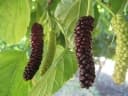
Morus macroura
Morus macroura
Safety & Hazards
None known
Cultivation Details
A very adaptable species, it can be grown from the warm temperate zone through to the tropics. Trees can be very cold tolerant, with some dormant plants reported to tolerate temperatures down to -10°c[1]. Grows best in a sunny position[1]. Prefers a deep, fertile, moist soil, but the plant is fairly adaptable[2, 1]. A fast-growing tree[3]. A very long-lived tree, able to fruit productively for several hundred years[2, 1]. Plants can be slow to come into fruiting when grown from seed, often taking several years[1]. Mulberries have brittle roots and so need to be handled with care when planting them out[4]. Any pruning should only be carried out in the winter when the plant is fully dormant because mulberries bleed badly when cut[4]. Ideally prune only badly placed branches and dead wood[4]. Plants in this genus are notably resistant to honey fungus[5]. A dioecious species, both male and female forms need to be grown if fruit and seed are required[6].
Propagation
The seed germinates best if given 2 - 3 months cold stratification[7, 8]. Sow the seed as soon as it is ripe if possible, otherwise in late winter in a cold frame. The seed usually germinates in the first spring, though it sometimes takes another 12 months. Prick out the seedlings into individual pots when they are large enough to handle and grow them on in the cold frame for their first winter. Plant them out in late spring or early summer after the last expected frosts. Cuttings of half-ripe wood, 7 - 10cm with a heel, mid summer in a frame. Plant out in spring. A good percentage take, though they sometimes fail to thrive[9, 10]. Cuttings of mature wood of the current season's growth, 25 - 30cm with a heel of 2 year old wood, autumn or early spring in a cold frame or a shady bed outside[9, 10, 5]. Bury the cuttings to threequarters of their depth. Layering in autumn[5]. Cite as: Temperate Plants Database, Ken Fern. temperate.theferns.info. 2026-02-21. <temperate.theferns.info/plant/Morus+macroura>
Pollinators
Data unavailable
References
- [1]Frutipedia - Encyclopedia of Edible Fruits of the World — Parmar Dr. C. · http://fruitipedia.com/index.htm ↩︎An online publication, listing over 400 species of fruits, usually with photos and some information on the plant.
- [2]Trade Winds Fruit — http://www.tradewindsfruit.com/index.htm ↩︎The on-line catalogue of a company selling seeds. Gives descriptions, photos and uses of a very wide range of fruit and other food-producing plants plus ornamentals.
- [3]Forest Restoration Planting in Northern Thailand — Pakkad G.; Elliott S.; Anusarnsunthorn V. Et al · Food and Agriculture Organization of the United Nations; Bangkok · 2002 · http://www.fao.org/ ↩︎A report on reforestation in northern Thailand by using specific pioneer species. It can be downloaded from the Internet.
- [4]Encyclopaedia of Herbs and their Uses. — Bown. D. · Dorling Kindersley, London. · 1995 · ISBN 0-7513-020-31 ↩︎A very well presented and informative book on herbs from around the globe. Plenty in it for both the casual reader and the serious student. Just one main quibble is the silly way of having two separate entries for each plant.
- [5]The New RHS Dictionary of Gardening. 1992. — Huxley. A. · MacMillan Press · 1992 · ISBN 0-333-47494-5 ↩︎Excellent and very comprehensive, though it contains a number of silly mistakes. Readable yet also very detailed.
- [6]Flora of China — Missouri Botanical Garden Press; St. Louis. · 1994 · http://flora.huh.harvard.edu/china/ ↩︎An excellent, comprehensive resource in 25 volumes. In addition to the botanical information the flora also gives basic information on habitat and some uses. An on-line version is also available.
- [7]Hardy Woody Plants from Seed. — McMillan-Browse. P. · Grower Books · 1985 · ISBN 0-901361-21-6 ↩︎Does not deal with many species but it is very comprehensive on those that it does cover. Not for casual reading.
- [8]Seed Manual for Ornamental Trees and Shrubs. — Gordon. A. G. and Rowe. D. C. F. · HMSO; London · 1982 · ISBN 0-11-710152-4 ↩︎Very comprehensive guide to growing trees and shrubs from seed. Not for the casual reader.
- [9]Propagation of Trees, Shrubs and Conifers. — Sheat. W. G. · MacMillan and Co · 1948 · ISBN - ↩︎A bit dated but a good book on propagation techniques with specific details for a wide range of plants.
- [10]The Reference Manual of Woody Plant Propagation. — Dirr. M. A. and Heuser. M. W. · Athens Ga. Varsity Press · 1987 · ISBN 0942375009 ↩︎A very detailed book on propagating trees. Not for the casual reader.
- [11]Flowers of India — http://www.flowersofindia.net/ ↩︎A wed site of native Indian plants, plus cultivated and naturalized species. It has good quality photos and terse details on more than 3,000 species and cultivars.
- [12]A Field Guide to Forest Trees of Northern Thailand — Gardener S.; Sidisunthorn P.; Anusarnsunthorn V. · Kobfai Publishing Project; Bangkok. · 2000 · ISBN 974-7799-01-4 ↩︎An excellent, concise guide to 430 species, plus notes on another 450 species. Excellent photographs and a separate section on distribution and plant uses.
- [13]Ethnobotanical Studies of Useful Trees of District Kotli, Azad Jammu and Kashmir — Muhammad Ajaib & Zaheer-Ud-Din Khan · 2014 · ISBN 2313-206X ↩︎
- [14]Plants and People of Nepal — Manandhar. N. P. · Timber Press. Oregon. · 2002 · ISBN 0-88192-527-6 ↩︎Excellent book, covering over 1,500 species of useful plants from Nepal together with information on the geography and peoples of Nepal. Good descriptions of the plants with terse notes on their uses.
- [15]A Manual of Indian Timbers. — Gamble. J. S. · Bishen Singh Mahendra Pal Singh · 1972 · ISBN - ↩︎First written in the 19th century, but still a classic, giving a lot of information on the uses and habitats of Indian trees. Not for the casual reader.
- [16]Cornucopia - A Source Book of Edible Plants. — Facciola. S. · Kampong Publications · 1990 · ISBN 0-9628087-0-9 ↩︎Excellent. Contains a very wide range of conventional and unconventional food plants (including tropical) and where they can be obtained (mainly N. American nurseries but also research institutes and a lot of other nurseries from around the world.
- [17]Forest Flora of Chakrata, Dehra Dun and Saharanpur. — Gupta. B. L. · Forest Research Institute Press · 1945 · ISBN - ↩︎A good flora for the middle Himalayan forests, sparsly illustrated. Not really for the casual reader.