Lonchocarpus — 20 species
Botanical species in the genus Lonchocarpus recorded in the PlantPeers database.

Lonchocarpus araripensis
Lonchocarpus araripensis
Family: Fabaceae
Cultivation
A plant of the 'Caatinga' dry forest region of northeast Brazil. The climate is hot and dry, there are usually 6 to 11 months without rain each year. The mean annual rainfall varies from 250 - 1,000mm, and the mean annual temperature is from 24 - 26°c.
Full cultivation guide →
Lonchocarpus campestris
Lonchocarpus campestris
Family: Fabaceae
Cultivation
Requires a sunny position. Young plants have a moderate rate of growth, There are conflicting reports on whether or not this tree has a symbiotic relationship with certain soil bacteria, so it is unclear as to whether this tree fixes atmospheric nitrogen.
Full cultivation guide →
Lonchocarpus cultratus
Lonchocarpus cultratus
Family: Fabaceae
Cultivation
Grows best in a sunny position. Succeeds in a wide range of soils, including both poor and dry soils. A fast-growing tree, able to reach a height of 3.5 metres within 2 years from seed.
Full cultivation guide →
Lonchocarpus heptaphyllus
Lonchocarpus heptaphyllus
Family: Fabaceae
Cultivation
Prefers a sunny position. Found in the wild mainly in sandy and peaty soils. Plants are tolerant of salt-laden winds and of salty soils.
Full cultivation guide →Lonchocarpus hondurensis
Lonchocarpus hondurensis
Family: Fabaceae
Cultivation
This species has a symbiotic relationship with certain soil bacteria, these bacteria form nodules on the roots and fix atmospheric nitrogen. Some of this nitrogen is utilized by the growing plant but some can also be used by other plants growing nearby.
Full cultivation guide →Lonchocarpus martynii
Lonchocarpus martynii
Family: Fabaceae
Cultivation
This species has a symbiotic relationship with certain soil bacteria, these bacteria form nodules on the roots and fix atmospheric nitrogen. Some of this nitrogen is utilized by the growing plant but some can also be used by other plants growing nearby.
Full cultivation guide →Lonchocarpus minimiflorus
Lonchocarpus minimiflorus
Family: Fabaceae
Cultivation
The plant commences flowering when still only a shrub. This species has a symbiotic relationship with certain soil bacteria, these bacteria form nodules on the roots and fix atmospheric nitrogen. Some of this nitrogen is utilized by the growing plant but some can also be used by other plants growing nearby.
Full cultivation guide →
Lonchocarpus muehlbergianus
Lonchocarpus muehlbergianus
Family: Fabaceae
Cultivation
Grows best in a sunny position. The plant grows best in a deep, moist, fertile soil. A fast-growing tree, able to reach a height of 3.5 metres within 2 years from seed.
Full cultivation guide →Lonchocarpus nicou
Lonchocarpus nicou
Family: Fabaceae
Cultivation
A plant of the moist tropics where it is found at elevations from near sea level to 1,340 metres. It grows best in areas where the mean annual temperature ranges from 23 - 32°c, but can tolerate 15 - 41°c. It prefers a mean annual rainfall in the range 2,300 - 2,700mm, but tolerates 2,000 - 3,100mm, and is found in areas with all year round rainfall and also where there is a distinct dry season.
Full cultivation guide →
Lonchocarpus punctatus
Lonchocarpus punctatus
Family: Fabaceae
Cultivation
A plant of tropical regions, growing in areas with a distinct dry season. The regions where the tree is found have an average annual temperature of 26°c with a maximum temperature of 36.7°c and a minimum temperature of 14.9°c. Average annual precipitation is approximately 1,288mm, ranging between 900 - 1,800mm.
Full cultivation guide →
Lonchocarpus sericeus
Lonchocarpus sericeus
Family: Fabaceae
Cultivation
A plant of the lowland moist tropics. Prefers a sunny position. Plants grow quickly when young and establish well.
Full cultivation guide →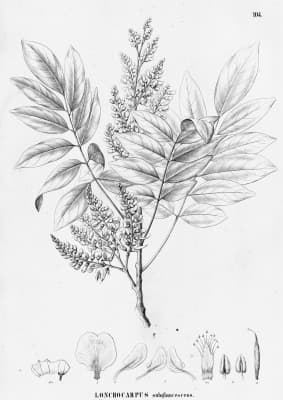
Lonchocarpus subglaucescens
Lonchocarpus subglaucescens
Family: Fabaceae
Cultivation
Succeeds in a sunny position to fairly moderate shade. Tolerant of dry to fairly wet soils. This species has a symbiotic relationship with certain soil bacteria; these bacteria form nodules on the roots and fix atmospheric nitrogen.
Full cultivation guide →