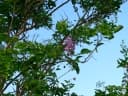
Lonchocarpus punctatus
Lonchocarpus punctatus
Safety & Hazards
The plant contains rotenone and has been used traditionally as a fish poison[1] - the rotenone kills or stuns the fish making them easy to catch, but the fish remain perfectly edible for mammals. Rotenone is classified by the World Health Organization as moderately hazardous. It is mildly toxic to humans and other mammals, but extremely toxic to many insects (hence its use as an insecticide) and aquatic life, including fish. This higher toxicity in fish and insects is because the lipophilic rotenone is easily taken up through the gills or trachea, but not as easily through the skin or the gastrointestinal tract. The lowest lethal dose for a child is 143 mg/kg, but human deaths from rotenone poisoning are rare because its irritating action causes vomiting. Deliberate ingestion of rotenone, however, can be fatal. The compound decomposes when exposed to sunlight and usually has an activity of six days in the environment.
Cultivation Details
A plant of tropical regions, growing in areas with a distinct dry season[1]. The regions where the tree is found have an average annual temperature of 26°c with a maximum temperature of 36.7°c and a minimum temperature of 14.9°c[2]. Average annual precipitation is approximately 1,288mm, ranging between 900 - 1,800mm[2]. Prefers a sunny position and a fertile, friable soil[1]. Established plants are very drought tolerant[1]. We have decided to follow what seems to be the majority decision and include here two other species that are sometimes treated as distinct[PFAF]. These species are:- Lonchocarpus longistylus Pittier. This is recorded as being endemic to Mexico. Lonchocarpua violaceus (Jacq.) DC. This is recorded from the West Indies and northern S. America. The uses detailed below are likely to apply to all three species if they are eventually found to be distinct, but we have noted which particular species have been recorded as having the uses. This species has a symbiotic relationship with certain soil bacteria, these bacteria form nodules on the roots and fix atmospheric nitrogen. Some of this nitrogen is utilized by the growing plant but some can also be used by other plants growing nearby[3].
Propagation
Seed. Under humid conditions the fresh seeds germinate at 65% without pre-treatment. A heterogeneous sample of seeds germinated approximately 10 days after sowing[2]. Seeds remain viable for approximately 6 months when stored under ambient conditions (24 - 30°c). With longer storage, their viability quickly diminishes[2]. Cite as: Tropical Plants Database, Ken Fern. tropical.theferns.info. 2026-02-20. <tropical.theferns.info/viewtropical.php?id=Lonchocarpus+punctatus>
Pollinators
Data unavailable
References
- [1]Tropical and Subtropical Trees - A Worldwide Encyclopaedic Guide. — Barwick. M. · Thames & Hudson, London · 2004 · ISBN 0-500-51181-0 ↩︎A superb book, very concise and well written, giving a wealth of information on 400 or more species including descriptions, habitat, cultivation details and plant uses. A wealth of colour photographs bring each plant vividly to life.
- [2]Tropical Tree Seed Manual — Vosso. J. Editor. · USDA Forest Service. · 2002 · http://www.rngr.net/Publications/ttsm ↩︎An extremely good guide, it can also be downloaded in its entirety from the address shown above.
- [3]Nodulation Plants in GRIN Taxonomy — United States Department of Agriculture · http://www.ars-grin.gov/~sbmljw/cgi-bin/taxnodul.pl?language=en ↩︎An online database listing plants that have either positive or negative reports on root and stem nodulation with nitrogen-fixing bacteria.
- [4]Dictionary of Economic Plants. — Uphof. J. C. Th. · Weinheim · 1959 · ISBN - ↩︎An excellent and very comprehensive guide but it only gives very short descriptions of the uses without any details of how to utilize the plants. Not for the casual reader.
- [5]Flora of Guatemala — Standley P.C. & J. A. Steyermark · 1946 - 1976 · http://www.archive.org/ ↩︎A superb reference, though somewhat dated. Gives lots of plant uses as well as information on plant habit and habitat. The entire flora (13 volumes) can now be downloaded from http://www.archive.org/
- [6]Tropical Timbers of the World. Ag. Handbook No. 607. — Chudnoff. Martin. · USDA Forest Service. Wisconsin. · 1984 ↩︎Terse details on the properties of the wood of almost 400 species of trees from the Tropics.
- [PFAF]Plants for a Future — pfaf.org ↩︎