Berberis — 52 species
Botanical species in the genus Berberis recorded in the PlantPeers database.

Berberis aggregata
Berberis aggregata
Family: Berberidaceae
Cultivation
Berberis aggregata is a moderatley cold-hardy plant, able to tolerate temperatures down to around -20°c when fully dormant. Prefers a warm moist loamy soil but it is by no means fastidious, succeeding in thin, dry and shallow soils. Grows well in heavy clay soils.
Full cultivation guide →Berberis amurensis
Berberis amurensis
Family: Berberidaceae
Cultivation
Prefers a warm moist loamy soil and light shade but it is by no means fastidious, succeeding in thin, dry and shallow soils. Grows well in heavy clay soils. This species is closely allied to Berberis vulgaris, it hybridizes freely with other members of the genus.
Full cultivation guide →Berberis angulosa
Berberis angulosa
Family: Berberidaceae
Cultivation
Prefers a warm moist loamy soil but it is by no means fastidious, succeeding in thin, dry and shallow soils. Grows well in heavy clay soils. Succeeds in full sun or light shade.
Full cultivation guide →Berberis aristata
Berberis aristata
Family: Berberidaceae
Cultivation
Berberis aristata is able to tolerate quite severe winters - it is known to have survived temperatures down to -15°c without damage. Prefers a warm moist loamy soil and light shade but it is by no means fastidious, succeeding in thin, dry and shallow soils. Grows well in heavy clay soils.
Full cultivation guide →Berberis asiatica
Berberis asiatica
Family: Berberidaceae
Cultivation
Berberis asiatica is not very hardy outside the milder regions of the temperate zone. It does experience frost and snow in its native range and can tolerate occasional, short-lived temperatures falling as low as -5°c. Plants grow very well in southwest England, for example., but are often cut to the ground in other parts of the country (though they will generally resprout from the base if the winter is not too severe).
Full cultivation guide →Berberis atrocarpa
Berberis atrocarpa
Family: Berberidaceae
Cultivation
Species in this genus generally prefer a warm moist loamy soil and light shade but they are by no means fastidious, succeeding in thin, dry and shallow soils and in full sun. Grows well in heavy clay soils. Hybridizes freely with other members of this genus.
Full cultivation guide →Berberis boliviana
Berberis boliviana
Family: Berberidaceae
Cultivation
Berberis boliviana is native to higher elevations in the tropics, generally at elevations from 2,500 - 4,000 metres and between latitudes of 20 - 13° south. In the north of its range it is often found in dry valleys, growing in areas where the mean annual rainfall is within the range 840 - 1,000mm, most of which falls in a cool season of around 6 months. In the dry season temperatures can be as high as 28°c in the daytime, but can fall below freezing in the night.
Full cultivation guide →Berberis calliantha
Berberis calliantha
Family: Berberidaceae
Cultivation
Prefers a warm moist loamy soil and light shade but it is by no means fastidious, succeeding in thin, dry and shallow soils and in full sun. Grows well in heavy clay soils. Hybridizes freely with other members of this genus.
Full cultivation guide →Berberis canadensis
Berberis canadensis
Family: Berberidaceae
Cultivation
Prefers a warm moist loamy soil but is by no means fastidious, succeeding in thin, dry and shallow soils. Grows well in heavy clay soils. Succeeds in full sun or light shade.
Full cultivation guide →Berberis chilensis
Berberis chilensis
Family: Berberidaceae
Cultivation
Berberis chilensis is a plant of the temperate zone of central Chile, where it can be found at elevations up to 2,000 metres. It is not very cold-hardy, tolerating occasional temperatures falling as low as -5°c. It grows in arid to semi-arid environments, experiencing dry seasons that can range from 3 - 10 months long and a mean annual precipitation ranging from 100 - 800mm with rain falling mainly in the cold season.
Full cultivation guide →Berberis chinensis
Berberis chinensis
Family: Berberidaceae
Cultivation
Plants are hardy to about -25°c. Species in this genus generally prefer a warm moist loamy soil and light shade but re by no means fastidious, often succeeding in thin, dry and shallow soils. Grows well in heavy clay soils.
Full cultivation guide →Berberis chingii
Berberis chingii
Family: Berberidaceae
Cultivation
Species in this genus generally prefer a warm moist loamy soil and light shade but they are by no means fastidious, succeeding in thin, dry and shallow soils. Grows well in heavy clay soils. Hybridizes freely with other members of this genus.
Full cultivation guide →Berberis chitria
Berberis chitria
Family: Berberidaceae
Cultivation
Prefers a warm moist loamy soil and light shade but it is by no means fastidious, succeeding in thin, dry and shallow soils. Grows well in heavy clay soils. Hybridizes freely with other members of this genus.
Full cultivation guide →Berberis chochoco
Berberis chochoco
Family: Berberidaceae
Cultivation
A plant mainly of the subtropics, just entering the tropics at moderate elevations.
Full cultivation guide →Berberis concinna
Berberis concinna
Family: Berberidaceae
Cultivation
Prefers a warm moist loamy soil and light shade but it is by no means fastidious, succeeding in thin, dry and shallow soils. Grows well in heavy clay soils. Hybridizes freely with other members of this genus.
Full cultivation guide →Berberis cooperi
Berberis cooperi
Family: Berberidaceae
Cultivation
Species in this genus generaly prefer a warm moist loamy soil and light shade but they are by no means fastidious, succeeding in thin, dry and shallow soils. Grows well in heavy clay soils. Hybridizes freely with other members of this genus.
Full cultivation guide →Berberis crataegina
Berberis crataegina
Family: Berberidaceae
Cultivation
Species in this genus generaly prefer a warm moist loamy soil and light shade but they are by no means fastidious, succeeding in thin, dry and shallow soils. Grows well in heavy clay soils. Hybridizes freely with other members of this genus.
Full cultivation guide →Berberis cretica
Berberis cretica
Family: Berberidaceae
Cultivation
Species in this genus generaly prefer a warm moist loamy soil and light shade but they are by no means fastidious, succeeding in thin, dry and shallow soils. Some Berberis species (especially Berberis vulgaris) harbour the black stem-rust fungus (Puccinia graminis Persoon). This is a major disease of wheat and barley crops and can spread from infected barberries to the grain crop.
Full cultivation guide →Berberis darwinii
Berberis darwinii
Family: Berberidaceae
Cultivation
Berberis darwinii can tolerate considerable winter cold, with temperatures dropping as low as -15°c. Prefers a warm moist loamy soil in full sun or light shade but it is by no means fastidious, succeeding in thin, dry and shallow soils. Grows well in heavy clay soils.
Full cultivation guide →Berberis empetrifolia
Berberis empetrifolia
Family: Berberidaceae
Cultivation
Berberis empetrifolia is well-adapted to cold, harsh environments, including rocky slopes in the high Andes and sandy beaches near the sea; it is hardy to about -15°c. Prefers a warm moist loamy soil and light shade but it is by no means fastidious, succeeding in thin, dry and shallow soils. Grows well in heavy clay soils.
Full cultivation guide →Berberis everestiana
Berberis everestiana
Family: Berberidaceae
Cultivation
Prefers a warm moist loamy soil and light shade but it is by no means fastidious, succeeding in thin, dry and shallow soils. Grows well in heavy clay soils. Hybridizes freely with other members of this genus.
Full cultivation guide →Berberis fendleri
Berberis fendleri
Family: Berberidaceae
Cultivation
Prefers a warm moist loamy soil but is by no means fastidious, succeeding in thin, dry and shallow soils. Grows well in heavy clay soils. Succeeds in full sun or light shade.
Full cultivation guide →Berberis gagnepainii
Berberis gagnepainii
Family: Berberidaceae
Cultivation
Prefers a warm moist loamy soil and light shade but it is by no means fastidious, succeeding in thin, dry and shallow soils. Grows well in heavy clay soils. A number of cultivars have been selected for their ornamental value.
Full cultivation guide →Berberis heteropoda
Berberis heteropoda
Family: Berberidaceae
Cultivation
Species in this genus generally prefer a warm moist loamy soil and light shade but are by no means fastidious, succeeding in thin, dry and shallow soils. Plants can be pruned back quite severely, they resprout well from the base. Hybridizes freely with other members of this genus.
Full cultivation guide →Berberis integerrima
Berberis integerrima
Family: Berberidaceae
Cultivation
Berberis integerrima is often found growing in semi-arid climates in Asia, where winters can be cold with snow, and summers are hot and often dry1161. Species in this genus generally prefer a warm moist loamy soil and light shade but are by no means fastidious, succeeding in thin, dry and shallow soils. Established plants are drought tolerant.
Full cultivation guide →Berberis jaeschkeana
Berberis jaeschkeana
Family: Berberidaceae
Cultivation
Species in this genus generally prefer a warm moist loamy soil and light shade but are by no means fastidious, succeeding in thin, dry and shallow soils. Grows well in heavy clay soils. Plants can be pruned back quite severely, they resprout well from the base.
Full cultivation guide →Berberis koreana
Berberis koreana
Family: Berberidaceae
Cultivation
Berberis koreana is a very hardy plant, tolerating winter temperatures occasionally falling down to about -30°c. Prefers a warm moist loamy soil and light shade but it is by no means fastidious, succeeding in thin, dry and shallow soils. Grows well in heavy clay soils.
Full cultivation guide →
Berberis laurina
Berberis laurina
Family: Berberidaceae
Cultivation
A plant of the warm temperate to tropical zones, found at elevations of 800 metres or more in the tropics.
Full cultivation guide →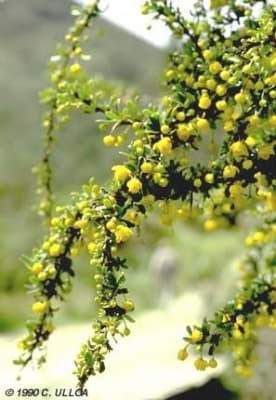
Berberis lutea
Berberis lutea
Family: Berberidaceae
Cultivation
A plant of high elevations in the Tropics, where it is usually found above 3,000 metres, though it occasionally descends as low as 1,900 metres.
Full cultivation guide →Berberis lycium
Berberis lycium
Family: Berberidaceae
Cultivation
Berberis lycium is a fairly hardy plant, tolerating winter temperatures falling occasionally as low as -15°c, but it suffers some damage in long, severe winters. Prefers a warm moist loamy soil and light shade but it is by no means fastidious, succeeding in thin, dry and shallow soils. Grows well in heavy clay soils.
Full cultivation guide →Berberis microphylla
Berberis microphylla
Family: Berberidaceae
Cultivation
Berberis microphylla is a fairly hardy plant, it can tolerate occasional winter temperatures falling as low as -15°c, though it can be deciduous in cold winters. Prefers a warm moist loamy soil and light shade but it is by no means fastidious, succeeding in thin, dry and shallow soils and in full sun. Grows well in heavy clay soils.
Full cultivation guide →Berberis muliensis
Berberis muliensis
Family: Berberidaceae
Cultivation
Berberis muliensis is a plant of warm temperate to subtropical regions of China, where it can be found at elevations up to 4,300 metres. Especially when collected from higher elevations, this species should succeed outdoors in milder regions of the temperate zone. It is reported to be able to tolerate temperatures down to at least -5°c.
Full cultivation guide →Berberis oblonga
Berberis oblonga
Family: Berberidaceae
Cultivation
Species in this genus generally prefer a warm moist loamy soil and light shade but are by no means fastidious, succeeding in thin, dry and shallow soils. Plants can be pruned back quite severely, they resprout well from the base. Hybridizes freely with other members of this genus.
Full cultivation guide →Berberis rariflora
Berberis rariflora
Family: Berberidaceae
Cultivation
Berberis rariflora is a plant of high elevations in the tropical regions of Bolivia, usually found at elevations in excess of 3,000 metres. Species in this genus generally prefer a warm moist loamy soil and light shade but they are by no means fastidious, succeeding in thin, dry and shallow soils. Hybridizes freely with other members of this genus.
Full cultivation guide →Berberis rotundifolia
Berberis rotundifolia
Family: Berberidaceae
Cultivation
Berberis rotundifolia is moderately cold-hardy, tolerating temperatures falling to around -15 to -20°c and often experiencing standing snow for several months. It grows in somewhat dry areas of southern Chile where the dry season lasts for 3 - 5 months and there is a mean annual rainfall of 400 - 800mm, most of which falls in the cold season. An easily grown plant, it prefers a position with some shade.
Full cultivation guide →Berberis rubrostilla
Berberis rubrostilla
Family: Berberidaceae
Cultivation
Prefers a warm moist loamy soil but it is by no means fastidious, succeeding in thin, dry and shallow soils. Grows well in heavy clay soils. Succeeds in full sun or light shade.
Full cultivation guide →Berberis ruscifolia
Berberis ruscifolia
Family: Berberidaceae
Cultivation
Berberis ruscifolia is found in the warm temperate to subtropical region of Argentina, Uruguay and Brazil. It has been grown successfully outdoors at Oxford Botanical Gardens in Enland where frosts are regularly observed in winter and temperatures can go below -10c at times. Prefers a warm moist loamy soil and light shade but it is by no means fastidious, succeeding in thin, dry and shallow soils.
Full cultivation guide →Berberis sherriffii
Berberis sherriffii
Family: Berberidaceae
Cultivation
Prefers a warm moist loamy soil and light shade but it is by no means fastidious, succeeding in thin, dry and shallow soils but disliking waterlogged soils. Grows well in heavy clay soils. Plants can be pruned back quite severely, they resprouts well from the base.
Full cultivation guide →Berberis sibirica
Berberis sibirica
Family: Berberidaceae
Cultivation
Prefers a warm moist loamy soil but it is by no means fastidious, succeeding in thin, dry and shallow soils. Grows well in heavy clay soils. Succeeds in full sun or light shade.
Full cultivation guide →Berberis sieboldii
Berberis sieboldii
Family: Berberidaceae
Cultivation
Prefers a warm moist loamy soil but it is by no means fastidious, succeeding in thin, dry and shallow soils. Grows well in heavy clay soils. Prefers a lime-free soil.
Full cultivation guide →Berberis sikkimensis
Berberis sikkimensis
Family: Berberidaceae
Cultivation
Prefers a warm moist loamy soil and light shade but it is by no means fastidious, succeeding in thin, dry and shallow soils. Grows well in heavy clay soils. This species is closely related to Berberis chitria.
Full cultivation guide →Berberis soulieana
Berberis soulieana
Family: Berberidaceae
Cultivation
Prefers a warm moist loamy soil and light shade but it is by no means fastidious, succeeding in thin, dry and shallow soils. Grows well in heavy clay soils. Hybridizes freely with other members of this genus.
Full cultivation guide →Berberis thunbergii
Berberis thunbergii
Family: Berberidaceae
Cultivation
Berberis thunbergii, when becoming naturalized outside of its native range, has shown a preference for areas where average maximum summer temperatures are in the region 21 - 25°c and average minimum winter temperatures range from -3 to -11°c. Dormant plants are able to tolerate temperatures down to about -25°c. An easily grown plant, it prefers a warm moist loamy soil but it is by no means fastidious, succeeding in thin, dry and shallow soils.
Full cultivation guide →Berberis trigona
Berberis trigona
Family: Berberidaceae
Cultivation
Prefers a warm moist loamy soil and light shade but it is by no means fastidious, succeeding in thin, dry and shallow soils. Tolerant of chalky soils. Grows well in heavy clay soils.
Full cultivation guide →Berberis ulicina
Berberis ulicina
Family: Berberidaceae
Cultivation
Berberis ulicina is found at elevations up to 4,800 metres in the Himalayas, where it experiences cold winters with snow and frost. It should be hardy at least in the milder regions of the temperate zone. Species in this genus generally prefer a warm moist loamy soil and light shade but are by no means fastidious, succeeding in thin, dry and shallow soils.
Full cultivation guide →Berberis verruculosa
Berberis verruculosa
Family: Berberidaceae
Cultivation
Plants are hardy to about -20°c. Prefers a warm moist loamy soil and light shade but it is by no means fastidious, succeeding in thin, dry and shallow soils. Grows well in heavy clay soils.
Full cultivation guide →Berberis vulgaris
Berberis vulgaris
Family: Berberidaceae
Cultivation
Berberis vulgaris is a plant of the temperate zone, where it tends to prefer humid, continental climates with cold winters. It is winter hardy to about -35°c. It grows best in areas where annual precipitation is in excess of 630mm.
Full cultivation guide →Berberis wallichiana
Berberis wallichiana
Family: Berberidaceae
Cultivation
Species in this genus generally prefer a warm moist loamy soil and light shade but are by no means fastidious, succeeding in thin, dry and shallow soils. Grows well in heavy clay soils. Plants can be pruned back quite severely, they resprout well from the base.
Full cultivation guide →Berberis wilsoniae
Berberis wilsoniae
Family: Berberidaceae
Cultivation
Berberis wilsoniae is a moderately cold-hardy plant, able to tolerate temperatures down to around -20°c when fully dormant. Prefers a warm moist loamy soil but it is by no means fastidious, succeeding in thin, dry and shallow soils. Grows well in heavy clay soils.
Full cultivation guide →Berberis x carminea
Berberis x carminea
Family: Berberidaceae
Cultivation
Plants are hardy to about -15°c. Prefers a warm moist loamy soil and light shade but it is by no means fastidious, succeeding in thin, dry and shallow soils. Grows well in heavy clay soils.
Full cultivation guide →Berberis x lologensis
Berberis x lologensis
Family: Berberidaceae
Cultivation
Plants are hardy to about -15°c. Prefers a warm moist loamy soil and light shade but it is by no means fastidious, succeeding in thin, dry and shallow soils. Grows well in heavy clay soils.
Full cultivation guide →Berberis x stenophylla
Berberis x stenophylla
Family: Berberidaceae
Cultivation
Plants are hardy to about -15°c. Prefers a warm moist loamy soil and light shade but it is by no means fastidious, succeeding in thin, dry and shallow soils. Grows well in heavy clay soils.
Full cultivation guide →