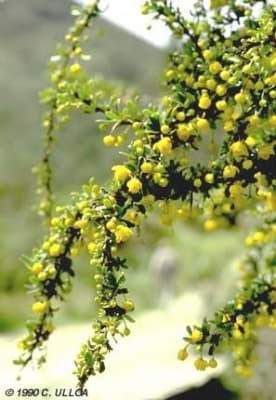
Berberis lutea
Berberis lutea
Safety & Hazards
All parts of the plant contain the alkaloid berberine - this is most concentrated in the roots, stems and inner bark, and least concentrated in the fruits. In small quantities berberine has a range of effective medicinal applications but, in excess, can cause vomiting, lowered blood pressure, reduced heart rate, lethargy, and other ill-effects. The fruit of most, if not all, members of this genus are more or less edible and can be eaten in quantity since the levels of berberine in the fruit are very low.
Cultivation Details
A plant of high elevations in the Tropics, where it is usually found above 3,000 metres, though it occasionally descends as low as 1,900 metres.
Propagation
Seed - best sown as soon as it is ripe[1]. Seed from over-ripe fruit will take longer to germinate[1], whilst stored seed may require cold stratification[2]. The seedlings are subject to damping off, so should be kept well ventilated[3]. When the seedlings are large enough to handle, prick them out into individual pots and grow them on until large enough to plant out. Cuttings of half-ripe wood in a frame. Cuttings of mature wood of the current season's growth, preferably with a heel, in a frame[1]. Cite as: Tropical Plants Database, Ken Fern. tropical.theferns.info. 2026-02-19. <tropical.theferns.info/viewtropical.php?id=Berberis+lutea>
Pollinators
Data unavailable
References
- [1]Propagation of Trees, Shrubs and Conifers. — Sheat. W. G. · MacMillan and Co · 1948 · ISBN - ↩︎A bit dated but a good book on propagation techniques with specific details for a wide range of plants.
- [2]Hardy Woody Plants from Seed. — McMillan-Browse. P. · Grower Books · 1985 · ISBN 0-901361-21-6 ↩︎Does not deal with many species but it is very comprehensive on those that it does cover. Not for casual reading.
- [3]The Reference Manual of Woody Plant Propagation. — Dirr. M. A. and Heuser. M. W. · Athens Ga. Varsity Press · 1987 · ISBN 0942375009 ↩︎A very detailed book on propagating trees. Not for the casual reader.
- [4]Dictionary of Economic Plants. — Uphof. J. C. Th. · Weinheim · 1959 · ISBN - ↩︎An excellent and very comprehensive guide but it only gives very short descriptions of the uses without any details of how to utilize the plants. Not for the casual reader.
- [5]Botanical Museum Leaflets Vol 28 — Harvard University; Cambridge, Mass. · 1981 · http://www.biodiversitylibrary.org ↩︎An article on the Ethnopharmacological uses of plants in northwestern S. America, amongst many other articles. It can be downloaded from the Internet.
- [6]Flora of Peru — Macbride. J.F. · Field Museum of Natural History · 1936 ↩︎An excellent attempt at a Flora of Peru, though it is clear that many of the plants were imperfectly known at that time and so information on them was sketchy. Available for download from the Internet.
- [7]Medicinal Plants of China — Duke. J. A. and Ayensu. E. S. · Reference Publications, Inc. · 1985 · ISBN 0-917256-20-4 ↩︎Details of over 1,200 medicinal plants of China and brief details of their uses. Often includes an analysis, or at least a list of constituents. Heavy going if you are not into the subject.