Tamarix — 12 species
Botanical species in the genus Tamarix recorded in the PlantPeers database.

Tamarix africana
Tamarix africana
Family: Tamaricaceae
Cultivation
Tamarix africana can succeed outdoors in the milder parts of the temperate zone, tolerating occasiona, short-lived l temperatures falling to around -5 to -10°c. An easily grown plant, succeeding in most soils and tolerant of saline conditions. Grows well in heavy clay soils as well as in sands and even shingle.
Full cultivation guide →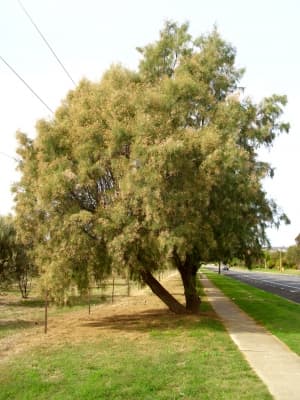
Tamarix aphylla
Tamarix aphylla
Family: Tamaricaceae
Cultivation
Tamarix aphylla is a plant of the arid and semi-arid subtropics and tropics, where it is found at elevations up to 1,400 metres. It grows best in areas where annual daytime temperatures are within the range 27 - 40°c, but can tolerate 8 - 50°c. When dormant, the plant can survive temperatures down to about -10°c, but young growth can be severely damaged at -1°c.
Full cultivation guide →Tamarix arceuthoides
Tamarix arceuthoides
Family: Tamaricaceae
Cultivation
Tamarix arceuthoides is a plant of temperate desert and semiarid shrublands. Plants flower mainly on wood produced the previous year.
Full cultivation guide →Tamarix canariensis
Tamarix canariensis
Family: Tamaricaceae
Cultivation
Tamarix canariensis is not very hardy outdoors in the temperate zone, but it succeeds in the milder areas, tolerating short periods when temperatures fall to between -5 and -10°c. An easily grown plant, succeeding in most soils and tolerant of saline conditions. Grows well in heavy clay soils as well as in sands and even shingle.
Full cultivation guide →Tamarix chinensis
Tamarix chinensis
Family: Tamaricaceae
Cultivation
Tamarix chinensis is a moderately cold-hardy plant, tolerating winter temperatures falling to around -20°c. It grows best in areas with hot summers and can tolerate arid, semi-arid and moist climates, tolerating mean annual rainfall as low as 50mm and rising to 1,500mm or more. An easily grown plant, succeeding in most soils and tolerant of waterlogged and saline conditions.
Full cultivation guide →Tamarix gallica
Tamarix gallica
Family: Tamaricaceae
Cultivation
Tamarix gallica is found especially in dry to semi-arid areas, though it can also tolerate moister climates. Mean annual rainfall can range between 100 - 600mm within its native range, though it can tolerate higher rainfall in cultivation. It is fairly cold-hardy, able to tolerate temperatures down to around -20°c, perhaps a little lower.
Full cultivation guide →Tamarix hispida
Tamarix hispida
Family: Tamaricaceae
Cultivation
Tamarix hispida is a moderately cold-hardy plant, tolerating temperatures falling as low as -20°c, but it is restricted to saline habitats. An easily grown plant, succeeding in most soils and tolerant of saline conditions. Grows well in heavy clay soils as well as in sands and even shingle.
Full cultivation guide →Tamarix parviflora
Tamarix parviflora
Family: Tamaricaceae
Cultivation
Tamarix parviflora is a moderately cold-hardy plant, able to tolerate temperatures falling to around -20°c in winter and rising to around 50°c in the summer. An easily grown plant, succeeding in most soils and tolerant of saline conditions in cultivation. Grows well in heavy clay soils as well as in sands and even shingle.
Full cultivation guide →Tamarix pycnocarpa
Tamarix pycnocarpa
Family: Tamaricaceae
Tamarix ramosissima
Tamarix ramosissima
Family: Tamaricaceae
Cultivation
Tamarix ramosissima is a plant mainly of the arid to moist temperate regions of Asia and East Europe. It has a wide climatic tolerance and can succeed in regions where winter temperatures can fall as low as -20°c whilst summers can rech 45°c or more. An easily grown plant, succeeding in most soils and tolerant of saline conditions.
Full cultivation guide →Tamarix senegalensis
Tamarix senegalensis
Family: Tamaricaceae
Cultivation
A plant of arid and semi-arid areas in the tropics and subtropics. Requires a sunny position. Succeeds in very dry, sandy soils so long as there is ground water no more than 3 metres deep.
Full cultivation guide →