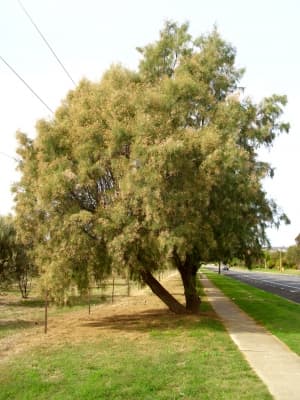
Tamarix aphylla
Tamarix aphylla
Safety & Hazards
None known
Cultivation Details
Tamarix aphylla is a plant of the arid and semi-arid subtropics and tropics, where it is found at elevations up to 1,400 metres. It grows best in areas where annual daytime temperatures are within the range 27 - 40°c, but can tolerate 8 - 50°c[1]. When dormant, the plant can survive temperatures down to about -10°c, but young growth can be severely damaged at -1°c[1]. It prefers a mean annual rainfall in the range 300 - 400mm, but tolerates 200 - 500mm[1]. An easily grown plant, succeeding in most soils and tolerant of saline conditions[2]. Grows well in heavy clay soils as well as in sands and even shingle[3]. Usually found near the coast, it succeeds inland if given a fairly good deep loam and a sunny position[2, 4]. Tolerant of maritime winds and dry soils when grown near the coast[2], plants require a moister soil and shelter from cold drying winds when they are grown inland in non-saline soils because they use the soil salts that are found in saline soils to help them reduce transpiration[4]. It grows more vigorously on land subject to occasional inundation than on land which is never flooded[5]. Prefers a pH in the range 6.5 - 7.5, tolerating 6 - 8.5[1]. The slender twigs are often hoary with deep punctate glands that produce a saline efflorescence. The salty 'tears' drip in the night and the soil beneath trees is generally covered with a salt layer making it very difficult for many species of plant to grow there[6]. This species flowers on the current year's growth[4]. Any pruning is best carried out in spring, hedges are also best trimmed at this time[7]. Plants are tolerant of severe pruning, sprouting freely from old wood[PFAF]. Plants produce a deep and extensive root system, ranging about 10 metres deep and 34 metres horizontally[5]. Plants in this genus are notably resistant to honey fungus[4].
Propagation
Seed - germination is rapid in fresh seed, but it has a very short period of viability unless stored at low temperatures[6]. Sow the seed in spring in a cold frame and only just cover. When they are large enough to handle, prick the seedlings out into individual pots and grow them on in the greenhouse for their first winter. Plant them out into their permanent positions in late spring or early summer, after the last expected frosts. Cuttings of half-ripe wood, mid summer in a frame. Very easy[4]. Cuttings of mature wood of the current seasons growth, 15 - 25cm long, planted outdoors in late autumn in a nursery bed or straight into their permanent position. High percentage[2, 4]. Cite as: Temperate Plants Database, Ken Fern. temperate.theferns.info. 2026-02-21. <temperate.theferns.info/plant/Tamarix+aphylla>
Pollinators
Bees, Insects
References
- [1]Ecocrop — http://ecocrop.fao.org/ecocrop/srv/en/home ↩︎Basic information on a wide range of useful plants, plus details of environmental needs where available.
- [2]Trees and Shrubs Hardy in Great Britain. Vol 1 - 4 and Supplement. — Bean. W. · Murray · 1981 · ISBN - ↩︎A classic with a wealth of information on the plants, but poor on pictures.
- [3]Ornamental Shrubs, Climbers and Bamboos. — Thomas. G. S. · Murray · 1992 · ISBN 0-7195-5043-2 ↩︎Contains a wide range of plants with a brief description, mainly of their ornamental value but also usually of cultivation details and varieties.
- [4]The New RHS Dictionary of Gardening. 1992. — Huxley. A. · MacMillan Press · 1992 · ISBN 0-333-47494-5 ↩︎Excellent and very comprehensive, though it contains a number of silly mistakes. Readable yet also very detailed.
- [5]World Agroforesty Centre — http://www.worldagroforestry.org/ ↩︎An excellent online database of a huge range of trees giving very good information on each plant - its uses, ecology, identity, propagation, pests etc.
- [6]Invasive Species Compendium — http://www.cabi.org ↩︎An immense resource - in depth information on over 900 species of invasive plants (it also has information on animals, fungi etc).
- [7]The RHS Gardener's Encyclopedia of Plants and Flowers — Brickell. C. · Dorling Kindersley Publishers Ltd. · 1990 · ISBN 0-86318-386-7 ↩︎Excellent range of photographs, some cultivation details but very little information on plant uses.
- [8]IUCN Red List of Threatened Species — http://www.iucnredlist.org/ ↩︎A list of plants under threat and facing possible extinction, usually with brief details of the threats and information on habitat.
- [9]Global Invasive Species Database — http://www.issg.org/database/welcome/ ↩︎Very detailed information on almost 400 species (with more being added) of plants that have become weeds in areas outside their native range.
- [10]Tropical and Subtropical Trees - A Worldwide Encyclopaedic Guide. — Barwick. M. · Thames & Hudson, London · 2004 · ISBN 0-500-51181-0 ↩︎A superb book, very concise and well written, giving a wealth of information on 400 or more species including descriptions, habitat, cultivation details and plant uses. A wealth of colour photographs bring each plant vividly to life.
- [11]African Flowering Plants Database — Conservatoire et Jardin Botaniques. · http://www.ville-ge.ch/musinfo/bd/cjb/africa/recherche.php ↩︎Contains information on over 150,000 plant names (including synonyms) giving a description and habitat, plus a distribution map.
- [12]Plants for Human Consumption. — Kunkel. G. · Koeltz Scientific Books · 1984 · ISBN 3874292169 ↩︎An excellent book for the dedicated. A comprehensive listing of Latin names with a brief list of edible parts.
- [13]Cornucopia - A Source Book of Edible Plants. — Facciola. S. · Kampong Publications · 1990 · ISBN 0-9628087-0-9 ↩︎Excellent. Contains a very wide range of conventional and unconventional food plants (including tropical) and where they can be obtained (mainly N. American nurseries but also research institutes and a lot of other nurseries from around the world.
- [14]Glossary of Indian Medicinal Plants (Including the Supplement). — Chopra. R. N., Nayar. S. L. and Chopra. I. C. · Council of Scientific and Industrial Research, New Delhi. · 1986 · ISBN - ↩︎Very terse details of medicinal uses of plants with a wide range of references and details of research into the plants chemistry. Not for the casual reader.
- [15]A Guide to Medicinal Plants in North Africa — IUCN; Malaga, Spain · 2005 · ISBN 2-8317-0893-1 ↩︎A guide to over 100 species of medicinal herbs in N. Africa.
- [16]Vegetable Tannins — Rottsieper. E.H.W. · The Forestal Land, Timber and Railways Co. Ltd. · 1946 · ISBN - ↩︎A fairly detailed treatise on the major sources of vegetable tannins.
- [17]Native American Ethnobotany — Moerman. D. · Timber Press. Oregon. · 1998 · ISBN 0-88192-453-9 ↩︎Very comprehensive but terse guide to the native uses of plants. Excellent bibliography, fully referenced to each plant, giving a pathway to further information. Not for the casual reader.
- [PFAF]Plants for a Future — pfaf.org ↩︎