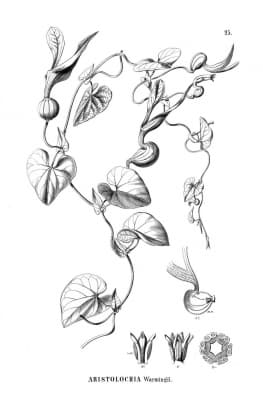
Aristolochia — 41 species
Botanical species in the genus Aristolochia recorded in the PlantPeers database.

Aristolochia acuminata
Aristolochia acuminata
Family: Aristolochiaceae
Cultivation
Prefers a well-drained, humus-rich, loamy soil and a position in full sun or partial shade. The flowers of many species in this genus form an intricate trap for pollinating insects. The insects are tempted to an area of the flower where they are unable to grip and they slide down into the utricle - downward pointing hairs prevent them climbing out.
Full cultivation guide →
Aristolochia albida
Aristolochia albida
Family: Aristolochiaceae
Cultivation
A plant of the tropics, growing in areas that have a distinct dry season. The root merits further investigation into its pharmacological activity. The flowers of many species in this genus form an intricate trap for pollinating insects.
Full cultivation guide →Aristolochia auricularia
Aristolochia auricularia
Family: Aristolochiaceae
Cultivation
Species in this genus generally prefer a well-drained loamy soil, rich in organic matter, in sun or semi-shade, also succeeding in ordinary garden soil. Most species in this genus have malodorous flowers, often smelling like decaying flesh. They are pollinated by the small flies that are attracted to the flowers by these foetid odours and by the purple-brown colour of the flowers.
Full cultivation guide →
Aristolochia bracteolata
Aristolochia bracteolata
Family: Aristolochiaceae
Cultivation
A plant of the drier tropics and subtropics, usually growing where there is a distinct dry season. The flowers of many species in this genus form an intricate trap for pollinating insects. The insects are tempted to an area of the flower where they are unable to grip and they slide down into the utricle - downward pointing hairs prevent them climbing out.
Full cultivation guide →
Aristolochia brasiliensis
Aristolochia brasiliensis
Family: Aristolochiaceae
Cultivation
Prefers a well-drained, humus-rich, loamy soil and a position in full sun or partial shade. The flowers of many species in this genus form an intricate trap for pollinating insects. The insects are tempted to an area of the flower where they are unable to grip and they slide down into the utricle - downward pointing hairs prevent them climbing out.
Full cultivation guide →Aristolochia clematitis
Aristolochia clematitis
Family: Aristolochiaceae
Cultivation
Prefers a well-drained loamy soil, rich in organic matter, in sun or semi-shade. Succeeds in ordinary garden soil. The plant has an invasive root system.
Full cultivation guide →Aristolochia contorta
Aristolochia contorta
Family: Aristolochiaceae
Cultivation
Prefers a well-drained loamy soil, rich in organic matter, in sun or semi-shade. Succeeds in ordinary garden soil. Most species in this genus have malodorous flowers, often smelling like decaying flesh.
Full cultivation guide →
Aristolochia cordiflora
Aristolochia cordiflora
Family: Aristolochiaceae
Cultivation
The flowers of many species in this genus form an intricate trap for pollinating insects. The insects are tempted to an area of the flower where they are unable to grip and they slide down into the utricle - downward pointing hairs prevent them climbing out. The trap helps to ensure the fertilization of the flowers and the insects are eventually released.
Full cultivation guide →
Aristolochia cymbifera
Aristolochia cymbifera
Family: Aristolochiaceae
Cultivation
Prefers a well-drained, humus-rich, loamy soil and a position in full sun or partial shade. The flowers of many species in this genus form an intricate trap for pollinating insects. The insects are tempted to an area of the flower where they are unable to grip and they slide down into the utricle - downward pointing hairs prevent them climbing out.
Full cultivation guide →Aristolochia debilis
Aristolochia debilis
Family: Aristolochiaceae
Cultivation
This species is not very hardy in Britain, tolerating temperatures down to about -5°c. Prefers a well-drained loamy soil, rich in organic matter, in sun or semi-shade. Succeeds in ordinary garden soil.
Full cultivation guide →Aristolochia fangchi
Aristolochia fangchi
Family: Aristolochiaceae
Cultivation
Coming from southern China, Aristolochia fangchi is only likely to tolerate light frosts and is unlikely to succeed outdoors in any but the mildest areas of the temperate zone. Prefers a well-drained loamy soil, rich in organic matter, in sun or semi-shade. Succeeds in ordinary garden soil.
Full cultivation guide →Aristolochia fontanesii
Aristolochia fontanesii
Family: Aristolochiaceae
Cultivation
Species in this genus generally prefer a well-drained loamy soil, rich in organic matter, in sun or semi-shade, also succeeding in ordinary garden soil. Most species in this genus have malodorous flowers, often smelling like decaying flesh. They are pollinated by the small flies that are attracted to the flowers by these foetid odours and by the purple-brown colour of the flowers.
Full cultivation guide →Aristolochia fordiana
Aristolochia fordiana
Family: Aristolochiaceae
Cultivation
Coming from southern China, Aristolochia fordiana is not likely to be very tolerant of frosts and is unlikely to succeed outdoors in any but the mildest areas of the temperate zone. Species in this genus generally prefer a well-drained loamy soil, rich in organic matter, in sun or semi-shade, also succeeding in ordinary garden soil. Most species in this genus have malodorous flowers, often smelling like decaying flesh.
Full cultivation guide →
Aristolochia grandiflora
Aristolochia grandiflora
Family: Aristolochiaceae
Cultivation
A plant of the lowland tropics, where it is found at elevations up to 600 metres. Prefers a well-drained, humus-rich, loamy soil and a position in full sun or partial shade. Plants often flower and fruit all year round.
Full cultivation guide →Aristolochia impressinervis
Aristolochia impressinervis
Family: Aristolochiaceae
Cultivation
Coming from southern China, Aristolochia impressinervis is only likely to tolerate light frosts and is unlikely to succeed outdoors in any but the mildest areas of the temperate zone. Species in this genus generally prefer a well-drained loamy soil, rich in organic matter, in sun or semi-shade, also succeeding in ordinary garden soil. Most species in this genus have malodorous flowers, often smelling like decaying flesh.
Full cultivation guide →Aristolochia kaempferi
Aristolochia kaempferi
Family: Aristolochiaceae
Cultivation
Prefers a well-drained loamy soil, rich in organic matter, in sun or semi-shade. Succeeds in ordinary garden soil. Most species in this genus have malodorous flowers, often smelling like decaying flesh.
Full cultivation guide →Aristolochia kwangsiensis
Aristolochia kwangsiensis
Family: Aristolochiaceae
Cultivation
Aristolochia kwangsiensis is found in hardyness zones 8 - 10 in southern and eastern China at elevations up to 1,600 metres. It should experience at least light frosts, but is unlikely to grow in any but the warmest parts of the temperate zone. Species in this genus generally prefer a well-drained loamy soil, rich in organic matter, in sun or semi-shade, also succeeding in ordinary garden soil.
Full cultivation guide →Aristolochia macrophylla
Aristolochia macrophylla
Family: Aristolochiaceae
Cultivation
Plants are hardy to at least -10°c. Prefers a well-drained loamy soil, rich in organic matter, in sun or semi-shade, but succeeds in ordinary garden soil. A fast-growing climbing plant, attaching itself by means of twining around other plants, it has been recommended for covering pergolas.
Full cultivation guide →Aristolochia manshuriensis
Aristolochia manshuriensis
Family: Aristolochiaceae
Cultivation
Species in this genus generally prefer a well-drained loamy soil, rich in organic matter, in sun or semi-shade, also succeeding in ordinary garden soil. Most species in this genus have malodorous flowers, often smelling like decaying flesh. They are pollinated by the small flies that are attracted to the flowers by these foetid odours and by the purple-brown colour of the flowers.
Full cultivation guide →Aristolochia mollissima
Aristolochia mollissima
Family: Aristolochiaceae
Cultivation
Aristolochia mollissima is found in mainly warm temperate regions of central and eastern China, growing in hardiness zones 6 - 9. Prefers a well-drained loamy soil, rich in organic matter, in sun or semi-shade. Succeeds in ordinary garden soil.
Full cultivation guide →
Aristolochia moupinensis
Aristolochia moupinensis
Family: Aristolochiaceae
Cultivation
Aristolochia moupinensis is found in eastern and central southern China, in hardyness zones 8 - 9. It can certainly experience at least mild frosts within its native range and should be able to be grown outside in the milder regions of the temperate zone. It has succeeded outdoors at Kew Botanic Gardens, England.
Full cultivation guide →Aristolochia obliqua
Aristolochia obliqua
Family: Aristolochiaceae
Cultivation
Species in this genus generally prefer a well-drained loamy soil, rich in organic matter, in sun or semi-shade, also succeeding in ordinary garden soil. Most species in this genus have malodorous flowers, often smelling like decaying flesh. They are pollinated by the small flies that are attracted to the flowers by these foetid odours and by the purple-brown colour of the flowers.
Full cultivation guide →Aristolochia paucinervis
Aristolochia paucinervis
Family: Aristolochiaceae
Cultivation
Aristolochia paucinervis is a plant of humid and sub-humid to sub-arid Mediterranean bioclimates. In the wild the plant prefers moist humid to dry substrates, stony, clay and sandy soils, relatively poor with a basic pH. It grows in full sun to mid-shade and flowers in spring.
Full cultivation guide →
Aristolochia philippinensis
Aristolochia philippinensis
Family: Aristolochiaceae
Aristolochia reticulata
Aristolochia reticulata
Family: Aristolochiaceae
Cultivation
Prefers a well-drained loamy soil, rich in organic matter, in sun or semi-shade. Succeeds in ordinary garden soil. Most species in this genus have malodorous flowers, often smelling like decaying flesh.
Full cultivation guide →Aristolochia rotunda
Aristolochia rotunda
Family: Aristolochiaceae
Cultivation
Prefers a well-drained loamy soil, rich in organic matter, in sun or semi-shade. Succeeds in ordinary garden soil. Most species in this genus have malodorous flowers, often smelling like decaying flesh.
Full cultivation guide →
Aristolochia rugosa
Aristolochia rugosa
Family: Aristolochiaceae
Cultivation
The flowers of many species in this genus form an intricate trap for pollinating insects. The insects are tempted to an area of the flower where they are unable to grip and they slide down into the utricle - downward pointing hairs prevent them climbing out. The trap helps to ensure the fertilization of the flowers and the insects are eventually released.
Full cultivation guide →
Aristolochia saccata
Aristolochia saccata
Family: Aristolochiaceae
Cultivation
Aristolochia saccata is found in the Himalayan regions of India, China, Nepal and Myanmar, generally growing in valleys. It almost certainly experiences frosts within its native range, though it is unlikely to be hardy outdoors in any but the milder regions of the temperate zone. Species in this genus generally prefer a well-drained loamy soil, rich in organic matter, in sun or semi-shade, also succeeding in ordinary garden soil.
Full cultivation guide →Aristolochia sericea
Aristolochia sericea
Family: Aristolochiaceae
Cultivation
Prefers a well-drained, humus-rich, loamy soil and a position in full sun or partial shade. The flowers of many species in this genus form an intricate trap for pollinating insects. The insects are tempted to an area of the flower where they are unable to grip and they slide down into the utricle - downward pointing hairs prevent them climbing out.
Full cultivation guide →Aristolochia serpentaria
Aristolochia serpentaria
Family: Aristolochiaceae
Cultivation
Aristolochia serpentaria is native to the warm temperate and subtropical climates of southeastern N. America. It is not a very cold-hardy plant, being able to tolerate short periods with temperatures down to between -5 and -10°c.
Full cultivation guide →
Aristolochia taliscana
Aristolochia taliscana
Family: Aristolochiaceae
Cultivation
A very variable plant, especially in the structure of its flower. The flowers of many species in this genus form an intricate trap for pollinating insects. The insects are tempted to an area of the flower where they are unable to grip and they slide down into the utricle - downward pointing hairs prevent them climbing out.
Full cultivation guide →Aristolochia tomentosa
Aristolochia tomentosa
Family: Aristolochiaceae
Cultivation
Plants are hardy to at least -10°c. Prefers a well-drained loamy soil, rich in organic matter, in sun or semi-shade, but succeeds in ordinary garden soil. A fast-growing climbing plant, attaching itself by means of twining around other plants, it has been recommended for covering pergolas.
Full cultivation guide →
Aristolochia triangularis
Aristolochia triangularis
Family: Aristolochiaceae
Cultivation
A plant mainly of the subtropics, where it is found at elevations up to 600 metres, also found at higher elevations in the tropics.
Full cultivation guide →Aristolochia tuberosa
Aristolochia tuberosa
Family: Aristolochiaceae
Cultivation
Species in this genus generally prefer a well-drained loamy soil, rich in organic matter, in sun or semi-shade, also succeeding in ordinary garden soil. Most species in this genus have malodorous flowers, often smelling like decaying flesh. They are pollinated by the small flies that are attracted to the flowers by these foetid odours and by the purple-brown colour of the flowers.
Full cultivation guide →Aristolochia tubiflora
Aristolochia tubiflora
Family: Aristolochiaceae
Cultivation
Aristolochia tubiflora is found in central and southern China, in hardyness zones 7 - 9. It can certainly experience at least mild frosts within its native range and should be able to be grown outside in the milder regions of the temperate zone. Species in this genus generally prefer a well-drained loamy soil, rich in organic matter, in sun or semi-shade, also succeeding in ordinary garden soil.
Full cultivation guide →Aristolochia versicolor
Aristolochia versicolor
Family: Aristolochiaceae
Cultivation
Coming from southern China, Aristolochia versicolor is only likely to tolerate light frosts and is unlikely to succeed outdoors in any but the mildest areas of the temperate zone. Species in this genus generally prefer a well-drained loamy soil, rich in organic matter, in sun or semi-shade, also succeeding in ordinary garden soil. Most species in this genus have malodorous flowers, often smelling like decaying flesh.
Full cultivation guide →