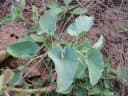
Aristolochiaceae FAMILY
Aristolochia bracteolata
Aristolochia bracteolata
Edibility
0/5
Medicinal
3/5
Safety & Hazards
The plant contains aristolochic acid and is poisonous to mammals[1].
Cultivation Details
HabitClimber
Growth—
A plant of the drier tropics and subtropics, usually growing where there is a distinct dry season. The flowers of many species in this genus form an intricate trap for pollinating insects. The insects are tempted to an area of the flower where they are unable to grip and they slide down into the utricle - downward pointing hairs prevent them climbing out[2]. The trap helps to ensure the fertilization of the flowers and the insects are eventually released[2].
Propagation
Seed - Cite as: Tropical Plants Database, Ken Fern. tropical.theferns.info. 2026-02-19. <tropical.theferns.info/viewtropical.php?id=Aristolochia+bracteolata>
Pollinators
Data unavailable
References
- [1]Revision of the genus Aristolochia (Aristolochiaceae) in Africa, Madagascar and adjacent islands — Holger De Groot, Stefan Wanke and Christoph Neinhuis · 2006 ↩︎
- [2]The New RHS Dictionary of Gardening. 1992. — Huxley. A. · MacMillan Press · 1992 · ISBN 0-333-47494-5 ↩︎Excellent and very comprehensive, though it contains a number of silly mistakes. Readable yet also very detailed.
- [3]African Flowering Plants Database — Conservatoire et Jardin Botaniques. · http://www.ville-ge.ch/musinfo/bd/cjb/africa/recherche.php ↩︎Contains information on over 150,000 plant names (including synonyms) giving a description and habitat, plus a distribution map.
- [4]Handbook of Ayurvedic Medicinal Plants — Kapoor. L. D. · CRC Press, Florida. · 2001 · ISBN 0-8493-2929-9 ↩︎A very detailed book on some of the key Ayurvedic herbs, giving both technical and non-technical information on each plant. The whole is very well referenced.
- [5]Dictionary of Economic Plants. — Uphof. J. C. Th. · Weinheim · 1959 · ISBN - ↩︎An excellent and very comprehensive guide but it only gives very short descriptions of the uses without any details of how to utilize the plants. Not for the casual reader.