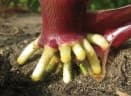
Zea mays
Zea mays
Safety & Hazards
None known
Cultivation Details
Zea mays requires a warm to hot growing season in order to produce a good crop. Different varieties have differing requirements as to how long that season is. Sweetcorn, for example, is harvested when the cobs when the seeds are still maturing and so needs a shorter growing season than a variety grown for its mature, dried seed. The period from planting to harvesting varies considerably. It may be as short as 70 days in some extra early cultivars, whilst it can be as long as 200 days in some very late cultivars[1]. Plants can be grown from the temperate zone to lowland tropical areas and can succeed at elevations up to 2,000 metres in the tropics[2]. They grow better in climates where the average rainfall is in the region of 800 - 1,200mm per annum[2]. A temperature of 20 - 24°c is best for optimum growth[2]. Heavy rainfall and temperatures in excess of 35°c adversely affect pollination and the quality of the seed[2]. Grows best in a sunny position[1]. Succeeds in a wide variety of soils, but well-drained, humus-rich, medium loams are generally preferable[2]. Requires a rich soil if it is to do well[3]. Requires a warm position a well drained soil and ample moisture in the growing season[4, 5]. Prefers a pH in the range 5.5 to 6.8[6]. Crops grown on more acid soils are likely to produce lower yields[2]. This species photosynthesizes by a more efficient method than most plants. Called the 'C4 carbon-fixation pathway', this process is particularly efficient at high temperatures, in bright sunlight and under dry conditions[1]. Climatic conditions, latitude and altitude influence growth duration. In tropical highland areas it may take 9 - 10 months to reach maturity[1]. Maize is predominantly cross-pollinating (90 - 95%), but is also self-fertile[1]. Maize has the highest yield potential among the cereal crops. The average world yield of maize is 4.4 tonnes per hectare, but grain yields over20 tonnes are possible. Average grain yields of maize in tropical Africa are about 1.25 tonnes, varying greatly from less than 1 tonne for smallholders to about 6 tonnes in commercial farms[1]. There are five main forms of corn, these have been classified as follows:- Sweetcorn is of fairly recent development. It has very sweet, soft-skinned grains that can be eaten raw or cooked before they are fully ripe. Fast-maturing cultivars have been developed that can produce a worthwhile crop even in more northerly latitudes if a suitable warm sunny sheltered site is chosen[7, PFAF]. Popping corn is a primitive form with hard-skinned grains. When roasted, these grains 'explode' to form the popular snack 'popcorn'[7]. Waxy corn is used mainly in the Far East. It has a tapioca-like starch[7]. Flint corn, which shrinks on drying, can have white, yellow, purple, red or blue-black grains[7]. It is not so sweet and also takes longer to mature so is a problematic crop in many temperate areas. There are many other uses for this plant as detailed below. Dent corn has mostly white to yellow grains. This and Flint corn are widely grown for oils, cornflour, cereals and silage crops. There are many named varieties[8].
Propagation
Seed - sow mid spring in individual pots in a greenhouse. Grow on quickly and plant out after the last expected frosts. A direct outdoor sowing, especially of some of the less sweet varieties, can be tried in May. Cite as: Temperate Plants Database, Ken Fern. temperate.theferns.info. 2026-02-21. <temperate.theferns.info/plant/Zea+mays>
Pollinators
Wind
References
- [1]Protabase - Plant Resources of Tropical Africa. — http://www.prota.org ↩︎An excellent on-line database with detailed information on over 3,200 species of useful plants of Africa.
- [2]Vegetables in the Tropics — Tindall. H. D. · MacMillan, Oxford. · 1983 · ISBN 0-333-24268-8 ↩︎An excellent, in-depth look at the main vegetable crops that can be grown in the Tropics, plus many less well-known plants.
- [3]A - Z of Companion Planting. — Allardice.P. · Cassell Publishers Ltd. · 1993 · ISBN 0-304-34324-2 ↩︎A well produced and very readable book.
- [4]New Vegetable Growers Handbook. — Simons. · Penguin · 1977 · ISBN 0-14-046-050-0 ↩︎A good guide to growing vegetables in temperate areas, not entirely organic.
- [5]Rare Vegetables for Garden and Table. — Organ. J. · Faber · 1960 · ISBN - ↩︎Unusual vegetables that can be grown outdoors in Britain. A good guide.
- [6]The New RHS Dictionary of Gardening. 1992. — Huxley. A. · MacMillan Press · 1992 · ISBN 0-333-47494-5 ↩︎Excellent and very comprehensive, though it contains a number of silly mistakes. Readable yet also very detailed.
- [7]Encyclopaedia of Herbs and their Uses. — Bown. D. · Dorling Kindersley, London. · 1995 · ISBN 0-7513-020-31 ↩︎A very well presented and informative book on herbs from around the globe. Plenty in it for both the casual reader and the serious student. Just one main quibble is the silly way of having two separate entries for each plant.
- [8]Fruits of the Earth. — Bianchini. F., Corbetta. F. and Pistoia. M. ↩︎Lovely pictures, a very readable book.
- [9]RHS Dictionary of Plants plus Supplement. 1956 — F. Chittendon. · Oxford University Press · 1951 · ISBN - ↩︎Comprehensive listing of species and how to grow them. Somewhat outdated, it has been replaced in 1992 by a new dictionary (see [ 200 ]).
- [10]Sturtevant's Edible Plants of the World. — Hedrick. U. P. · Dover Publications · 1972 · ISBN 0-486-20459-6 ↩︎Lots of entries, quite a lot of information in most entries and references.
- [11]The Oxford Book of Food Plants. — Harrison. S. Wallis. M. Masefield. G. · Oxford University Press · 1975 · ISBN - ↩︎Good drawings of some of the more common food plants from around the world. Not much information though.
- [12]Cornucopia - A Source Book of Edible Plants. — Facciola. S. · Kampong Publications · 1990 · ISBN 0-9628087-0-9 ↩︎Excellent. Contains a very wide range of conventional and unconventional food plants (including tropical) and where they can be obtained (mainly N. American nurseries but also research institutes and a lot of other nurseries from around the world.
- [13]Medicinal Plants of China — Duke. J. A. and Ayensu. E. S. · Reference Publications, Inc. · 1985 · ISBN 0-917256-20-4 ↩︎Details of over 1,200 medicinal plants of China and brief details of their uses. Often includes an analysis, or at least a list of constituents. Heavy going if you are not into the subject.
- [14]Eat the Weeds. — Harris. B. C. · Pivot Health · 1973 · ISBN - ↩︎Interesting reading.
- [15]Edible Leaves of the Tropics — Martin. F. W.; Ruberte. R. M. & Meitzner. L. S. · Echo. USA. · 1998 · ISBN 0-9653360-1-8 ↩︎A terse guide, giving reasonable detail on the more common leaf crops and brief information on a wide range of lesser known plants.
- [16]Hamlyn Encyclopaedia of Plants. — Triska. Dr. · Hamlyn · 1975 · ISBN 0-600-33545-3 ↩︎Very interesting reading, giving some details of plant uses and quite a lot of folk-lore.
- [17]Dictionary of Economic Plants. — Uphof. J. C. Th. · Weinheim · 1959 · ISBN - ↩︎An excellent and very comprehensive guide but it only gives very short descriptions of the uses without any details of how to utilize the plants. Not for the casual reader.
- [18]A Modern Herbal. — Grieve. · Penguin · 1984 · ISBN 0-14-046-440-9 ↩︎Not so modern (1930's?) but lots of information, mainly temperate plants.
- [19]Edible and Medicinal Plants. — Launert. E. · Hamlyn · 1981 · ISBN 0-600-37216-2 ↩︎Covers plants in Europe. a drawing of each plant, quite a bit of interesting information.
- [20]The Dictionary of Modern Herbalism. — Mills. S. Y. ↩︎An excellent small herbal.
- [21]Handbook of Chinese Herbs and Formulas. — Yeung. Him-Che. · Institute of Chinese Medicine, Los Angeles · 1985 · ISBN - ↩︎An excellent Chinese herbal giving information on over 500 species. Rather technical and probably best suited to the more accomplished user of herbs.
- [22]A Field Guide to Medicinal Plants. Eastern and Central N. America. — Foster. S. & Duke. J. A. · Houghton Mifflin Co. · 1990 · ISBN 0395467225 ↩︎A concise book dealing with almost 500 species. A line drawing of each plant is included plus colour photographs of about 100 species. Very good as a field guide, it only gives brief details about the plants medicinal properties.
- [23]Medicinal Plants in Vietnam — Nguyen Van Dan & Doan Thi Nhu · World Health Organisation · 1989 · ISBN 92 9061 101 4 ↩︎An excellent book, giving information on over 200 plants, their medicinal compounds and applications.
- [24]A Dictionary of Plants Used by Man. — Usher. G. · Constable · 1974 · ISBN 0094579202 ↩︎Forget the sexist title, this is one of the best books on the subject. Lists a very extensive range of useful plants from around the world with very brief details of the uses. Not for the casual reader.
- [25]Plants for Man. — Schery. R. W. ↩︎Fairly readable but not very comprehensive. Deals with plants from around the world.
- [26]The Herb Book. — Lust. J. · Bantam books · 1983 · ISBN 0-553-23827-2 ↩︎Lots of information tightly crammed into a fairly small book.
- [27]Flora of the USSR. — Komarov. V. L. · Israel Program for Scientific Translation · 1968 · http://www.biodiversitylibrary.org · ISBN - ↩︎An immense (25 or more large volumes) and not yet completed translation of the Russian flora. Full of information on plant uses and habitats but heavy going for casual readers. It can be downloaded from the Internet.
- [28]Economic Botany. — Hill. A. F. · The Maple Press · 1952 · ISBN - ↩︎Not very comprehensive, but it is quite readable and goes into some detail about the plants it does cover.
- [29]Plant Fibres for Papermaking. — Bell. L. A. · Liliaceae Press · 1988 · ISBN - ↩︎A good practical section on how to make paper on a small scale plus details of about 75 species (quite a few of them tropical) that can be used.
- [PFAF]Plants for a Future — pfaf.org ↩︎