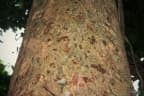
Zanha golungensis
Zanha golungensis
Safety & Hazards
The fruits can cause severe diarrhoea if eaten in large quantities[1]. The fruits, and other parts of the plant, contain saponins[1]. Although poisonous, saponins are poorly absorbed by the human body and so most pass through without harm. Saponins are quite bitter and can be found in many common foods such as some beans. They can be removed by carefully leaching in running water. Thorough cooking, and perhaps changing the cooking water once, will also normally remove most of them. However, it is not advisable to eat large quantities of food that contain saponins. Saponins are much more toxic to some creatures, such as fish, and hunting tribes have traditionally put large quantities of them in streams, lakes etc in order to stupefy or kill the fish[PFAF]. Although used medicinally, fatalities following ingestion of an infusion of the pounded root are known[2].
Cultivation Details
A dioecious species, both male and female forms need to be grown if fruit and seed are required[1].
Propagation
Seed - best sown as soon as it is ripe[1]. Cite as: Tropical Plants Database, Ken Fern. tropical.theferns.info. 2026-02-20. <tropical.theferns.info/viewtropical.php?id=Zanha+golungensis>
Pollinators
Data unavailable
References
- [1]Edible Wild Plants of Tanzania — Ruffo, C.K.: Birnie, A. & Tengnas, B. · Regional Land Management Unit; Nairobi. · 2002 · ISBN 9966-896-60-0 ↩︎A very well presented, simple guide to growing and utilizing wild food plants in Tanzania, with line drawings of each plant, a description, habitat and range, non-food as well as food uses, plus basic information on growing the plants.
- [2]Flora of Tropical East Africa — Beentje H.J. · Royal Botanic Gardens; Kew. · 2002 · http://plants.jstor.org/search?st=396814 ↩︎Available on-line, a modern flora of East Africa.
- [3]African Flowering Plants Database — Conservatoire et Jardin Botaniques. · http://www.ville-ge.ch/musinfo/bd/cjb/africa/recherche.php ↩︎Contains information on over 150,000 plant names (including synonyms) giving a description and habitat, plus a distribution map.
- [4]The Useful Plants of West Tropical Africa. — Burkil. H. M. · Royal Botanic Gardens; Kew. · 1985 - 2004 ↩︎Brief descriptions and details of the uses of over 4,000 plants. A superb, if terse, resource, it is also available electronically on the Web - see http://www.aluka.org/
- [5]West African Forests and Forestry — Unwin A.H. · T. Fisher Unwin Ltd.; London · 1920 · http://www.biodiversitylibrary.org ↩︎Quite extensive information on some of the trees of West Africa. The book can be downloaded from the Internet
- [6]Useful Plants of Nyasaland — Williamson J. · The Government Printer, Zomba, Nyasaland. · 1955 · http://www.biodiversitylibrary.org ↩︎Brief details of the uses of almost 500 species of plants.
- [7]Field Guide to the Moist Forest Trees of Tanzania. — Lovett J.C.; Ruffo C.K.; Gereau R.E.; Taplin J.R.D · Frontier · http://www.york.ac.uk/res/celp/webpages/projects/ecology/tree%20guide/introduction.htm · ISBN 1-873070-33-0 ↩︎A lovely little book giving a basic identification guide to more than 650 species of trees growing in Tanzania. It is also available to view on the internet.
- [PFAF]Plants for a Future — pfaf.org ↩︎