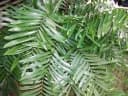
Zamia erosa
Zamia erosa
Cultivation Details
Succeeds in full sun or in light shade[4]. Requires a well drained soil[4]. Cycad species can usually be transplanted easily even when quite large. The best time for moving them is just before the beginning of a new growing season, the roots being trimmed if they are damaged and perhaps some leaves being removed. New roots should develop quickly as the season progresses[5]. Species in this genus form structures known as coralloid roots. These roots branch off from the taproot or secondary roots and are distinctive in that they grow laterally or upward, forming a nodular mass at the apex. These coralloid roots occur slightly below or slightly above the soil surface and generally contain cyanobacteria, also known as blue-green algae. These are able to fix atmospheric nitrogen and make it available as a nutrient to the plant. The ability to extract this important nutrient from the air explains how many cycad species are able to survive on almost sterile soils[5]. A dioecious species, with individual plants producing either all male or all female cones. Therefore both male and female forms of the plant need to be grown if seed is required[5]. On very rare occasions, usually when a plant has been under severe stress, it can change sex and produce either all female or all male cones[5].
Propagation
Seed - remove the fleshy coating and surface sow on damp sand. Germination is best at around 23 - 29°c[6]. Pot up young seedlings into a rich, moist medium, as soon as they are large enough to handle and grow on at high temperatures without any check to growth until 2 - 3 leaves have been produced at one time, otherwise they may enter dormancy[6]. Cite as: Tropical Plants Database, Ken Fern. tropical.theferns.info. 2026-02-20. <tropical.theferns.info/viewtropical.php?id=Zamia+erosa>
Pollinators
Insects
References
- [1]Poisonous Plants of North Carolina — http://www.ces.ncsu.edu/depts/hort/consumer/poison/poison.htm ↩︎An excellent concise but comprehensive guide to toxic plants that grow in N. Carolina. It lists even those plants that are of very low toxicity, including several well-known food plants such as carrots and potatoes.
- [2]Dictionary of Economic Plants. — Uphof. J. C. Th. · Weinheim · 1959 · ISBN - ↩︎An excellent and very comprehensive guide but it only gives very short descriptions of the uses without any details of how to utilize the plants. Not for the casual reader.
- [3]Flora of Guatemala — Standley P.C. & J. A. Steyermark · 1946 - 1976 · http://www.archive.org/ ↩︎A superb reference, though somewhat dated. Gives lots of plant uses as well as information on plant habit and habitat. The entire flora (13 volumes) can now be downloaded from http://www.archive.org/
- [4]Palm and Cycad Societies of Australia. — http://www.pacsoa.org.au/ ↩︎Contains at least a little information on the majority of palm and cycad species, plus a wealth of photographs. A first class website.
- [5]The Cycads — Whitelock L.M. · Timber Press; Portland, Oregon · 2002 · ISBN 0-88192-522-5 ↩︎An excellent book dealing with the eleven different genera and almost 300 species of plants we know as Cycads. There are detailed descriptions and a host of other information for each species.
- [6]The New RHS Dictionary of Gardening. 1992. — Huxley. A. · MacMillan Press · 1992 · ISBN 0-333-47494-5 ↩︎Excellent and very comprehensive, though it contains a number of silly mistakes. Readable yet also very detailed.
- [7]The Cycad Pages — Royal Botanic Gardens, Sydney. · 2012 · http://plantnet.rbgsyd.nsw.gov.au/PlantNet/cycad/wlist.html ↩︎A website dedicated to the various species of Cycad, with a comprehensive description of all the known species (as of 2012). At present (2015), the site is still running but is no longer being updated
- [8]IUCN Red List of Threatened Species — http://www.iucnredlist.org/ ↩︎A list of plants under threat and facing possible extinction, usually with brief details of the threats and information on habitat.
- [9]Contributions from the United States National Herbarium Vol. 8 — Government Printing Office; Washington. · 1905 · http://www.biodiversitylibrary.org ↩︎Includes an article on the economic plants of Puerto Rico. It can be downloaded from the Internet.