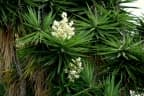
Yucca gigantea
Yucca gigantea
Safety & Hazards
None known
Cultivation Details
A plant of the drier tropics, where it is found at elevations up to 2,700 metres, it can be grown in much wetter areas if the soil is very well-drained[1]. It grows best in areas where annual daytime temperatures are within the range 18 - 32°c, but can tolerate 6 - 38°c[1]. It prefers a mean annual rainfall in the range 1,000 - 1,600mm, but tolerates 700 - 4,000mm[1]. Requires a sunny position that is sheltered from cold, drying winds[2]. Prefers a well-drained, rich, loamy soil, but is tolerant of poor sandy soils[2]. Prefers a pH in the range 5 - 6, tolerating 4.5 - 7.3[1]. The plant can be harvested for its flower buds 2 - 3 years after planting out cuttings[1]. Members of this genus seem to be immune to the predations of rabbits[3]. The flowers of most members of this genus can only be pollinated by a certain species of moth. This moth does not live outside of the plants native range and, if fruit and seed is required, hand pollination is necessary. This can be quite easily and successfully done using something like a small paint brush. The flowers open at night[4] and are powerfully fragrant at this time[5].
Propagation
Seed - pre-soaking the seed for 24 hours in warm water may reduce the germination time. Sow in containers in a lightly shaded position. The seed usually germinates within 1 - 12 months if kept at a temperature of 20°c. Prick out the seedlings into individual pots when they are large enough to handle and grow them on until large enough to plant out. Root cuttings. Lift the plant and remove small buds from the base of the stem and rhizomes. Dip in dry wood ashes to stop any bleeding and plant in a sandy soil in pots until established[6]. Cite as: Tropical Plants Database, Ken Fern. tropical.theferns.info. 2026-02-20. <tropical.theferns.info/viewtropical.php?id=Yucca+gigantea>
Pollinators
Moth
References
- [1]Ecocrop — http://ecocrop.fao.org/ecocrop/srv/en/home ↩︎Basic information on a wide range of useful plants, plus details of environmental needs where available.
- [2]The New RHS Dictionary of Gardening. 1992. — Huxley. A. · MacMillan Press · 1992 · ISBN 0-333-47494-5 ↩︎Excellent and very comprehensive, though it contains a number of silly mistakes. Readable yet also very detailed.
- [3]Perennial Garden Plants — Thomas. G. S. · J. M. Dent & Sons, London. · 1990 · ISBN 0 460 86048 8 ↩︎A concise guide to a wide range of perennials. Lots of cultivation guides, very little on plant uses.
- [4]The Complete Trees of N. America. Field Guide and Natural History. — Elias. T. · Van Nostrand Reinhold Co. · 1980 · ISBN 0442238622 ↩︎A very good concise guide. Gives habitats, good descriptions, maps showing distribution and a few of the uses. It also includes the many shrubs that occasionally reach tree proportions.
- [5]Scented Flora of the World. — Genders. R. · Robert Hale. London. · 1994 · ISBN 0-7090-5440-8 ↩︎An excellent, comprehensive book on scented plants giving a few other plant uses and brief cultivation details. There are no illustrations.
- [6]Propagation of Trees, Shrubs and Conifers. — Sheat. W. G. · MacMillan and Co · 1948 · ISBN - ↩︎A bit dated but a good book on propagation techniques with specific details for a wide range of plants.
- [7]Flora of Guatemala — Standley P.C. & J. A. Steyermark · 1946 - 1976 · http://www.archive.org/ ↩︎A superb reference, though somewhat dated. Gives lots of plant uses as well as information on plant habit and habitat. The entire flora (13 volumes) can now be downloaded from http://www.archive.org/
- [8]Dictionary of Economic Plants. — Uphof. J. C. Th. · Weinheim · 1959 · ISBN - ↩︎An excellent and very comprehensive guide but it only gives very short descriptions of the uses without any details of how to utilize the plants. Not for the casual reader.
- [9]Cornucopia II — Facciola. S. · Kampong Publications, California. · 1998 · ISBN 0-9628087-2-5 ↩︎The second edition of an excellent guide to the edible uses of plants, though it does not give any details of cultivation etc.