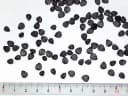
Yucca aloifolia
Yucca aloifolia
Safety & Hazards
The roots contain saponins[1]. Although poisonous, saponins also have a range of medicinal applications and many saponin-rich plants are used in herbalism (particularly as emetics, expectorants and febrifuges) or as sources of raw materials for the pharmaceutical industry. Saponins are also found in a number of common foods, such as many beans. Saponins have a quite bitter flavour and are in general poorly absorbed by the human body, so most pass through without harm. They can be removed by carefully leaching in running water. Thorough cooking, and perhaps changing the cooking water once, will also normally remove most of them. However, it is not advisable to eat large quantities of raw foods that contain saponins. Saponins are much more toxic to many cold-blooded creatures, such as fish, and hunting tribes have traditionally put large quantities of them in streams, lakes etc in order to stupefy or kill the fish and make them easy to catch[PFAF].
Cultivation Details
Yucca aloifolia is a plant of the warm temperate to tropical zones, usually found at low elevations. It tolerates occasional temperatures down to about -10°c if in a suitable site[2, 3]. Thrives in any soil but prefers a sandy loam and full exposure to the sun[2]. Plants can succeed in light shade[PFAF]. Plants are hardier when grown on poor sandy soils[3]. Established plants are very drought resistant[2]. Members of this genus seem to be immune to the predations of rabbits[4]. The flowers of most members of this genus can only be pollinated by a certain species of moth. This moth does not live outside of the plants native range and, if fruit and seed is required, hand pollination is necessary. This can be quite easily and successfully done using something like a small paint brush. This species, however, does not require the Yucca moth for pollination and will set fruit without hand pollination[2]. The flowers open at night[5] and are powerfully fragrant at this time[6]. Individual crowns are monocarpic, dying after flowering[4]. However, the crown will usually produce a number of side shoots before it dies and these will grow on to flower in later years[4]. Plants in this genus are notably resistant to honey fungus[3]. Several named forms have been developed for their ornamental value[3].
Propagation
Seed - sow spring in a greenhouse. Pre-soaking the seed for 24 hours in warm water may reduce the germination time. It usually germinates within 1 - 12 months if kept at a temperature of 20°c. Prick out the seedlings into individual pots when they are large enough to handle and grow them on in the greenhouse or cold frame for at least their first two winters. Plant them out into their permanent positions in early summer and consider giving them some winter protection for at least their first winter outdoors - a simple pane of glass is usually sufficient[PFAF]. Root cuttings in late winter or early spring. Lift in mid spring and remove small buds from base of stem and rhizomes. Dip in dry wood ashes to stop any bleeding and plant in a sandy soil in pots in a greenhouse until established[7]. Cite as: Temperate Plants Database, Ken Fern. temperate.theferns.info. 2026-02-21. <temperate.theferns.info/plant/Yucca+aloifolia>
Pollinators
Self
References
- [1]A Field Guide to Medicinal Plants. Eastern and Central N. America. — Foster. S. & Duke. J. A. · Houghton Mifflin Co. · 1990 · ISBN 0395467225 ↩︎A concise book dealing with almost 500 species. A line drawing of each plant is included plus colour photographs of about 100 species. Very good as a field guide, it only gives brief details about the plants medicinal properties.
- [2]Trees and Shrubs Hardy in Great Britain. Vol 1 - 4 and Supplement. — Bean. W. · Murray · 1981 · ISBN - ↩︎A classic with a wealth of information on the plants, but poor on pictures.
- [3]The New RHS Dictionary of Gardening. 1992. — Huxley. A. · MacMillan Press · 1992 · ISBN 0-333-47494-5 ↩︎Excellent and very comprehensive, though it contains a number of silly mistakes. Readable yet also very detailed.
- [4]Perennial Garden Plants — Thomas. G. S. · J. M. Dent & Sons, London. · 1990 · ISBN 0 460 86048 8 ↩︎A concise guide to a wide range of perennials. Lots of cultivation guides, very little on plant uses.
- [5]The Complete Trees of N. America. Field Guide and Natural History. — Elias. T. · Van Nostrand Reinhold Co. · 1980 · ISBN 0442238622 ↩︎A very good concise guide. Gives habitats, good descriptions, maps showing distribution and a few of the uses. It also includes the many shrubs that occasionally reach tree proportions.
- [6]Scented Flora of the World. — Genders. R. · Robert Hale. London. · 1994 · ISBN 0-7090-5440-8 ↩︎An excellent, comprehensive book on scented plants giving a few other plant uses and brief cultivation details. There are no illustrations.
- [7]Propagation of Trees, Shrubs and Conifers. — Sheat. W. G. · MacMillan and Co · 1948 · ISBN - ↩︎A bit dated but a good book on propagation techniques with specific details for a wide range of plants.
- [8]Flora of N. America — http://flora.huh.harvard.edu/fna/ ↩︎An on-line version of the flora with an excellent description of the plant including a brief mention of plant uses.
- [9]RHS Dictionary of Plants plus Supplement. 1956 — F. Chittendon. · Oxford University Press · 1951 · ISBN - ↩︎Comprehensive listing of species and how to grow them. Somewhat outdated, it has been replaced in 1992 by a new dictionary (see [ 200 ]).
- [10]Manual of the Trees of N. America. — Sargent. C. S. · Dover Publications Inc. New York. · 1965 · http://www.biodiversitylibrary.org/ · ISBN 0-486-20278-X ↩︎Two volumes, a comprehensive listing of N. American trees though a bit out of date now. Good details on habitats, some details on plant uses. Not really for the casual reader. It can be downloaded from the internet.
- [11]Native American Ethnobotany — Moerman. D. · Timber Press. Oregon. · 1998 · ISBN 0-88192-453-9 ↩︎Very comprehensive but terse guide to the native uses of plants. Excellent bibliography, fully referenced to each plant, giving a pathway to further information. Not for the casual reader.
- [12]Plants for Human Consumption. — Kunkel. G. · Koeltz Scientific Books · 1984 · ISBN 3874292169 ↩︎An excellent book for the dedicated. A comprehensive listing of Latin names with a brief list of edible parts.
- [13]Mansfeld's Database of Agricultural and Horticultural Plants — http://mansfeld.ipk-gatersleben.de/pls/htmldb_pgrc/f?p=185:3:4292127278597336 ↩︎Terse details of a huge range of useful plants.
- [14]Cornucopia - A Source Book of Edible Plants. — Facciola. S. · Kampong Publications · 1990 · ISBN 0-9628087-0-9 ↩︎Excellent. Contains a very wide range of conventional and unconventional food plants (including tropical) and where they can be obtained (mainly N. American nurseries but also research institutes and a lot of other nurseries from around the world.
- [15]Yucca — 2007 · http://www.naturaldatabase.com/ ↩︎A very comprehensive database of herbs, minerals and other natural products taken to promote health
- [16]Glossary of Indian Medicinal Plants (Including the Supplement). — Chopra. R. N., Nayar. S. L. and Chopra. I. C. · Council of Scientific and Industrial Research, New Delhi. · 1986 · ISBN - ↩︎Very terse details of medicinal uses of plants with a wide range of references and details of research into the plants chemistry. Not for the casual reader.
- [17]Yuccas of the Southwest — Webber J.M. · USDA · 1953 ↩︎Rather dated, but very detailed information on the various species and their uses
- [18]A Weavers Garden — Buchanan. R. · McGraw-Hill Contemporary · 1987 · ISBN 0934026289 ↩︎Covers all aspects of growing your own clothes, from fibre plants to dyes.
- [PFAF]Plants for a Future — pfaf.org ↩︎