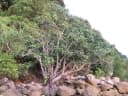
Xylocarpus rumphii
Xylocarpus rumphii
Safety & Hazards
None known
Cultivation Details
A plant of the wet, lowland tropics. It grows best in areas where annual daytime temperatures are within the range 18 - 35°c, but can tolerate 7 - 39°c[1]. It prefers a mean annual rainfall in the range 2,000 - 4,000mm, but tolerates 1,600 - 5,000mm[1]. Grows best in a sunny position[1]. Prefers a fertile, loamy to heavy soil[1]. Tolerates high levels of salt in the soil[1]. Prefers a pH in the range 6.5 - 7, tolerating 5.5 - 7.5[1]. Tolerant of salt-laden winds[PFAF]. The trees often produce basal suckers when they are damaged, and plants can sometimes develop several trunks[2]. Flowers are functionally unisexual, male flowers having a non-functional, rather slender ovary, female flowers having non-functional stamens either never dehiscent or with sterile pollen[2]. It has been observed that certain individuals, although flowering profusely, never produce fruit; this suggests that dioecism sometimes occurs[2]. The corky testa of the seed represents an adaption to dispersal by water, and seeds may start to germinate while still floating[2].
Propagation
Seed - Cite as: Tropical Plants Database, Ken Fern. tropical.theferns.info. 2026-02-20. <tropical.theferns.info/viewtropical.php?id=Xylocarpus+rumphii>
Pollinators
Data unavailable
References
- [1]Ecocrop — http://ecocrop.fao.org/ecocrop/srv/en/home ↩︎Basic information on a wide range of useful plants, plus details of environmental needs where available.
- [2]Plant Resources of Southeast Asia — http://proseanet.org/ ↩︎Lots of information on the uses of the plants of SE Asia.
- [3]Flora of China — Missouri Botanical Garden Press; St. Louis. · 1994 · http://flora.huh.harvard.edu/china/ ↩︎An excellent, comprehensive resource in 25 volumes. In addition to the botanical information the flora also gives basic information on habitat and some uses. An on-line version is also available.
- [4]Flora Malesiana Series 1 — Various · Nationaal Herbarium Nederiand, Universiteit Leiden branch · http://www.archive.org ↩︎A massive treatment of the plants of the Malaysian Archipelago. Much of it has been made available to download from the Internet
- [5]Medicinal Plants in Papua New Guinea — World Health Organisation · 2009 · ISBN 978-92-9061-249-0 ↩︎Traditional medicinal uses of 126 species from Papua New Guinea, including information on modern research into the plants.
- [6]Dictionary of Economic Plants. — Uphof. J. C. Th. · Weinheim · 1959 · ISBN - ↩︎An excellent and very comprehensive guide but it only gives very short descriptions of the uses without any details of how to utilize the plants. Not for the casual reader.
- [PFAF]Plants for a Future — pfaf.org ↩︎