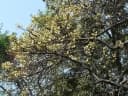
Xylia xylocarpa
Xylia xylocarpa
Safety & Hazards
None known
Cultivation Details
A plant of the moist to wet lowland tropics, occasionally to elevations of 850 metres[1]. It is found in areas where annual daytime annual rainfall is within the range 16 - 35°c, though it can tolerate 8 - 35°c[2]. It prefers a mean annual rainfall of 1,700 - 4,500mm, but tolerates 1,300 - 5,000mm, succeeding in areas with no dry season as well as those with a clearly defined dry season[2]. Prefers a dry season of 3 - 5 months[3]. Prefers a sunny position, but also succeeds in light shade[1, 3]. Prefers a deep, well-drained sandy soil, but can succeed in a range of conditions[3]. Prefers a pH in the range 5 - 6, tolerating 4.5 - 6.5[2]. The growth rate of young trees is reportedly fairly high: In India trees were on average 5.7 metres tall and 8cm in diameter after 5 years; in Bangladesh 16 metres tall and 19cm after 10 years. A 23-year-old tree growing in the Arboretum of the Forest Research Institute Malaysia achieved 26 metres height and 30cm in diameter[3]. Trees can be coppiced[3]. The plant is fire resistant[2]. It regenerates well after fires[3]. The tree has a well-developed, deep tap-root[3]. This species has a symbiotic relationship with certain soil bacteria, these bacteria form nodules on the roots and fix atmospheric nitrogen. Some of this nitrogen is utilized by the growing plant but some can also be used by other plants growing nearby[4].
Propagation
Seed - it can be stored at ambient temperatures for more than three years if kept dry[1, 3]. Fresh seeds do not need pre-treatment[1]. Stored seeds should be pre-soaked prior to sowing - immerse the seed in almost boiling water for a few minutes (being careful not to cook the seed!) and then soak it in warm water for 12 - 24 hours, by which time it should have imbibed water and swollen up[PFAF]. Seed viability is high and germination occurs readily when sown under shade and with adequate watering[3]. A germination rate of 70% - 90% can be expected, with the seeds sprouting within 3 - 4 days[3]. Direct seeding is recommended, as seedlings do not stand the shock of transplanting well, probably because the tap root develops rapidly and attains 30cm length in 1 - 2 months[3]. Cite as: Tropical Plants Database, Ken Fern. tropical.theferns.info. 2026-02-20. <tropical.theferns.info/viewtropical.php?id=Xylia+xylocarpa>
Pollinators
Data unavailable
References
- [1]Seed Leaflets — Various · Forest & Landscape. Denmark · http://en.sl.life.ku.dk/Publikationer/Udgivelser/PopulaerPublikationer.aspx?katid={D28373CC-6EF3-4EF8-B097-6D83FABF209E}&serieid={9F1C3DB1-6E7B-4CF1-AF53-F480B0CB40EF}&sort=title ↩︎A series of leaflets, jointly produced by the University of Copenhagen and the Royal Botanic Gardens at Kew, focussing on seed information for a number species, but also giving a lot of other information about each plant.
- [2]Ecocrop — http://ecocrop.fao.org/ecocrop/srv/en/home ↩︎Basic information on a wide range of useful plants, plus details of environmental needs where available.
- [3]Digital Compendium of Forestry Species of Cambodia — www.digitalspecies.blogspot.com; Phnom Penh · 2008 · http://www.digitalspecies.blogspot.com ↩︎A very detailed booklet, produced in PDF format on the internet, giving information on around 100 species of trees.
- [4]The New RHS Dictionary of Gardening. 1992. — Huxley. A. · MacMillan Press · 1992 · ISBN 0-333-47494-5 ↩︎Excellent and very comprehensive, though it contains a number of silly mistakes. Readable yet also very detailed.
- [5]Mansfeld's Database of Agricultural and Horticultural Plants — http://mansfeld.ipk-gatersleben.de/pls/htmldb_pgrc/f?p=185:3:4292127278597336 ↩︎Terse details of a huge range of useful plants.
- [6]Strategies for the Sustaibable Use and Management of Timber Trees - SE Asia. — UNEP; Cambridge, UK. · 2007 · http://www.unep-wcmc.org/forest/timber/workshops/pdf/SEAsia_2007_V2.pdf ↩︎A draft document in PDF format, available on the Internet. It gives brief details on habitat, uses etc of over 100 species of trees from SE Aia.
- [7]Ethnobotanical Exploration of Malkangiri District of Orissa, India — Prusti A.B. & Behera K.K. · 2007 · http://opensiuc.lib.siu.edu/ebl ↩︎
- [8]Glossary of Indian Medicinal Plants (Including the Supplement). — Chopra. R. N., Nayar. S. L. and Chopra. I. C. · Council of Scientific and Industrial Research, New Delhi. · 1986 · ISBN - ↩︎Very terse details of medicinal uses of plants with a wide range of references and details of research into the plants chemistry. Not for the casual reader.
- [9]Economic Products of India. Volume 1. — Watt. G. · Government of India: Calcutta. · 1883 ↩︎Although over 100 years old, it still contains a wealth of information on useful plants. Many of the botanical names have been changed since then, so you have to check for up to date names. The book can be downloaded from the Internet.
- [PFAF]Plants for a Future — pfaf.org ↩︎