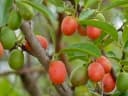
Ximenia caffra
Ximenia caffra
Safety & Hazards
None known
Cultivation Details
A plant of drier areas in the tropics and subtropics where it can be found at elevations up to 2,000 metres. It grows in areas where the mean annual temperature is within the range 14 - 30°c and can tolerate light to moderate frosts. It prefers a mean annual rainfall within the range 250 - 1,270mm[1, 2]. Requires a sunny position[2]. It succeeds on clay loams, clays, compacted loamy sand, sandy clay loams, and friable clays with laterite horizon[1]. Established plants are drought tolerant[2]. Young plants have a moderate rate of growth, increasing in height by up to 50cm a year[2]. Plants in the wild often reproduce profusely from seed[1]. Plants respond well to coppicing and also produce suckers[3]. This plant is partly parasitic, and will grow better once in the ground where it can make contact with other plant roots[2]. The root system is non-aggressive[2].
Propagation
Seed - sow in a semi-shaded position in a nursery seedbed or in a container. It generally germinates easily within 14 - 30 days. Prick the seedlings out into individual containers when the first two true leaves have appeared[2]. Cite as: Tropical Plants Database, Ken Fern. tropical.theferns.info. 2026-02-20. <tropical.theferns.info/viewtropical.php?id=Ximenia+caffra>
Pollinators
Data unavailable
References
- [1]World Agroforesty Centre — http://www.worldagroforestry.org/ ↩︎An excellent online database of a huge range of trees giving very good information on each plant - its uses, ecology, identity, propagation, pests etc.
- [2]Frutipedia - Encyclopedia of Edible Fruits of the World — Parmar Dr. C. · http://fruitipedia.com/index.htm ↩︎An online publication, listing over 400 species of fruits, usually with photos and some information on the plant.
- [3]Indigenous multipurpose trees of Tanzania. — Hines. D.A. & Eckman. K. · 1993 · ISBN 0-9697075-0-9 ↩︎A simple handbook with information on over 50 species of trees found in Tanzania giving details of environmental requirements, cultivation needs, uses etc. It can be downloaded from the Internet.
- [4]African Flowering Plants Database — Conservatoire et Jardin Botaniques. · http://www.ville-ge.ch/musinfo/bd/cjb/africa/recherche.php ↩︎Contains information on over 150,000 plant names (including synonyms) giving a description and habitat, plus a distribution map.
- [5]Edible Wild Plants of Tanzania — Ruffo, C.K.: Birnie, A. & Tengnas, B. · Regional Land Management Unit; Nairobi. · 2002 · ISBN 9966-896-60-0 ↩︎A very well presented, simple guide to growing and utilizing wild food plants in Tanzania, with line drawings of each plant, a description, habitat and range, non-food as well as food uses, plus basic information on growing the plants.
- [6]PlantZAfrica.com — http://www.plantzafrica.com ↩︎An excellent site giving detailed descriptions and uses of many S. African plants.
- [PFAF]Plants for a Future — pfaf.org ↩︎