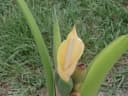
Xanthosoma sagittifolium
Xanthosoma sagittifolium
Safety & Hazards
All parts of the plant contain calcium oxalate crystals. This substance is toxic fresh and, if eaten, makes the mouth, tongue and throat feel as if hundreds of small needles are digging in to them. However, calcium oxalate is easily broken down either by thoroughly cooking the plant or by fully drying it and, in either of these states, it is safe to eat the plant. People with a tendency to rheumatism, arthritis, gout, kidney stones and hyperacidity should take especial caution if including this plant in their diet[1].
Cultivation Details
Tania is often grown where the soil moisture content is too low for the successful cultivation of Colocasia, but production is most successful in areas of high air humidity[2]. The crop is often restricted to lowland areas where climatic conditions favour rapid growth, it grows best at elevations below 800 metres, though successful crops have been produced at elevations up to 1,900 metres[3, 2]. It grows best in areas with a mean annual rainfall in the range 1,000 - 2,000mm, but tolerates 750 - 6,000mm[2]. It prefers a mean annual temperature within the range 20 - 28°c, but can tolerate 10 - 35°c[2]. Grows best in a fertile soil rich in organic matter[3]. Dislikes heavy clay soils[3]. Tolerant of some shade, though it grows best in full sun[3]. Prefers a pH in the range 5.5 - 7, tolerating 4.5 - 7.8[2]. It can take 240 - 420 days to produce its first crop[3]. Optimum yields of corms are 25 - 37 tonnes per hectare, though the average is about 6 - 12 tonnes[2]. Like many species in the family Araceae, this plant has the ability to heat the flowering spadix as the pollen becomes ready for fertilization. This heat greatly increases the strength of the aroma released by the plant, thus attracting more pollinating insects. It can also have the effect of making the insects more active, thus increasing the level of fertilization[4].
Propagation
Seed - rarely produced in cultivation[3]. Division of the smaller corms that are produced on the side of the main corm[3]. Cite as: Tropical Plants Database, Ken Fern. tropical.theferns.info. 2026-02-20. <tropical.theferns.info/viewtropical.php?id=Xanthosoma+sagittifolium>
Pollinators
Data unavailable
References
- [1]Encyclopaedia of Herbs and their Uses. — Bown. D. · Dorling Kindersley, London. · 1995 · ISBN 0-7513-020-31 ↩︎A very well presented and informative book on herbs from around the globe. Plenty in it for both the casual reader and the serious student. Just one main quibble is the silly way of having two separate entries for each plant.
- [2]Ecocrop — http://ecocrop.fao.org/ecocrop/srv/en/home ↩︎Basic information on a wide range of useful plants, plus details of environmental needs where available.
- [3]Vegetables in the Tropics — Tindall. H. D. · MacMillan, Oxford. · 1983 · ISBN 0-333-24268-8 ↩︎An excellent, in-depth look at the main vegetable crops that can be grown in the Tropics, plus many less well-known plants.
- [4]Aroids: Plants of the Arum Family. — Bown D. · Timber Press; Portland, Oregon. · 2000 · ISBN 0-88192-485-7 ↩︎An excellent treatment of the family Araceae, giving lots of information about the plants, how to grow them, their uses etc. I found it a bit disordered - if you want all the information on a specific species you have to trawl through the whole book.
- [5]The New RHS Dictionary of Gardening. 1992. — Huxley. A. · MacMillan Press · 1992 · ISBN 0-333-47494-5 ↩︎Excellent and very comprehensive, though it contains a number of silly mistakes. Readable yet also very detailed.
- [6]Dictionary of Economic Plants. — Uphof. J. C. Th. · Weinheim · 1959 · ISBN - ↩︎An excellent and very comprehensive guide but it only gives very short descriptions of the uses without any details of how to utilize the plants. Not for the casual reader.
- [7]Cornucopia II — Facciola. S. · Kampong Publications, California. · 1998 · ISBN 0-9628087-2-5 ↩︎The second edition of an excellent guide to the edible uses of plants, though it does not give any details of cultivation etc.
- [PFAF]Plants for a Future — pfaf.org ↩︎