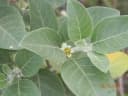
Withania somnifera
Withania somnifera
Safety & Hazards
The plant is toxic if eaten[1]. Although providing many well-known foods for people, including the potato, tomato, pepper and aubergine, most plants in the family Solanaceae also contain poisonous alkaloids. Unless there are specific entries with information on edible uses, it would be unwise to ingest any part of this plant[PFAF].
Cultivation Details
A plant of drier areas in the tropics and subtropics, where it is found at elevations up to 1,800 metres[2]. It grows best in areas where the mean annual temperature falls within the range 18 - 32°c, but can tolerate 12 - 40°c[2]. It is not tolerant of frost[2]. It prefers a mean annual rainfall in the range 650 - 750mm, tolerating 300 - 800mm[2]. This species is not hardy in temperate climates but it can be grown as an annual, flowering and fruiting in its first year from seed[3]. Succeeds in full sun and in light shade[2]. A fairly easily grown plant, it requires a warm sheltered position and a well-drained moderately fertile, sandy to loamy soil[3, 2, PFAF]. Prefers a dry stony soil[1]. It prefers a pH in the range 7.5 - 8, but tolerates 6.5 - 8.5[2]. The plant is often cultivated as an annual in India[4]. A good crop in India yields 650 - 800 kilos of fresh root per hectare (350 - 450 kilos of dry roots), but the average is 300 - 500 kilos. The average yield of seed is 50 - 75 kilos[4]. Plants can flower all year round[4]. Several improved cultivars have been released in India, including 'Rakshita', 'Poshita', 'WS-20' and 'WS-22'[4]. The plant has a smell akin to that of a sweaty horse[2].
Propagation
Seed - sow early spring in a greenhouse. There is usually a high germination rate within 2 weeks. Prick out the seedlings into individual pots once they are large enough to handle and plant them out after the last expected frost. Consider giving the plants some protection, such as a cloche, until they are established and growing away well. Cite as: Temperate Plants Database, Ken Fern. temperate.theferns.info. 2026-02-21. <temperate.theferns.info/plant/Withania+somnifera>
Pollinators
Self, Bees
References
- [1]Encyclopaedia of Herbs and their Uses. — Bown. D. · Dorling Kindersley, London. · 1995 · ISBN 0-7513-020-31 ↩︎A very well presented and informative book on herbs from around the globe. Plenty in it for both the casual reader and the serious student. Just one main quibble is the silly way of having two separate entries for each plant.
- [2]Ecocrop — http://ecocrop.fao.org/ecocrop/srv/en/home ↩︎Basic information on a wide range of useful plants, plus details of environmental needs where available.
- [3]A Weavers Garden — Buchanan. R. · McGraw-Hill Contemporary · 1987 · ISBN 0934026289 ↩︎Covers all aspects of growing your own clothes, from fibre plants to dyes.
- [4]Protabase - Plant Resources of Tropical Africa. — http://www.prota.org ↩︎An excellent on-line database with detailed information on over 3,200 species of useful plants of Africa.
- [5]Cornucopia - A Source Book of Edible Plants. — Facciola. S. · Kampong Publications · 1990 · ISBN 0-9628087-0-9 ↩︎Excellent. Contains a very wide range of conventional and unconventional food plants (including tropical) and where they can be obtained (mainly N. American nurseries but also research institutes and a lot of other nurseries from around the world.
- [6]Glossary of Indian Medicinal Plants (Including the Supplement). — Chopra. R. N., Nayar. S. L. and Chopra. I. C. · Council of Scientific and Industrial Research, New Delhi. · 1986 · ISBN - ↩︎Very terse details of medicinal uses of plants with a wide range of references and details of research into the plants chemistry. Not for the casual reader.
- [7]The Encyclopedia of Medicinal Plants — Chevallier. A. · Dorling Kindersley. London · 1996 · ISBN 9-780751-303148 ↩︎An excellent guide to over 500 of the more well known medicinal herbs from around the world.
- [8]Narcotic Plants — Emboden. W. · Studio Vista · 1979 · ISBN 0-289-70864-8 ↩︎A lot of details about the history, chemistry and use of narcotic plants, including hallucinogens, stimulants, inebriants and hypnotics.
- [9]Gemsbok Bean and Kalahari Truffle — Leffers A. · Gamsberg MacMillan; Namibia. · 2003 · ISBN 99916-0-491-X ↩︎Details of the traditional uses of over 200 species of plants in northeastern Namibia. Written for the non-expert, there is usually at least one photograph with each plant entry.
- [PFAF]Plants for a Future — pfaf.org ↩︎