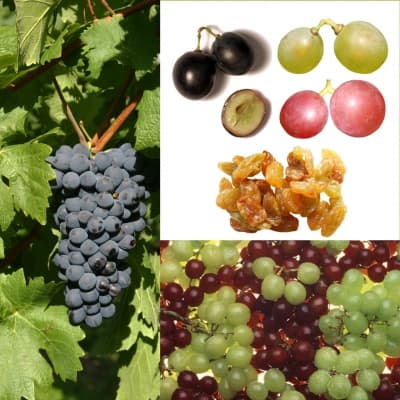
Vitis vinifera
Vitis vinifera
Safety & Hazards
None known
Cultivation Details
Grapes are natives of temperate to subtropical areas, but cultivars have been developed that can be grown at higher elevations in the tropics, generally between 300 - 2,000 metres[1]. The plant grows best in areas where annual daytime temperatures are within the range 18 - 30°c, but can tolerate 10 - 38°c[1]. When dormant, the plant can survive temperatures down to about -20°c, but young growth can be severely damaged at -3°c[1]. The plant grows most satisfactorily when the winter is sufficiently cold to ensure a period of complete dormancy each year[1]. It prefers a mean annual rainfall in the range 700 - 850mm, but tolerates 400 - 1,200mm[1]. Succeeds in sun or partial shade though a warm sunny sheltered position is required for the fruit to ripen[2]. Prefers a deep rich moist well-drained moderately fertile loam[3, 2]. Grows best in a calcareous soil, but dislikes excessively chalky soils[2]. Prefers a pH in the range 5.5 - 7.5, tolerating 4.5 - 8.5[1]. Reported yields of fruit range from 10 - 90 tonnes per hectare[1]. Grapes are very susceptible to attacks by phylloxera, this disease is especially prevalent in some areas of Europe and it almost destroyed the grape industry. However, American species of grapes that are resistant to phylloxera are now used as rootstocks and this allows grapes to be grown in areas where the disease is common. Plants in this genus are notably susceptible to honey fungus[2]. The flowers are intensely fragrant[4]. Any pruning should be carried out when the plants are dormant otherwise they bleed profusely[5]. The cultivated grape is thought to have been derived from V. Vinifera sylvestris. (Gmel.)Hegi. This form has dioecious flowers and produces small black grapes.
Propagation
Seed - best sown in a cold frame as soon as it is ripe[PFAF]. Six weeks cold stratification improves the germination rate, and so stored seed is best sown in a cold frame as soon as it is obtained. Germination should take place in the first spring, but sometimes takes another 12 months. Prick out the seedlings into individual pots when they are large enough to handle and grow them on in a cold frame for their first winter. Plant out in early summer. Cuttings of mature wood of the current seasons growth, December/January in a frame. These cuttings can be of wood 15 - 30cm long or they can be of short sections of the stem about 5cm long with just one bud at the top of the section. In this case a thin, narrow strip of the bark about 3cm long is removed from the bottom half of the side of the stem. This will encourage callusing and the formation of roots. Due to the size of these cuttings they need to be kept in a more protected environment than the longer cuttings. Layering. Cite as: Temperate Plants Database, Ken Fern. temperate.theferns.info. 2026-02-21. <temperate.theferns.info/plant/Vitis+vinifera>
Pollinators
Insects
References
- [1]Ecocrop — http://ecocrop.fao.org/ecocrop/srv/en/home ↩︎Basic information on a wide range of useful plants, plus details of environmental needs where available.
- [2]The New RHS Dictionary of Gardening. 1992. — Huxley. A. · MacMillan Press · 1992 · ISBN 0-333-47494-5 ↩︎Excellent and very comprehensive, though it contains a number of silly mistakes. Readable yet also very detailed.
- [3]RHS Dictionary of Plants plus Supplement. 1956 — F. Chittendon. · Oxford University Press · 1951 · ISBN - ↩︎Comprehensive listing of species and how to grow them. Somewhat outdated, it has been replaced in 1992 by a new dictionary (see [ 200 ]).
- [4]Scented Flora of the World. — Genders. R. · Robert Hale. London. · 1994 · ISBN 0-7090-5440-8 ↩︎An excellent, comprehensive book on scented plants giving a few other plant uses and brief cultivation details. There are no illustrations.
- [5]Ornamental Shrubs, Climbers and Bamboos. — Thomas. G. S. · Murray · 1992 · ISBN 0-7195-5043-2 ↩︎Contains a wide range of plants with a brief description, mainly of their ornamental value but also usually of cultivation details and varieties.
- [6]Flora of the British Isles. — Clapham, Tutin and Warburg. · Cambridge University Press · 1962 · ISBN - ↩︎A very comprehensive flora, the standard reference book but it has no pictures.
- [7]Sturtevant's Edible Plants of the World. — Hedrick. U. P. · Dover Publications · 1972 · ISBN 0-486-20459-6 ↩︎Lots of entries, quite a lot of information in most entries and references.
- [8]Trees and Shrubs Hardy in Great Britain. Vol 1 - 4 and Supplement. — Bean. W. · Murray · 1981 · ISBN - ↩︎A classic with a wealth of information on the plants, but poor on pictures.
- [9]Dictionary of Economic Plants. — Uphof. J. C. Th. · Weinheim · 1959 · ISBN - ↩︎An excellent and very comprehensive guide but it only gives very short descriptions of the uses without any details of how to utilize the plants. Not for the casual reader.
- [10]Cornucopia - A Source Book of Edible Plants. — Facciola. S. · Kampong Publications · 1990 · ISBN 0-9628087-0-9 ↩︎Excellent. Contains a very wide range of conventional and unconventional food plants (including tropical) and where they can be obtained (mainly N. American nurseries but also research institutes and a lot of other nurseries from around the world.
- [11]Eat the Weeds. — Harris. B. C. · Pivot Health · 1973 · ISBN - ↩︎Interesting reading.
- [12]Edible Native Plants of the Rocky Mountains. — Harrington. H. D. · University of New Mexico Press · 1967 · ISBN 0-8623-0343-9 ↩︎A superb book. Very readable, it gives the results of the authors experiments with native edible plants.
- [13]Encyclopaedia of Medicinal Plants. — Chiej. R. · MacDonald · 1984 · ISBN 0-356-10541-5 ↩︎Covers plants growing in Europe. Also gives other interesting information on the plants. Good photographs.
- [14]Encyclopaedia of Herbs and their Uses. — Bown. D. · Dorling Kindersley, London. · 1995 · ISBN 0-7513-020-31 ↩︎A very well presented and informative book on herbs from around the globe. Plenty in it for both the casual reader and the serious student. Just one main quibble is the silly way of having two separate entries for each plant.
- [15]The Encyclopedia of Medicinal Plants — Chevallier. A. · Dorling Kindersley. London · 1996 · ISBN 9-780751-303148 ↩︎An excellent guide to over 500 of the more well known medicinal herbs from around the world.
- [16]A Modern Herbal. — Grieve. · Penguin · 1984 · ISBN 0-14-046-440-9 ↩︎Not so modern (1930's?) but lots of information, mainly temperate plants.
- [17]Medicinal Plants of China — Duke. J. A. and Ayensu. E. S. · Reference Publications, Inc. · 1985 · ISBN 0-917256-20-4 ↩︎Details of over 1,200 medicinal plants of China and brief details of their uses. Often includes an analysis, or at least a list of constituents. Heavy going if you are not into the subject.
- [18]Glossary of Indian Medicinal Plants (Including the Supplement). — Chopra. R. N., Nayar. S. L. and Chopra. I. C. · Council of Scientific and Industrial Research, New Delhi. · 1986 · ISBN - ↩︎Very terse details of medicinal uses of plants with a wide range of references and details of research into the plants chemistry. Not for the casual reader.
- [19]Handbook of the Bach Flower Remedies — Chancellor. P. M. · C. W. Daniel Co. Ltd. · 1985 · ISBN 85207 002 0 ↩︎Details the 38 remedies plus how and where to prescribe them.
- [20]Nature's Colors - Dyes from Plants. — Grae. I. · MacMillan Publishing Co. New York. · 1974 · ISBN 0-02-544950-8 ↩︎A very good and readable book on dyeing.
- [21]A Dictionary of Plants Used by Man. — Usher. G. · Constable · 1974 · ISBN 0094579202 ↩︎Forget the sexist title, this is one of the best books on the subject. Lists a very extensive range of useful plants from around the world with very brief details of the uses. Not for the casual reader.
- [PFAF]Plants for a Future — pfaf.org ↩︎