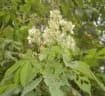
Vitex pinnata
Vitex pinnata
Safety & Hazards
None known
Cultivation Details
Vitex pinnata is common in comparatively dry regions in lowland forest, where it can be found at elevations up to 1,000 metres. It is found in areas where the mean annual rainfall is within the range 590 - 1,500mm, and the mean annual temperature 20 - 32°c[1]. Young trees grow moderately slowly, with a mean annual diameter increment of 0.6 cm and slightly over 1 cm in Myanmar and Java respectively. One year-old seedlings may reach 2 metres in height, mean annual height increment for the first 15 years after planting is about 1 metre[1]. Planted trees start to flower after 11 - 12 years in Java[1]. Planting should be done early in the rainy season. Generally at m x 3 metres , occasionally at 1 x 1 - 2 metres on very fertile soils[1]. For charcoal production, stands planted at densities of 2,500 trees/ha have yielded 16 - 18 tonnes of charcoal in 4 years[1]. Moderately fire resistant[1].
Propagation
Seed - pre-soaking the seeds for 15 seconds in hot water stimulates and increases germination[1]. Seeds start to germinate 10 - 40 days after sowing with a germination rate of 60 - 80%[1]. Seed can be stored for 1 year after depulping[1]. Under dense forest canopy germination is completely inhibited, but the seeds remain dormant and viable for more than 6 months. Seed under light shade differentiates into 2 fractions: one with seeds germinating within 2 months, the other with seeds remaining dormant and only germinating when exposed to full sunlight[1]. Cite as: Tropical Plants Database, Ken Fern. tropical.theferns.info. 2026-02-20. <tropical.theferns.info/viewtropical.php?id=Vitex+pinnata>
Pollinators
Insects
References
- [1]World Agroforesty Centre — http://www.worldagroforestry.org/ ↩︎An excellent online database of a huge range of trees giving very good information on each plant - its uses, ecology, identity, propagation, pests etc.
- [2]IUCN Red List of Threatened Species — http://www.iucnredlist.org/ ↩︎A list of plants under threat and facing possible extinction, usually with brief details of the threats and information on habitat.
- [3]Dictionary of Economic Plants. — Uphof. J. C. Th. · Weinheim · 1959 · ISBN - ↩︎An excellent and very comprehensive guide but it only gives very short descriptions of the uses without any details of how to utilize the plants. Not for the casual reader.
- [4]The Silviculture of Indian Trees — Troup. R.S. · Oxford, at the Clarendon Press · 1921 · http://www.biodiversitylibrary.org ↩︎An excellent treatment.