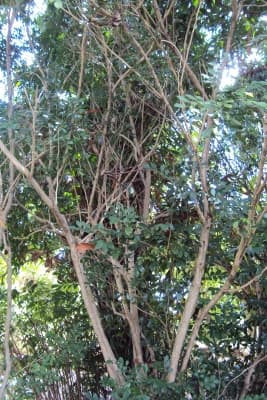
Vitex doniana
Vitex doniana
Safety & Hazards
The sawdust from the wood has been known to cause dermatitis[1].
Cultivation Details
Black plum is a plant of hot, tropical climates where it is found at elevations from near sea level to 1,850 metres[2]. It grows best in areas where annual daytime temperatures are within the range 14 - 28°c, but can tolerate 10 - 36°c[3]. It prefers a mean annual rainfall in the range 750 - 2,000mm, but tolerates 600 - 2,500mm[3]. Grows best in a sunny position[3]. Occurs on a variety of well-drained soils of varying origins, usually alluvial soils[2]. Prefers a pH in the range 5.5 - 7, tolerating 5 - 7.5[3]. The growth rate is moderate. In plantations in northern Cote d'Ivoire, seedlings were on average 70 - 90cm tall after 3 years, the tallest ones reaching 170cm[1]. On good soils in southern Burkina Faso early growth is a bit faster[1]. Trees respond well to coppicing and also produce root suckers[2, 4]. The fruit falls from the trees when it is ripe. It is not damaged by this fall so people generally harvest from under the tree rather than picking it from the tree[4]. The flowers are extremely attractive to bees[4]. This species has a symbiotic relationship with certain soil bacteria, these bacteria form nodules on the roots and fix atmospheric nitrogen. Some of this nitrogen is utilized by the growing plant but some can also be used by other plants growing nearby[5].
Propagation
Seed - The seed has a hard coat, which slows down germination. Any pre-treatment would be to soften or abrade this seed coat and allow the ingress of water[2]. This can either be done by soaking the seed in hot water that is allowed to cool - if the seed has not shown signs of swelling within 12 - 24 hours then remove from the water and abrade the seedcoat, being careful not to damage the seed below[PFAF]. It is thought forest fires help in inducing germination because they help break the hard seedcoat[2]. The treated seed is said to germinate easily - it can be raised in a nursery and transplanted, or can be sown in situ[4]. Root suckers[4]. Cuttings[4]. Cite as: Tropical Plants Database, Ken Fern. tropical.theferns.info. 2026-02-20. <tropical.theferns.info/viewtropical.php?id=Vitex+doniana>
Pollinators
Bees, Sunbirds
References
- [1]Protabase - Plant Resources of Tropical Africa. — http://www.prota.org ↩︎An excellent on-line database with detailed information on over 3,200 species of useful plants of Africa.
- [2]World Agroforesty Centre — http://www.worldagroforestry.org/ ↩︎An excellent online database of a huge range of trees giving very good information on each plant - its uses, ecology, identity, propagation, pests etc.
- [3]Ecocrop — http://ecocrop.fao.org/ecocrop/srv/en/home ↩︎Basic information on a wide range of useful plants, plus details of environmental needs where available.
- [4]Lost Crops of Africa. Vol. 3 Fruits. — National Academy Press · 2008 · ISBN 030910596X ↩︎Masses of information on about 70 species of plants that have been utilized as fruits in Africa.
- [5]The New RHS Dictionary of Gardening. 1992. — Huxley. A. · MacMillan Press · 1992 · ISBN 0-333-47494-5 ↩︎Excellent and very comprehensive, though it contains a number of silly mistakes. Readable yet also very detailed.
- [6]The Useful Plants of West Tropical Africa. — Burkil. H. M. · Royal Botanic Gardens; Kew. · 1985 - 2004 ↩︎Brief descriptions and details of the uses of over 4,000 plants. A superb, if terse, resource, it is also available electronically on the Web - see http://www.aluka.org/
- [7]Perennial Edible Fruits of the Tropics : an Inventory — Martin, F. W.; Campbell, C. W.; Rubertbe, R. M. · U.S. Dept. of Agriculture, Agricultural Research Service · 1987 ↩︎A booklet giving terse details of almost 300 species of edible fruits, plus regional lists of Botanical and Common names for over 2,500 less well-known edible fruits of the tropics.
- [8]Mansfeld's Database of Agricultural and Horticultural Plants — http://mansfeld.ipk-gatersleben.de/pls/htmldb_pgrc/f?p=185:3:4292127278597336 ↩︎Terse details of a huge range of useful plants.
- [9]IUCN Red List of Threatened Species — http://www.iucnredlist.org/ ↩︎A list of plants under threat and facing possible extinction, usually with brief details of the threats and information on habitat.
- [10]Cornucopia II — Facciola. S. · Kampong Publications, California. · 1998 · ISBN 0-9628087-2-5 ↩︎The second edition of an excellent guide to the edible uses of plants, though it does not give any details of cultivation etc.
- [PFAF]Plants for a Future — pfaf.org ↩︎