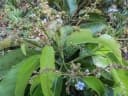
Vitex cofassus
Vitex cofassus
Safety & Hazards
None known
Cultivation Details
Vitex cofassus is a plant mainly of the lowland moist tropics, though it can also be found at elevations up to 2,000 metres[1]. It grows best in areas where the mean annual temperature is 22 - 28°c, the mean annual rainfall is in the range 1,500 - 3,500mm, and there are distinct wet and dry seasons[2, 1]. Requires a sunny position[1]. Grows well on dry limestone soils with clay to sandy soil textures[1]. Young trees grow moderately slowly[2]. Trees can commence flowering and setting seed when around 5 years old[2, 1].
Propagation
Seed - best stored dry in airtight containers, when it should remain viable for at least a year[1]. Untreated, fresh seed usually has a germination rate of around 30%, this can be increased to around 70% if the seed is first soaked for 10 minutes in hot water at 70°c and then allowed to soak for 24 hours in warm water before sowing[1]. Sow the seeds in a nursery seedbed, covering with about 1cm of soil[1]. Germination usually takes 10 - 40 days. When the seedlings are large enough to handle, pot them up into individual containers and they should be ready to plant out 3 - 4 months later[1]. Cite as: Tropical Plants Database, Ken Fern. tropical.theferns.info. 2026-02-20. <tropical.theferns.info/viewtropical.php?id=Vitex+cofassus>
Pollinators
Insects, ?Bees
References
- [1]Seed Leaflets — Various · Forest & Landscape. Denmark · http://en.sl.life.ku.dk/Publikationer/Udgivelser/PopulaerPublikationer.aspx?katid={D28373CC-6EF3-4EF8-B097-6D83FABF209E}&serieid={9F1C3DB1-6E7B-4CF1-AF53-F480B0CB40EF}&sort=title ↩︎A series of leaflets, jointly produced by the University of Copenhagen and the Royal Botanic Gardens at Kew, focussing on seed information for a number species, but also giving a lot of other information about each plant.
- [2]World Agroforesty Centre — http://www.worldagroforestry.org/ ↩︎An excellent online database of a huge range of trees giving very good information on each plant - its uses, ecology, identity, propagation, pests etc.
- [3]Guide to the Trees of Papua New Guinea — Conn. B.J. & Damas. K.Q. · http://www.pngplants.org/PNGtrees/ ↩︎An Internet site giving good descriptions of the trees of Papua New Guinea.
- [4]IUCN Red List of Threatened Species — http://www.iucnredlist.org/ ↩︎A list of plants under threat and facing possible extinction, usually with brief details of the threats and information on habitat.