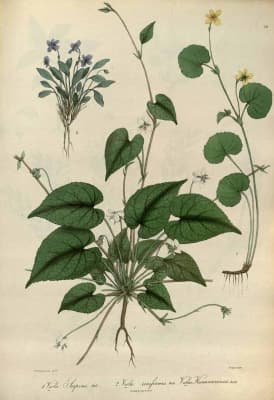
Viola pilosa
Viola pilosa
Cultivation Details
Viola pilosa has a wide native range from the warm temperate zone of southern China into the tropics of Thailand and Indonesia (where it is usually found at elevations over 1,000 metres)[5]. Species in this genus generally prefer a cool moist well-drained humus-rich soil in partial or dappled shade and protection from scorching winds. They can tolerate sandstone and limestone soils but become chlorotic if the pH is too high. They prefer a pH between 6 and 6.5[6]. The flowers have a pleasant fragrance[7]. All members of this genus have more or less edible leaves and flower buds, though those species with yellow flowers can cause diarrhoea if eaten in large quantities[1, 2, 3]. Like several other members of this genus, this species has two types of flower. The first type has petals and is pollinated by insects, the second type, known as cleistogamous, does not have petals, never opens, but self-fertilizes and produces fertile seed[8].
Propagation
Seed - best sown in the autumn in a cold frame. Sow stored seed in early spring in a cold frame. Prick out the seedlings into individual pots when they are large enough to handle and plant them out in the summer. Division in the autumn or just after flowering. Larger divisions can be planted out direct into their permanent positions, though we have found that it is best to pot up smaller divisions and grow them on in light shade in a greenhouse or cold frame until they are growing away well. Plant them out in the summer or the following spring. Cite as: Temperate Plants Database, Ken Fern. temperate.theferns.info. 2026-02-21. <temperate.theferns.info/plant/Viola+pilosa>
Pollinators
Insects, Cleistogamous
References
- [1]A Field Guide to N. American Edible Wild Plants. — Elias. T. and Dykeman. P. · Van Nostrand Reinhold · 1982 · ISBN 0442222009 ↩︎Very readable.
- [2]Edible Native Plants of the Rocky Mountains. — Harrington. H. D. · University of New Mexico Press · 1967 · ISBN 0-8623-0343-9 ↩︎A superb book. Very readable, it gives the results of the authors experiments with native edible plants.
- [3]Wild Food Plants of Indiana. — McPherson. A. and S. · Indiana University Press · 1977 · ISBN 0-253-28925-4 ↩︎A nice pocket guide to this region of America.
- [4]Plant Resources of Southeast Asia — http://proseanet.org/ ↩︎Lots of information on the uses of the plants of SE Asia.
- [5]Flora Malesiana Series 1 — Various · Nationaal Herbarium Nederiand, Universiteit Leiden branch · http://www.archive.org ↩︎A massive treatment of the plants of the Malaysian Archipelago. Much of it has been made available to download from the Internet
- [6]The New RHS Dictionary of Gardening. 1992. — Huxley. A. · MacMillan Press · 1992 · ISBN 0-333-47494-5 ↩︎Excellent and very comprehensive, though it contains a number of silly mistakes. Readable yet also very detailed.
- [7]Flora of Japan — http://www.foj.info ↩︎An on-line version of the flora - an excellent resource.
- [8]Flora of N. America — http://flora.huh.harvard.edu/fna/ ↩︎An on-line version of the flora with an excellent description of the plant including a brief mention of plant uses.
- [9]Flora of China — Missouri Botanical Garden Press; St. Louis. · 1994 · http://flora.huh.harvard.edu/china/ ↩︎An excellent, comprehensive resource in 25 volumes. In addition to the botanical information the flora also gives basic information on habitat and some uses. An on-line version is also available.
- [10]Trade in Indian Medicinal Plants — D.K.Ved, S.Noorunnisa Begum, & K.Ravi Kumar · Apple Academic Press; Oakville, Canada · 2018 · ISBN 978-1-77188-600-0 ↩︎
- [11]Ethnic Food Plants and Ethnic Food Preparation in Western and Central Himalayas — Ballabh B. & Pullaiah T. · Apple Academic Press; Oakville, Canada · 2018 · ISBN 978-1-77188-550- ↩︎
- [12]Indian Medicinal Plants; An Illustrated Dictionary — Khare C.P. (Ed.) · Springer-Verlag Berlin/Heidelberg · 2007 · ISBN 978-0-387-70637-5 ↩︎
- [13]Ethnobotanical studies of herbs of Agra Valley, Parachinar, Upper Kurram Agency, Pakistan — Ajaib M. et al · 2014 ↩︎