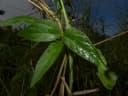
Vigna vexillata
Vigna vexillata
Safety & Hazards
None known
Cultivation Details
A plant of the moist to humid tropics, where it is found from sea level to elevations of 1,500 metres[1]. It grows best in areas where the mean annual temperature is within the range 20 - 28°c, but is tolerant of 15 - 32°c[1]. It prefers a mean annual rainfall in the range 1,300 - 2,100mm, tolerating 650 - 4,200mm[1]. Prefers a sunny position[1]. Plants can be found in the deep shade of trees in the wild[2]. Grows best in a light to medium, well-drained soil[1]. Tolerant of occasional waterlogging[3]. Succeeds in poor soils[3]. Prefers a pH in the range 5.5 - 6.5, but can tolerate 5.5 - 8[1]. A fast-growing plant from seed, quickly covering the ground[3]. Flowering occurs 3 - 4 months after planting, and the seedpods ripen about 1 month later. When the fruits are ripe, the tubers are also ready for harvesting[3]. This species has a symbiotic relationship with certain soil bacteria, these bacteria form nodules on the roots and fix atmospheric nitrogen. Some of this nitrogen is utilized by the growing plant but some can also be used by other plants growing nearby[4]. When removing plant remains at the end of the growing season, it is best to only remove the aerial parts of the plant, leaving the roots in the ground to decay and release their nitrogen[PFAF].
Propagation
Seed - it takes 8 - 10 days to germinate[3]. Cite as: Tropical Plants Database, Ken Fern. tropical.theferns.info. 2026-02-20. <tropical.theferns.info/viewtropical.php?id=Vigna+vexillata>
Pollinators
Bees
References
- [1]Ecocrop — http://ecocrop.fao.org/ecocrop/srv/en/home ↩︎Basic information on a wide range of useful plants, plus details of environmental needs where available.
- [2]Gemsbok Bean and Kalahari Truffle — Leffers A. · Gamsberg MacMillan; Namibia. · 2003 · ISBN 99916-0-491-X ↩︎Details of the traditional uses of over 200 species of plants in northeastern Namibia. Written for the non-expert, there is usually at least one photograph with each plant entry.
- [3]Plant Resources of Southeast Asia — http://proseanet.org/ ↩︎Lots of information on the uses of the plants of SE Asia.
- [4]Nodulation Plants in GRIN Taxonomy — United States Department of Agriculture · http://www.ars-grin.gov/~sbmljw/cgi-bin/taxnodul.pl?language=en ↩︎An online database listing plants that have either positive or negative reports on root and stem nodulation with nitrogen-fixing bacteria.
- [5]African Flowering Plants Database — Conservatoire et Jardin Botaniques. · http://www.ville-ge.ch/musinfo/bd/cjb/africa/recherche.php ↩︎Contains information on over 150,000 plant names (including synonyms) giving a description and habitat, plus a distribution map.
- [6]Cornucopia II — Facciola. S. · Kampong Publications, California. · 1998 · ISBN 0-9628087-2-5 ↩︎The second edition of an excellent guide to the edible uses of plants, though it does not give any details of cultivation etc.
- [7]Wild edible plants traditionally used by the tribes in the Parambikulam Wildlife Sanctuary, Keala, India — Yesodharan K. & Sujana K.A. · 2007 ↩︎
- [8]Genetic Resources of Under-exploited Legumes/Tribal Pulses of Western Ghats, Tamil Nadu — Kalidass C. & Mohan V.R. · 2011 ↩︎
- [9]Flora of China — Missouri Botanical Garden Press; St. Louis. · 1994 · http://flora.huh.harvard.edu/china/ ↩︎An excellent, comprehensive resource in 25 volumes. In addition to the botanical information the flora also gives basic information on habitat and some uses. An on-line version is also available.
- [PFAF]Plants for a Future — pfaf.org ↩︎