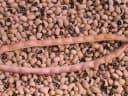
Vigna unguiculata unguiculata
Vigna unguiculata unguiculata
Safety & Hazards
None known
Cultivation Details
A plant of the lowland tropics, where it can also be cultivated at elevations up to 1,500 metres. It grows best in areas where annual daytime temperatures are within the range 20 - 35°c, but can tolerate 10 - 40°c[1]. The plant cannot tolerate frost It prefers a mean annual rainfall in the range 600 - 1,500mm, but tolerates 400 - 4,100mm[1]. Prefers a position in full sun, tolerating light shade[1]. Succeeds in a wide variety of soils, from sandy loams to clays, so long as they are well-drained[2]. Prefers a pH in the range 5.5 - 7.5, tolerating 4.3 - 8.8[1]. Good yields have been obtained on peaty soils, but the plant dislikes alkaline soils since this reduces nodulation of bacteria on the roots and causes chlorosis of the leaves[2]. Young seed pods can be harvested about 2 months after sowing, whilst mature seeds can be obtained in 3 - 5 months[2]. Up to 6 tonnes per hectare of pods can be obtained per hectare, or 400 - 750kg of dried seed[2]. There are many named varieties[2, 3]. Most cultivars are day-length neutral, though short-day forms are also known[2]. This species has a symbiotic relationship with certain soil bacteria, these bacteria form nodules on the roots and fix atmospheric nitrogen. Some of this nitrogen is utilized by the growing plant but some can also be used by other plants growing nearby[4]. When removing plant remains at the end of the growing season, it is best to only remove the aerial parts of the plant, leaving the roots in the ground to decay and release their nitrogen.
Propagation
Seed - pre-soak for 12 hours in warm water and sow 1 - 3cm deep in situ[2]. The seed germinates best when the soil temperature is above 21c[2]. Cite as: Tropical Plants Database, Ken Fern. tropical.theferns.info. 2026-02-20. <tropical.theferns.info/viewtropical.php?id=Vigna+unguiculata+unguiculata>
Pollinators
Insects
References
- [1]Ecocrop — http://ecocrop.fao.org/ecocrop/srv/en/home ↩︎Basic information on a wide range of useful plants, plus details of environmental needs where available.
- [2]Vegetables in the Tropics — Tindall. H. D. · MacMillan, Oxford. · 1983 · ISBN 0-333-24268-8 ↩︎An excellent, in-depth look at the main vegetable crops that can be grown in the Tropics, plus many less well-known plants.
- [3]Cornucopia II — Facciola. S. · Kampong Publications, California. · 1998 · ISBN 0-9628087-2-5 ↩︎The second edition of an excellent guide to the edible uses of plants, though it does not give any details of cultivation etc.
- [4]Nodulation Plants in GRIN Taxonomy — United States Department of Agriculture · http://www.ars-grin.gov/~sbmljw/cgi-bin/taxnodul.pl?language=en ↩︎An online database listing plants that have either positive or negative reports on root and stem nodulation with nitrogen-fixing bacteria.
- [5]Tropical Food Gardens — Norrington. L. · Bloomings Books (Melbourne) · 2001 · ISBN 1-876473-41-x ↩︎Excellent little book giving some basic information on a range of plants.
- [6]Dictionary of Economic Plants. — Uphof. J. C. Th. · Weinheim · 1959 · ISBN - ↩︎An excellent and very comprehensive guide but it only gives very short descriptions of the uses without any details of how to utilize the plants. Not for the casual reader.
- [7]Medicinal Plants of the Guianas — DeFilipps, R. A.; Maina, S. L.; & Crepin, J. · Smithsonian Museum · http://botany.si.edu/bdg/medicinal/index.html ↩︎A down-loadable PDF document of a book in pre-publication awaiting illustration. An excellent, if rather terse, guide to the traditional medicinal uses of the plants of the region