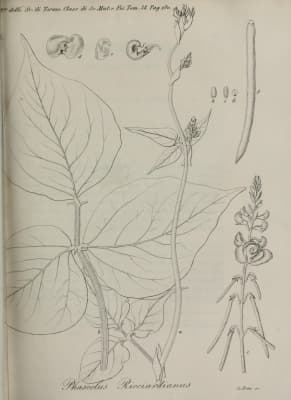
Vigna umbellata
Vigna umbellata
Safety & Hazards
None known
Cultivation Details
A plant of the tropics, where it is found at elevations up to 2,000 metres. It grows best in areas where annual daytime temperatures are within the range 18 - 30°c, but can tolerate 10 - 40°c[1]. It prefers a mean annual rainfall in the range 700 - 1,500mm, but tolerates 300 - 2,000mm[1]. Requires a sunny position[1]. Grows best on a moderately fertile loam, though it is tolerant of a wide range of well-drained soil types[2]. Prefers a pH in the range 6 - 7.5, tolerating 5.5 - 8[1]. Many forms are moderately drought resistant[2]. Rice bean seedlings grow vigorously and establish themselves quickly[3]. They are able to smother weeds due to their vigorous growth[3]. Plants can commence flowering 60 - 75 days from sowing with the seed maturing in 92 - 135 days[3]. The average seed yield is only 200 - 300 kilos per hectare, but the low yields are related to the often very short crop cycle. Experimental yields up to 2500 kilos have been obtained in India[3]. Flowers are self-compatible, but cross-pollination also occurs[3]. A short day plant, requiring day lengths of less than 12 hours to initiate flowering[2]. There are many named cultivars[2]. This species has a symbiotic relationship with certain soil bacteria, these bacteria form nodules on the roots and fix atmospheric nitrogen. Some of this nitrogen is utilized by the growing plant but some can also be used by other plants growing nearby[4]. When removing plant remains at the end of the growing season, it is best to only remove the aerial parts of the plant, leaving the roots in the ground to decay and release their nitrogen.
Propagation
Seed - sow in situ. Cite as: Tropical Plants Database, Ken Fern. tropical.theferns.info. 2026-02-20. <tropical.theferns.info/viewtropical.php?id=Vigna+umbellata>
Pollinators
Data unavailable
References
- [1]Ecocrop — http://ecocrop.fao.org/ecocrop/srv/en/home ↩︎Basic information on a wide range of useful plants, plus details of environmental needs where available.
- [2]Vegetables in the Tropics — Tindall. H. D. · MacMillan, Oxford. · 1983 · ISBN 0-333-24268-8 ↩︎An excellent, in-depth look at the main vegetable crops that can be grown in the Tropics, plus many less well-known plants.
- [3]Protabase - Plant Resources of Tropical Africa. — http://www.prota.org ↩︎An excellent on-line database with detailed information on over 3,200 species of useful plants of Africa.
- [4]The New RHS Dictionary of Gardening. 1992. — Huxley. A. · MacMillan Press · 1992 · ISBN 0-333-47494-5 ↩︎Excellent and very comprehensive, though it contains a number of silly mistakes. Readable yet also very detailed.
- [5]Cornucopia II — Facciola. S. · Kampong Publications, California. · 1998 · ISBN 0-9628087-2-5 ↩︎The second edition of an excellent guide to the edible uses of plants, though it does not give any details of cultivation etc.