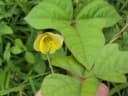
Vigna trilobata
Vigna trilobata
Safety & Hazards
None known
Cultivation Details
A plant of the drier tropics, where it is found at elevations up to 2,100 metres. It grows best in areas where annual daytime temperatures are within the range 22 - 31°c, but can tolerate 18 - 35°c[1]. The plant can survive temperatures down to about -1°c[1]. It prefers a mean annual rainfall in the range 700 - 900mm, but tolerates 520 - 1,440mm[1]. Succeeds in full sun and in light shade[1]. Succeeds in a range of soils, including heavy clay soils that crack in dry conditions[2]. Plants can tolerate occasional waterlogging of the soil[1]. Tolerant of moderate levels of salt in the soil[1]. Prefers a pH in the range 7 - 8.5, tolerating 6.5 - 9[1]. Established plants are very drought tolerant[2]. This species has a symbiotic relationship with certain soil bacteria, these bacteria form nodules on the roots and fix atmospheric nitrogen. Some of this nitrogen is utilized by the growing plant but some can also be used by other plants growing nearby[3].
Propagation
Seed - Cite as: Tropical Plants Database, Ken Fern. tropical.theferns.info. 2026-02-20. <tropical.theferns.info/viewtropical.php?id=Vigna+trilobata>
Pollinators
Data unavailable
References
- [1]Ecocrop — http://ecocrop.fao.org/ecocrop/srv/en/home ↩︎Basic information on a wide range of useful plants, plus details of environmental needs where available.
- [2]Plant Resources of Southeast Asia — http://proseanet.org/ ↩︎Lots of information on the uses of the plants of SE Asia.
- [3]Nodulation Plants in GRIN Taxonomy — United States Department of Agriculture · http://www.ars-grin.gov/~sbmljw/cgi-bin/taxnodul.pl?language=en ↩︎An online database listing plants that have either positive or negative reports on root and stem nodulation with nitrogen-fixing bacteria.
- [4]Flora of China — Missouri Botanical Garden Press; St. Louis. · 1994 · http://flora.huh.harvard.edu/china/ ↩︎An excellent, comprehensive resource in 25 volumes. In addition to the botanical information the flora also gives basic information on habitat and some uses. An on-line version is also available.
- [5]Genetic Resources of Under-exploited Legumes/Tribal Pulses of Western Ghats, Tamil Nadu — Kalidass C. & Mohan V.R. · 2011 ↩︎
- [6]Flowers of India — http://www.flowersofindia.net/ ↩︎A wed site of native Indian plants, plus cultivated and naturalized species. It has good quality photos and terse details on more than 3,000 species and cultivars.
- [7]Wild edible plants traditionally used by the tribes in the Parambikulam Wildlife Sanctuary, Keala, India — Yesodharan K. & Sujana K.A. · 2007 ↩︎