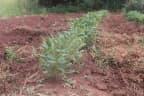
Vigna subterranea
Vigna subterranea
Safety & Hazards
None known
Cultivation Details
Succeeds in lowland tropical areas and up to an elevation of around 1,500 metres[1]. Adapted to growing in areas with relatively high temperatures up to 30°c[1]. Prefers an evenly distributed annual precipitation in the range 600 - 1,000mm, though satisfactory yields can be obtained in areas with a pronounced dry season[1]. Plants are tolerant of periods of heavy rainfall, except when they are flowering[1]. Prefers a sunny position[2]. Prefers a sandy loam soil that is rich in organic matter, but can succeed in any well-drained soil[3, 1]. Succeeds in a soil of medium or low fertility[1]. Dislikes calcareous soils[1]. Grows best in a pH of 5 - 6.5[1]. Established plants are relatively drought resistant[1]. Flowering usually commences about 30 - 55 days after sowing the seed[3]. A harvest can be obtained about 3 - 4 months after sowing the seed[1]. Yields of 300 - 600kg per hectare can be obtained[1]. Like the peanut (Arachis hypogaea) the seeds of this plant develop beneath the soil[1]. Most cultivars are adapted to short days[1]. This species has a symbiotic relationship with certain soil bacteria, these bacteria form nodules on the roots and fix atmospheric nitrogen. Some of this nitrogen is utilized by the growing plant but some can also be used by other plants growing nearby[4]. When removing plant remains at the end of the growing season, it is best to only remove the aerial parts of the plant, leaving the roots in the ground to decay and release their nitrogen.
Propagation
Seed - pre-soak for 12 hours in warm water and sow in situ. Seed germinates best at a temperature of 30 - 35°c, it does not germinate properly below 15°c or above 40°c[3]. The seed sprouts within 5 - 21 days[3]. Cite as: Tropical Plants Database, Ken Fern. tropical.theferns.info. 2026-02-20. <tropical.theferns.info/viewtropical.php?id=Vigna+subterranea>
Pollinators
Self
References
- [1]Vegetables in the Tropics — Tindall. H. D. · MacMillan, Oxford. · 1983 · ISBN 0-333-24268-8 ↩︎An excellent, in-depth look at the main vegetable crops that can be grown in the Tropics, plus many less well-known plants.
- [2]Ecocrop — http://ecocrop.fao.org/ecocrop/srv/en/home ↩︎Basic information on a wide range of useful plants, plus details of environmental needs where available.
- [3]Protabase - Plant Resources of Tropical Africa. — http://www.prota.org ↩︎An excellent on-line database with detailed information on over 3,200 species of useful plants of Africa.
- [4]The New RHS Dictionary of Gardening. 1992. — Huxley. A. · MacMillan Press · 1992 · ISBN 0-333-47494-5 ↩︎Excellent and very comprehensive, though it contains a number of silly mistakes. Readable yet also very detailed.
- [5]Flora Zambesiaca — http://apps.kew.org/efloras/fz/intro.html ↩︎An excellent online flora of plants from the Zambezi River basin. It lists a number of the plant uses as well as the habitats and botanical descriptions of the plants.
- [6]The Useful Plants of West Tropical Africa. — Burkil. H. M. · Royal Botanic Gardens; Kew. · 1985 - 2004 ↩︎Brief descriptions and details of the uses of over 4,000 plants. A superb, if terse, resource, it is also available electronically on the Web - see http://www.aluka.org/
- [7]Cornucopia II — Facciola. S. · Kampong Publications, California. · 1998 · ISBN 0-9628087-2-5 ↩︎The second edition of an excellent guide to the edible uses of plants, though it does not give any details of cultivation etc.