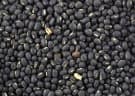
Vigna mungo
Vigna mungo
Safety & Hazards
None known
Cultivation Details
A plant of the drier tropics, where it is found at elevations up to 2,000 metres. It grows best in areas where annual daytime temperatures are within the range 22 - 35°c, but can tolerate 8 - 40°c[1]. The plant does not tolerate frost. It prefers a mean annual rainfall in the range 650 - 900mm, but tolerates 530 - 2,430mm[1]. Rain at flowering time has a very adverse effect upon seed yields[2]. Plants are not adapted to wet, humid areas with high rainfall, but can, however, be grown in the dry season of wetter areas so long as this is at least 4 months in duration[3]. Requires a sunny position[1]. Grows well in well-drained, fairly heavy fertile soils[3]. Tolerant of moderate levels of salt in the soil[1]. Prefers a pH in the range 5.5 - 6.5, tolerating 4.5 - 7.5[1]. Established plants are drought resistant[3]. Immature pods can be harvested about 60 - 80 days after sowing[3, 1]. Mature beans can be harvested after 75 - 130 days[1]. Yields of 500 - 650 kilos per hectare of dried seeds can be obtained[3]. The average yield of dry seeds in India can vary between 340 - 1,500 kilos per hectare[1]. There are some named varieties[3]. There are three main forms of this plant:- Var mungo. A large seeded, early maturing form with black seeds[4, 3]. Var viridis Bose. A small seeded late maturing form with brown, green or grey seeds[4, 3]. Ver silvestris Lukoki, Maréchal & Otoul. The original, wild form. Most cultivars require short daylengths[3]. This species has a symbiotic relationship with certain soil bacteria, these bacteria form nodules on the roots and fix atmospheric nitrogen. Some of this nitrogen is utilized by the growing plant but some can also be used by other plants growing nearby[5]. When removing plant remains at the end of the growing season, it is best to only remove the aerial parts of the plant, leaving the roots in the ground to decay and release their nitrogen.
Propagation
Seed - presoak for 12 hours in warm water and sow in situ. The seed generally sprouts within 7 - 10 days[4]. Cite as: Tropical Plants Database, Ken Fern. tropical.theferns.info. 2026-02-20. <tropical.theferns.info/viewtropical.php?id=Vigna+mungo>
Pollinators
Self, Insects
References
- [1]Ecocrop — http://ecocrop.fao.org/ecocrop/srv/en/home ↩︎Basic information on a wide range of useful plants, plus details of environmental needs where available.
- [2]Annals of the Missouri Botanical Garden Vol. 76 — Missouri Botanical Garden · 1989 ↩︎An excellent botanical publication, available for download from the Internet. This volume contains a monograph of the genus Zapoteca (Calliandra) amongst other things.
- [3]Vegetables in the Tropics — Tindall. H. D. · MacMillan, Oxford. · 1983 · ISBN 0-333-24268-8 ↩︎An excellent, in-depth look at the main vegetable crops that can be grown in the Tropics, plus many less well-known plants.
- [4]Protabase - Plant Resources of Tropical Africa. — http://www.prota.org ↩︎An excellent on-line database with detailed information on over 3,200 species of useful plants of Africa.
- [5]The New RHS Dictionary of Gardening. 1992. — Huxley. A. · MacMillan Press · 1992 · ISBN 0-333-47494-5 ↩︎Excellent and very comprehensive, though it contains a number of silly mistakes. Readable yet also very detailed.
- [6]Dictionary of Economic Plants. — Uphof. J. C. Th. · Weinheim · 1959 · ISBN - ↩︎An excellent and very comprehensive guide but it only gives very short descriptions of the uses without any details of how to utilize the plants. Not for the casual reader.
- [7]Cornucopia II — Facciola. S. · Kampong Publications, California. · 1998 · ISBN 0-9628087-2-5 ↩︎The second edition of an excellent guide to the edible uses of plants, though it does not give any details of cultivation etc.