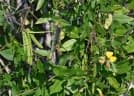
Vigna luteola
Vigna luteola
Safety & Hazards
None known
Cultivation Details
Vigna luteola is found over a diverse range of temperature environments, succeeding as an annual in the temperate zone and growing as a perennial in the tropics from sea level to over 2,000 metres. The average annual temperature in these areas ranges from as low as 13°c up to about 26°c. The optimum temperature for growth is in the range of 20 - 30°c. The growing plant is very susceptible to frost[1, 2]. While it can make a useful contribution in areas with average annual rainfalls as low as 800mm, ideally the rainfall should be 1,250mm, and up to at least 4,000 mm. In lower rainfall environments, soils should have good moisture storage characteristics[1, 2]. Adapted to a wide range of soil types, from light loams to heavy textured clays, and from very acid to strongly alkaline soils. It is adapted to poorly drained and moderately saline soils[2]. The plant has little drought tolerance and does not perform well under dry conditions[2]. It prefers good soil moisture conditions, and is tolerant of waterlogging and short-term flooding[2]. The plant is considered a weed of rice crops in South America, and in South Africa it figures on the national weed list[1]. While it is recorded as causing some problems in rice crops, there are no records of this species becoming a major weed[2]. The plant is day-neutral and flowers throughout the year[1]. Seed harvest is difficult owing to the plant's indeterminate flowering habit. Pods are hidden by new growth before they can be picked, and so hand harvesting has been the only method employed to date. The pods also shatter[1]. This species has a symbiotic relationship with certain soil bacteria; these bacteria form nodules on the roots and fix atmospheric nitrogen. Some of this nitrogen is utilized by the growing plant but some can also be used by other plants growing nearby[3].
Propagation
Seed - it has a hard seedcoat and may benefit from scarification before sowing in order to speed up and improve germination[2]. This can usually be done by pouring a small amount of nearly boiling water on the seeds (being careful not to cook them!) and then soaking them for 12 - 24 hours in warm water. By this time they should have imbibed moisture and swollen - if they have not, then carefully make a nick in the seedcoat (being careful not to damage the embryo) and soak for a further 12 hours before sowing. Cite as: Tropical Plants Database, Ken Fern. tropical.theferns.info. 2026-02-20. <tropical.theferns.info/viewtropical.php?id=Vigna+luteola>
Pollinators
Data unavailable
References
- [1]Protabase - Plant Resources of Tropical Africa. — http://www.prota.org ↩︎An excellent on-line database with detailed information on over 3,200 species of useful plants of Africa.
- [2]Tropical Forages — http://www.tropicalforages.info/key/Forages/Media/Html/index.htm ↩︎Mainly focussed on forage plants, the site gives a lot of information on the plant, with a good botanical description, details of cultivation, plant uses and a good selection of photographs.
- [3]Nodulation Plants in GRIN Taxonomy — United States Department of Agriculture · http://www.ars-grin.gov/~sbmljw/cgi-bin/taxnodul.pl?language=en ↩︎An online database listing plants that have either positive or negative reports on root and stem nodulation with nitrogen-fixing bacteria.