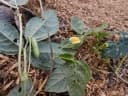
Vigna hosei
Vigna hosei
Safety & Hazards
None known
Cultivation Details
A plant of the wet tropics, where it is found at elevations up to 1,100 metres. It grows best in areas where annual daytime temperatures are within the range 22 - 30°c, but can tolerate 15 - 35°c[1]. It does not tolerate frosts. It prefers a mean annual rainfall in the range 3,000 - 3,500mm, but tolerates 2,500 - 4,000mm[1]. Succeeds in full sun and in light shade[1]. Succeeds in sandy to clayey soils and is tolerant of occasional waterlogging[1]. Prefers a pH in the range 4.5 - 5, tolerating 4 - 5.5[1]. The plant has a shallow root system and a low tolerance of drought[2]. Flowering commences about 6 months after planting, self-pollination is the rule[2]. An outstanding characteristic of the plant is its persistence under shade, but full sunlight is required for good seed production[2]. Seed production is often poor and only about 50 kilos per hectare can be harvested. Harvesting the seed on a field scale is also difficult[2]. Besides producing normal aerial flowers and pods, the plant also produces flowers and pods which are hidden under the litter of leaves covering the soil[2]. A ground cover of Vigna hosei can be removed easily by hoeing the soil, followed by a clean weeding[2]. This species has a symbiotic relationship with certain soil bacteria, these bacteria form nodules on the roots and fix atmospheric nitrogen. Some of this nitrogen is utilized by the growing plant but some can also be used by other plants growing nearby. Although non-specific in its Rhizobium requirement, inoculation is preferably carried out with a selected cowpea strain such as CB 756[2, 3].
Propagation
Seed - it has a hard seedcoat and may benefit from scarification before sowing to speed up germination. This can usually be done by pouring a small amount of nearly boiling water on the seeds (being careful not to cook them!) and then soaking them for 12 - 24 hours in warm water. By this time they should have imbibed moisture and swollen - if they have not, then carefully make a nick in the seedcoat (being careful not to damage the embryo) and soak for a further 12 hours before sowing. Prior to sowing, the seeds may be inoculated with compost containing an appropriate Rhizobium strain[2] Cuttings - it is recommended to plant during the rainy season and to use 20cm long, 3-noded cuttings planted 100 - 150cm apart[2]. Cite as: Tropical Plants Database, Ken Fern. tropical.theferns.info. 2026-02-20. <tropical.theferns.info/viewtropical.php?id=Vigna+hosei>
Pollinators
Self
References
- [1]Ecocrop — http://ecocrop.fao.org/ecocrop/srv/en/home ↩︎Basic information on a wide range of useful plants, plus details of environmental needs where available.
- [2]Plant Resources of Southeast Asia — http://proseanet.org/ ↩︎Lots of information on the uses of the plants of SE Asia.
- [3]Nodulation Plants in GRIN Taxonomy — United States Department of Agriculture · http://www.ars-grin.gov/~sbmljw/cgi-bin/taxnodul.pl?language=en ↩︎An online database listing plants that have either positive or negative reports on root and stem nodulation with nitrogen-fixing bacteria.
- [4]IUCN Red List of Threatened Species — http://www.iucnredlist.org/ ↩︎A list of plants under threat and facing possible extinction, usually with brief details of the threats and information on habitat.
- [5]Flora of China — Missouri Botanical Garden Press; St. Louis. · 1994 · http://flora.huh.harvard.edu/china/ ↩︎An excellent, comprehensive resource in 25 volumes. In addition to the botanical information the flora also gives basic information on habitat and some uses. An on-line version is also available.