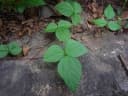
Vigna angularis
Vigna angularis
Safety & Hazards
None known
Cultivation Details
Adzuki bean is a plant of the subtropics, and is widely cultivated from the temperate zone to higher elevations in the tropics, where it is can be grown at elevations from 420 - 1,500 metres. It grows best in areas where annual daytime temperatures are within the range 15 - 30°c, but can tolerate 5 - 36°c[1]. The plant cannot tolerate frost. It prefers a mean annual rainfall in the range 900 - 1,300mm, but tolerates 530 - 1,800mm[1]. It is generally seen as a short-day plant, requiring a day length of 12½ hours or less to initiate flowering and fruiting, though cultivars can vary in their response to day length[2]. Requires a sunny position[1]. Succeeds in a wide range of well-drained soils[1]. Prefers a pH in the range 5.5 - 6.5, tolerating 5 - 7.5[1]. Some cultivars are fairly drought tolerant[2]. The plant can commence cropping within 60 - 190 days from seed[1]. Average seed yields range from 1 - 2.5 tonnes per hectare. In Taiwan yields of 1,450 kilos are common, in Japan 1,900 kilos, in Kenya 500 - 600 kilos and in New Zealand 1,340 - 2,240 kilos[1]. There are many named varieties[3]. This species has a symbiotic relationship with certain soil bacteria, these bacteria form nodules on the roots and fix atmospheric nitrogen. Some of this nitrogen is utilized by the growing plant but some can also be used by other plants growing nearby[2]. When removing plant remains at the end of the growing season, it is best to only remove the aerial parts of the plant, leaving the roots in the ground to decay and release their nitrogen.
Propagation
Seed - pre-soak the seed for 12 hours in warm water and sow in situ. It requires soil temperatures above 16 °c for germination[4]. Cite as: Tropical Plants Database, Ken Fern. tropical.theferns.info. 2026-02-20. <tropical.theferns.info/viewtropical.php?id=Vigna+angularis>
Pollinators
Bees
References
- [1]Ecocrop — http://ecocrop.fao.org/ecocrop/srv/en/home ↩︎Basic information on a wide range of useful plants, plus details of environmental needs where available.
- [2]The New RHS Dictionary of Gardening. 1992. — Huxley. A. · MacMillan Press · 1992 · ISBN 0-333-47494-5 ↩︎Excellent and very comprehensive, though it contains a number of silly mistakes. Readable yet also very detailed.
- [3]Cornucopia II — Facciola. S. · Kampong Publications, California. · 1998 · ISBN 0-9628087-2-5 ↩︎The second edition of an excellent guide to the edible uses of plants, though it does not give any details of cultivation etc.
- [4]Plant Resources of Southeast Asia — http://proseanet.org/ ↩︎Lots of information on the uses of the plants of SE Asia.
- [5]Dictionary of Economic Plants. — Uphof. J. C. Th. · Weinheim · 1959 · ISBN - ↩︎An excellent and very comprehensive guide but it only gives very short descriptions of the uses without any details of how to utilize the plants. Not for the casual reader.