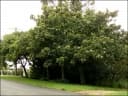
Vernicia montana
Vernicia montana
Safety & Hazards
The whole plant is poisonous. Animals, including cattle, horses and chicken that have eaten the leaves or seed cake show haemorrhagic diarrhoea accompanied by anorexia. In severe cases, they become emaciated and may die in 1 - 3 weeks[1]. The fruits are attractive in appearance and taste, but ingestion by humans of even a single seed causes severe abdominal cramps, vomiting, diarrhoea and general exhaustion after 3 - 5 hours[1].
Cultivation Details
A plant of the subtropics and tropics, in tropical areas it is usually grown at elevations from 800 - 2,000 metres. It grows best in areas that are frost-free, with an average annual temperatures in the range 15 - 27°c; and where the mean annual rainfall is 850 - 2,000mm[1]. The plants requirement for low temperatures in order to initiate flowering is less than that of Vernicia fordii[1]. Prefers a slightly acid soil, tolerating a pH in the range 5.5 - 8[1]. Adequate soil fertility is needed for good production. It is often grown on slopes, but grows well on flat land provided it is well-drained[1]. Harvesting by manual collection of the fallen fruits is the most common method, but in China green fruits are also picked from the trees[1]. Careful selection of clones can extend the harvesting season. During the rainy season, fruits should be collected every 10 days, and during the dry season about once a month[1]. Average yields of seeds are 3.5 tonnes per hectare in China and 1.8 tonnes in Malawi. In Malawi annual yields of air-dry seed of the best clonal material gradually increase from 280 kg/ha in 3 - 6-year-old plantations to 2.200 kg/ha in 11 - 14-year-old plantations and 3,000 kg/ha in 20-years-old plantations; yields of plantations of unselected seedling material are about half these amounts[1]. Plantations with a close planting system reach maximum production at an earlier age, but the maximum yields are the same as those from trees that are more widely spaced[1]. Regular weeding around the plants is needed for ease of harvesting[1]. In hedgerow systems, pruning and training are recommended to obtain a frame of a few main branches and open crown[1]. There are two main forms of this species, recognized in Malawi as types A and B. Similar types are also recognized in Indonesia as the Indo-China type and the China type:- Type A is a fast-growing tree with a tall, straight trunk forming tiers of 5 spreading branches at regular intervals. Secondary branches form at relatively long intervals. The trees take 3 - 5 years to come into bearing[1]. Type B is more shrub-like. When the main stem has produced 1 or 2 tiers of branches, it loses its dominance. Secondary branches are formed at short intervals. The trees come into bearing after 3 years. Several high-yielding vigorously growing clones have been selected from this form[1]. This species can hybridize with Vernicia fordii in the wild[1]. Occasionally monoecious, but more normally a dioecious species, in which case both male and female forms need to be grown if fruit and seed are required[1].
Propagation
Seed - best sown as soon as it is ripe, when it will germinate quickly. Stored seed develops a hard seedcoat and may benefit from scarification before sowing in order to speed up germination. This can usually be done by pouring a small amount of nearly boiling water on the seeds (being careful not to cook them!) and then soaking them for 12 - 24 hours in warm water. By this time they should have imbibed moisture and swollen - if they have not, then carefully make a nick in the seedcoat (being careful not to damage the embryo) and soak for a further 12 hours before sowing. When the loop of the hypocotyl becomes visible above the ground, seedlings are transferred from the germination bed to the nursery. Seedlings are transplanted into the field when they are 1 year old[1]. In Malawi budding is done in the nursery. The simple shield method of budding at a height of 5 - 7.5 cm above the ground is commonly applied. Cite as: Tropical Plants Database, Ken Fern. tropical.theferns.info. 2026-02-20. <tropical.theferns.info/viewtropical.php?id=Vernicia+montana>
Pollinators
Bees, Butterflies
References
- [1]Protabase - Plant Resources of Tropical Africa. — http://www.prota.org ↩︎An excellent on-line database with detailed information on over 3,200 species of useful plants of Africa.
- [2]Biotik, Laos — http://biotik.org/species_list_laos.html ↩︎Information on more than 100 species of Laotian trees.
- [3]Flora of China — Missouri Botanical Garden Press; St. Louis. · 1994 · http://flora.huh.harvard.edu/china/ ↩︎An excellent, comprehensive resource in 25 volumes. In addition to the botanical information the flora also gives basic information on habitat and some uses. An on-line version is also available.
- [PFAF]Plants for a Future — pfaf.org ↩︎