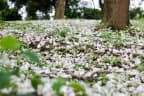
Vernicia fordii
Vernicia fordii
Safety & Hazards
The oil from the seed is poisonous[1]. The leaves and seeds contain a toxic saponin[2]. Although poisonous, saponins are poorly absorbed by the human body and so most pass through without harm. Saponins are quite bitter and can be found in many common foods such as some beans. They can be removed by carefully leaching in running water. Thorough cooking, and perhaps changing the cooking water once, will also normally remove most of them. However, it is not advisable to eat large quantities of food that contain saponins. Saponins are much more toxic to some creatures, such as fish, and hunting tribes have traditionally put large quantities of them in streams, lakes etc in order to stupefy or kill the fish[PFAF].
Cultivation Details
Tung tree is a plant mainly of subtropical areas, though it can also be grown at higher elevations in the tropics and in some of the warmer regions in the temperate zone - it is cultivated in the Caucasus, for example, where it has been sufficiently cold- resistant and withstood markedly low temperatures without any ill effects[3]. It is reported to tolerate an annual precipitation of 64 - 173cm, average temperatures ranging from 18.7 - 26.2°c, and a pH of 5.4 - 7.1[4]. Tung trees are very exacting in climatic and soil requirements[4]. They require long, hot summers with abundant moisture, with usually at least 1,120mm of rainfall rather evenly distributed through the year[4]. Trees require 350 - 400 hours in winter with temperatures 7.2°c or lower - without this cold requirement, trees tend to produce suckers from the main branches. Vigorous but not succulent growth is the most cold resistant - trees are susceptible to cold injury when in active growth[4]. Succeeds in full sun and in dappled shade. One report says that the plant is very tolerant of soil conditions[3]. It is easily grown in a loamy soil but the plants are unable to withstand much frost[5]. Requires a lime-free soil[6]. Tung trees usually begin bearing fruit the third year after planting, and are usually in commercial production by the fourth or fifth year, attaining maximum production in 10 - 12 years. Average life of trees in United States is 30 years. Fruits mature and drop to the ground in late September to early November. At this time they contain about 60% moisture. Fruits must be dried to 15% moisture before processing. Fruits should be left on ground 3 - 4 weeks until hulls are dead and dry, and the moisture content has dropped below 30%. Fruits are gathered by hand into baskets or sacks. Fruits do not deteriorate on ground until they germinate in spring[4]. Production of tung is best where day and night temperatures are uniformly warm. Much variation reduces tree growth and fruit size. Trees grow best if planted on hilltops or slopes, as good air-drainage reduces losses from spring frosts. Contour-planting on high rolling land escapes frost damage. Tung makes its best growth on virgin land. Soils must be well-drained, deep aerated, and have a high moisture-holding capacity to be easily penetrated by the roots. Green manure crops and fertilizers may be needed. Dolomitic lime may be used to correct excessive acidity; pH 6.0 - 6.5 is best; liming is beneficial to most soils in the Tung Belt, the more acid soils requiring greater amounts of lime[4]. Seedlings generally vary considerably from parent plants in growth and fruiting characters. Seedlings which have been self-pollinated for several generations give rather uniform plants[4]. Only 1 out of 100 selected 'mother' tung trees will produce seedlings sufficiently uniform for commercial planting[4]. Usually seedling trees outgrow budded trees, but budded trees produce larger crops and are more uniform in production, oil content and date of fruit maturity[4]. This species can hybridize with Vernicia montana in the wild[7]. There are some named varieties[4].
Propagation
Seed - sow early to mid spring in a warm greenhouse. When large enough to handle, prick the seedlings out into individual pots and grow them on for at least the first winter in a greenhouse. Plant out in early summer and give the plants some protection from the cold for their first winter outdoors. Tung seed are normally short-lived and must be planted during the season following harvest. Seeds are best hulled before planting, as hulls retard germination. Hulled seed may be planted dry, but soaking in water for 5 - 7 days hastens germination. Stratification, cold treatment or chemical treatment of seeds brings about more rapid and uniform germination. Dry-stored seed should be planted no later than late winter; stratified seed by mid-early spring; cold-treated and chemical treated seed by early mid spring[4]. Cuttings of mature wood in a frame[6]. Most successful budding is done in late August, by the simple shield method, requiring piece of budstock bark, including a bud, that will fit into a cut in the rootstock bar[4]. A T-shaped cut is made in bark of rootstock at point 5 - 7.5 cm above ground level, the flaps of bark loosened, shield-bud slipped inside flaps and the flaps tied tightly over the transplanted bud with rubber budding stripe, 12 cm long, 0.6 cm wide, 0.002 thick. After about 7 days, rubber stripe is cut to prevent binding. As newly set buds are susceptible to cold injury, soil is mounded over them for winter. When growth starts in spring, soil is pulled back and each stock cut back to within 3.5 cm of the dormant bud. Later, care consists of keeping all suckers removed and the trees well-cultivated[4]. Spring budding is done only as a last resort if necessary trees are not propagated the previous fall[4]. Cite as: Temperate Plants Database, Ken Fern. temperate.theferns.info. 2026-02-21. <temperate.theferns.info/plant/Vernicia+fordii>
Pollinators
Bees
References
- [1]A Colour Atlas of Poisonous Plants. — Frohne. D. and Pfänder. J. · Wolfe · 1984 · ISBN 0723408394 ↩︎Brilliant. Goes into technical details but in a very readable way. The best work on the subject that I've come across so far.
- [2]Medicinal Plants of China — Duke. J. A. and Ayensu. E. S. · Reference Publications, Inc. · 1985 · ISBN 0-917256-20-4 ↩︎Details of over 1,200 medicinal plants of China and brief details of their uses. Often includes an analysis, or at least a list of constituents. Heavy going if you are not into the subject.
- [3]Flora of the USSR. — Komarov. V. L. · Israel Program for Scientific Translation · 1968 · http://www.biodiversitylibrary.org · ISBN - ↩︎An immense (25 or more large volumes) and not yet completed translation of the Russian flora. Full of information on plant uses and habitats but heavy going for casual readers. It can be downloaded from the Internet.
- [4]Handbook of Energy Crops — Duke. J. · - · 1983 · https://hort.purdue.edu/newcrop/duke_energy/dukeindex.html · ISBN - ↩︎Published only on the Internet, excellent information on a wide range of both temperate and tropical plants.
- [5]RHS Dictionary of Plants plus Supplement. 1956 — F. Chittendon. · Oxford University Press · 1951 · ISBN - ↩︎Comprehensive listing of species and how to grow them. Somewhat outdated, it has been replaced in 1992 by a new dictionary (see [ 200 ]).
- [6]The New RHS Dictionary of Gardening. 1992. — Huxley. A. · MacMillan Press · 1992 · ISBN 0-333-47494-5 ↩︎Excellent and very comprehensive, though it contains a number of silly mistakes. Readable yet also very detailed.
- [7]Protabase - Plant Resources of Tropical Africa. — http://www.prota.org ↩︎An excellent on-line database with detailed information on over 3,200 species of useful plants of Africa.
- [8]Plantae Wilsonae. Vol 1 - 3 — Wilson. E. H. · University Press; Cambridge. · 1911 - 1917 · http://www.biodiversitylibrary.org ↩︎Details of the palnts collected by the plant collector E. H. Wilson on his travels in China. Gives some habitats. Not for the casual reader. It can be downloaded from the internet.
- [9]Flora of China — Missouri Botanical Garden Press; St. Louis. · 1994 · http://flora.huh.harvard.edu/china/ ↩︎An excellent, comprehensive resource in 25 volumes. In addition to the botanical information the flora also gives basic information on habitat and some uses. An on-line version is also available.
- [10]Tanaka's Cyclopedia of Edible Plants of the World. — Tanaka. T. & Nakao S. · Keigaku Publishing; Tokyo · 1976 · ISBN - ↩︎The most comprehensive list of edible plants I've come across. Only the briefest entry for each species, though, and some of the entries are more than a little dubious. Not for the casual reader.
- [11]A Barefoot Doctors Manual. — ? · Running Press; Philadelphica. · 1977 · ISBN 0-914294-92-X ↩︎A very readable herbal from China, combining some modern methods with traditional chinese methods.
- [12]Dictionary of Economic Plants. — Uphof. J. C. Th. · Weinheim · 1959 · ISBN - ↩︎An excellent and very comprehensive guide but it only gives very short descriptions of the uses without any details of how to utilize the plants. Not for the casual reader.
- [13]Plants for Man. — Schery. R. W. ↩︎Fairly readable but not very comprehensive. Deals with plants from around the world.
- [14]A Dictionary of Plants Used by Man. — Usher. G. · Constable · 1974 · ISBN 0094579202 ↩︎Forget the sexist title, this is one of the best books on the subject. Lists a very extensive range of useful plants from around the world with very brief details of the uses. Not for the casual reader.
- [15]Economic Botany. — Hill. A. F. · The Maple Press · 1952 · ISBN - ↩︎Not very comprehensive, but it is quite readable and goes into some detail about the plants it does cover.
- [PFAF]Plants for a Future — pfaf.org ↩︎