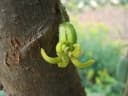
Vasconcellea x heilbornii
Vasconcellea x heilbornii
Safety & Hazards
None known
Cultivation Details
A plant of the highland tropics, where it is usually found at elevations of 1,400 - 2,50 metres[1]. It can also be grown at lower elevations in subtropical and warm, essentially frost-free temperate areas. Yields of over 100 tonnes per hectare are possible[1]. There are several named varieties[2]. The plant coppices well[1]. Although this species is dioecious (male and female flowers on separate plants), fruits are usually produced parthenocarpically, without the need of pollen for fertilisation[2, 3]. A few viable seeds will often be produced, however, if the flower is pollinated[3].
Propagation
Seed - unlikely to breed true since this is a hybrid species. Seeds are sometimes produced when the flowers are fertilized, these can be used to propagate the plant. Sow the seed in individual containers or in a nursery seedbed in light shade. Germination can be slow and difficult, taking about 30 days[3]. Seedlings can be planted out when 4 - 6 months old[3]. Cuttings work fairly well and maintain female lines that do not need pollination in order to produce fruit.. Cite as: Tropical Plants Database, Ken Fern. tropical.theferns.info. 2026-02-20. <tropical.theferns.info/viewtropical.php?id=Vasconcellea+x+heilbornii>
Pollinators
Self
References
- [1]Lost Crops of the Incas — Popenoe. H. et al · National Academy Press · 1990 · ISBN 0-309-04264-X ↩︎An excellent book. Very readable, with lots of information and good pictures of some lesser known food plants of S. America.
- [2]Cornucopia II — Facciola. S. · Kampong Publications, California. · 1998 · ISBN 0-9628087-2-5 ↩︎The second edition of an excellent guide to the edible uses of plants, though it does not give any details of cultivation etc.
- [3]Study of the Cultivation Potential of Native Fruit Species in Loja Province, Ecuador — Scheldeman X. · http://www.tropicallab.ugent.be/start.htm ↩︎A partial study, published on the Internet, of the family Caricaceae, with some very good photographs. Also, some notes on the Cherimoya.