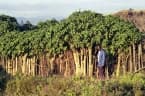
Vasconcellea pubescens
Vasconcellea pubescens
Safety & Hazards
None known
Cultivation Details
A plant of higher elevations up to 3,000 metres, with well-distributed rainfall in the tropics[1, 2], it can be grown at lower elevations and also in the subtropics and warm, essentially frost-free temperate areas[1]. It grows best in areas where the mean annual rainfall is 1,000 - 1,700mm, but tolerates a range of 500 - 2,800mm[3]. It prefers a mean minimum temperature of 17°c and a maximum of 22°c, but can tolerate a range from 10 - 28°c[3]. Plants can tolerate occasional short-lived frosts to about -3°c when dormant, but only -1°c when coming into growth[3]. Requires a fertile, well-drained soil and a sunny but sheltered position[1]. Established plants can tolerate prolonged droughts[3]. Prefers a pH in the range 6 - 7, but can tolerate 4.5 - 8.4[3]. Plants can start producing fruit in just 2 years from seed[2]. A single tree can produce 50 - 60 fruits a year[4]. The fruit of this species has potential commercial use in the warm temperate zone[1]. This species can be monoecious or dioecious. Dioecious forms will need both male and female forms to be grown if fruit and seed are required[5].
Propagation
Seed - sow in containers shaded from direct light. It germinates best at a temperature around 24 - 30c[1]. Germinates in 2 - 6 weeks[1]. Transfer the containers to a sunny position when plants are about 2 weeks old, planting out into permanent positions when the plants are large enough. Cite as: Tropical Plants Database, Ken Fern. tropical.theferns.info. 2026-02-20. <tropical.theferns.info/viewtropical.php?id=Vasconcellea+pubescens>
Pollinators
Data unavailable
References
- [1]The New RHS Dictionary of Gardening. 1992. — Huxley. A. · MacMillan Press · 1992 · ISBN 0-333-47494-5 ↩︎Excellent and very comprehensive, though it contains a number of silly mistakes. Readable yet also very detailed.
- [2]Perennial Edible Fruits of the Tropics : an Inventory — Martin, F. W.; Campbell, C. W.; Rubertbe, R. M. · U.S. Dept. of Agriculture, Agricultural Research Service · 1987 ↩︎A booklet giving terse details of almost 300 species of edible fruits, plus regional lists of Botanical and Common names for over 2,500 less well-known edible fruits of the tropics.
- [3]Ecocrop — http://ecocrop.fao.org/ecocrop/srv/en/home ↩︎Basic information on a wide range of useful plants, plus details of environmental needs where available.
- [4]Trade Winds Fruit — http://www.tradewindsfruit.com/index.htm ↩︎The on-line catalogue of a company selling seeds. Gives descriptions, photos and uses of a very wide range of fruit and other food-producing plants plus ornamentals.
- [5]Study of the Cultivation Potential of Native Fruit Species in Loja Province, Ecuador — Scheldeman X. · http://www.tropicallab.ugent.be/start.htm ↩︎A partial study, published on the Internet, of the family Caricaceae, with some very good photographs. Also, some notes on the Cherimoya.
- [6]Dictionary of Economic Plants. — Uphof. J. C. Th. · Weinheim · 1959 · ISBN - ↩︎An excellent and very comprehensive guide but it only gives very short descriptions of the uses without any details of how to utilize the plants. Not for the casual reader.
- [7]Mansfeld's Database of Agricultural and Horticultural Plants — http://mansfeld.ipk-gatersleben.de/pls/htmldb_pgrc/f?p=185:3:4292127278597336 ↩︎Terse details of a huge range of useful plants.