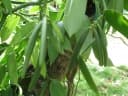
Vanilla planifolia
Vanilla planifolia
Safety & Hazards
Calcium oxalate crystals are present in the plant, which may cause dermatitis in vanilla workers[1].
Cultivation Details
The plant thrives in hot moist insular climates with frequent, but not excessive rain and requires two drier months to check vegetative growth and bring the vines into flower[2]. It grows best in areas where annual daytime temperatures are in the range 21 - 30°c, but can tolerate 10 - 33°c[2]. It prefers a mean annual rainfall of 2,000 - 2,500mm, tolerating 1,500 - 3,000mm[2]. An epiphytic plant, growing in pockets of humus on tree branches[3]. It requires a position in semi-shade, well-protected from winds[4]. Prefers a pH in the range 5.5 - 7, tolerating 4.3 - 8[2]. Plants produced from short cuttings, around 30cm in length, will take 3 - 5 years before they flower and start to produce fruit. If longer cuttings, around 90 - 100cm in length, are used, then fruiting can commence after only 1 - 2 years[2]. Under favourable conditions a plant may grow 60 - 120cm per month[1]. The plant has an economic life of about 10 - 15 years before yields drop and it needs replacing[2]. The flowers usually need to be hand pollinated, especially when being cultivated outside the plants natural range. The fruits mature in 180 - 270 days from flowering[2]. They are harvested when still green and lacking their distinctive aroma, and are then put through a lengthy curing process during which time they turn brown and develop their aroma[2]. Yields are very variable - a good vanillery may yield about 2.5 - 4 t/ha per year of fresh fruit, which gives 500 - 800 kg/ha of cured beans[2]. The flowers are pollinated by a specific species of moth in the night time. In areas where the moth is absent, hand pollination is necessary[4].
Propagation
Seed - surface sow, preferably as soon as it is ripe, and do not allow the compost to dry out. The seed of this species is extremely simple, it has a minute embryo surrounded by a single layer of protective cells. It contains very little food reserves and depends upon a symbiotic relationship with a species of fungus. The fungal hyphae invade the seed and enter the cells of the embryo. The orchid soon begins to digest the fungal tissue and this acts as a food supply for the plant until it is able to obtain nutrients from decaying material in the soil[5]. It is best to use some of the soil that is growing around established plants in order to introduce the fungus, or to sow the seed around a plant of the same species and allow the seedlings to grow on until they are large enough to move. Cuttings, 90 - 120cm long, with at least three leaf nodes. Sit them in loose, friable soil, but do not bury deeply or they will rot[4]. New shoots develop after 30 - 40 days[1]. Cuttings 1.5 - 2 metres long can be taken at any time of the year, but are best towards the end of the dry season[3]. The cuttings are kept loosely coiled in a dry, shady place for 2 - 3 weeks before insertion in open compost[3]. New shoots develop after 30 - 40 days[1]. Cite as: Tropical Plants Database, Ken Fern. tropical.theferns.info. 2026-02-20. <tropical.theferns.info/viewtropical.php?id=Vanilla+planifolia>
Pollinators
Moths
References
- [1]Plant Resources of Southeast Asia — http://proseanet.org/ ↩︎Lots of information on the uses of the plants of SE Asia.
- [2]Ecocrop — http://ecocrop.fao.org/ecocrop/srv/en/home ↩︎Basic information on a wide range of useful plants, plus details of environmental needs where available.
- [3]Encyclopaedia of Herbs and their Uses. — Bown. D. · Dorling Kindersley, London. · 1995 · ISBN 0-7513-020-31 ↩︎A very well presented and informative book on herbs from around the globe. Plenty in it for both the casual reader and the serious student. Just one main quibble is the silly way of having two separate entries for each plant.
- [4]Tropical Food Gardens — Norrington. L. · Bloomings Books (Melbourne) · 2001 · ISBN 1-876473-41-x ↩︎Excellent little book giving some basic information on a range of plants.
- [5]The New RHS Dictionary of Gardening. 1992. — Huxley. A. · MacMillan Press · 1992 · ISBN 0-333-47494-5 ↩︎Excellent and very comprehensive, though it contains a number of silly mistakes. Readable yet also very detailed.
- [6]Cornucopia II — Facciola. S. · Kampong Publications, California. · 1998 · ISBN 0-9628087-2-5 ↩︎The second edition of an excellent guide to the edible uses of plants, though it does not give any details of cultivation etc.