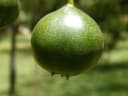
Vangueria madagascariensis
Vangueria madagascariensis
Safety & Hazards
None known
Cultivation Details
A plant of the tropics and subtropics, where it is found at elevations up to 2,400 metres. It grows best in areas where annual daytime temperatures are within the range 17 - 29°c, but can tolerate 12 - 34°c[1]. Plants are intolerant of frost[2]. It prefers a mean annual rainfall in the range 800 - 1,500mm, but tolerates 600 - 2,500mm[1]. Requires a sunny position[3]. Succeeds in volcanic ash soils; light yellowish-brown to reddish-yellow, gritty, sandy clay loams and red to dark red friable clays with lateritic horizon[3]. Prefers a pH in the range 5.5 - 7, tolerating 5 - 7.5[1]. The species is fire sensitive[3]. The flowers have an awful aroma[4]. The plant can be coppiced and pollarded[3].
Propagation
Seed germination is difficult owing to the hard seed coat[3]. Nicking the seed or soaking it in cold water overnight may hasten germination[3]. Untreated seed germinates well but sporadically, taking up to 6 weeks[3]. Seed can retain its viability for a year if dried properly[3]. There are 500-600 seeds/kg[3]. Cite as: Tropical Plants Database, Ken Fern. tropical.theferns.info. 2026-02-20. <tropical.theferns.info/viewtropical.php?id=Vangueria+madagascariensis>
Pollinators
Bees
References
- [1]Ecocrop — http://ecocrop.fao.org/ecocrop/srv/en/home ↩︎Basic information on a wide range of useful plants, plus details of environmental needs where available.
- [2]Perennial Edible Fruits of the Tropics : an Inventory — Martin, F. W.; Campbell, C. W.; Rubertbe, R. M. · U.S. Dept. of Agriculture, Agricultural Research Service · 1987 ↩︎A booklet giving terse details of almost 300 species of edible fruits, plus regional lists of Botanical and Common names for over 2,500 less well-known edible fruits of the tropics.
- [3]World Agroforesty Centre — http://www.worldagroforestry.org/ ↩︎An excellent online database of a huge range of trees giving very good information on each plant - its uses, ecology, identity, propagation, pests etc.
- [4]Inventory of Seeds and Plants Imported Vol. 25 — USDA Government Printing Office; Washington DC. · 1911 ↩︎Details of seeds imported for trials by the United States Department of Agriculture in the last quarter of 1910, often detailing the uses of the plant and various other miscellaneous information. It can be downloaded from the Internet.
- [5]Mansfeld's Database of Agricultural and Horticultural Plants — http://mansfeld.ipk-gatersleben.de/pls/htmldb_pgrc/f?p=185:3:4292127278597336 ↩︎Terse details of a huge range of useful plants.
- [6]The Useful Plants of West Tropical Africa. — Burkil. H. M. · Royal Botanic Gardens; Kew. · 1985 - 2004 ↩︎Brief descriptions and details of the uses of over 4,000 plants. A superb, if terse, resource, it is also available electronically on the Web - see http://www.aluka.org/
- [7]Plant Resources of Southeast Asia — http://proseanet.org/ ↩︎Lots of information on the uses of the plants of SE Asia.
- [8]Raintree Nutrition - Tropical Plant Database — http://www.rain-tree.com/plants.htm ↩︎Detailed information on the medicinal uses of more than two hundred rainforest plants, mainly from S. America, with basic descriptions of the plants, their other uses etc.
- [9]Dictionary of Economic Plants. — Uphof. J. C. Th. · Weinheim · 1959 · ISBN - ↩︎An excellent and very comprehensive guide but it only gives very short descriptions of the uses without any details of how to utilize the plants. Not for the casual reader.
- [10]Edible Wild Plants of Tanzania — Ruffo, C.K.: Birnie, A. & Tengnas, B. · Regional Land Management Unit; Nairobi. · 2002 · ISBN 9966-896-60-0 ↩︎A very well presented, simple guide to growing and utilizing wild food plants in Tanzania, with line drawings of each plant, a description, habitat and range, non-food as well as food uses, plus basic information on growing the plants.