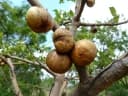
Vangueria infausta
Vangueria infausta
Safety & Hazards
None known
Cultivation Details
A tree of the subtropics to tropics, usually growing in areas with a distinct dry season at elevations up to 1,500 metres[1, 2]. It grows best in areas where annual daytime temperatures are within the range 17 - 28°c, though it can tolerate 12 - 36°c[2]. The plant is fairly frost-tolerant and is able to withstand temperatures down to -5°c when it is dormant, though even light frosts can damage the young growth[2]. It prefers a mean annual rainfall of 800 - 1,200mm, but tolerates 700 - 1,500mm[2]. Succeeds in full sun to light shade[2]. Succeeds in most soils so long as they are well drained[2]. Established plants are drought tolerant[2]. Prefers a pH in the range 5.5 - 7, tolerating 5 - 7.5[2]. A slow growing plant, usually increasing height by less than 50cm a year[3, 4].
References
- [1]Flora Zambesiaca — http://apps.kew.org/efloras/fz/intro.html ↩︎An excellent online flora of plants from the Zambezi River basin. It lists a number of the plant uses as well as the habitats and botanical descriptions of the plants.
- [2]Ecocrop — http://ecocrop.fao.org/ecocrop/srv/en/home ↩︎Basic information on a wide range of useful plants, plus details of environmental needs where available.
- [3]PlantZAfrica.com — http://www.plantzafrica.com ↩︎An excellent site giving detailed descriptions and uses of many S. African plants.
- [4]World Agroforesty Centre — http://www.worldagroforestry.org/ ↩︎An excellent online database of a huge range of trees giving very good information on each plant - its uses, ecology, identity, propagation, pests etc.
- [5]Edible Wild Plants of Tanzania — Ruffo, C.K.: Birnie, A. & Tengnas, B. · Regional Land Management Unit; Nairobi. · 2002 · ISBN 9966-896-60-0 ↩︎A very well presented, simple guide to growing and utilizing wild food plants in Tanzania, with line drawings of each plant, a description, habitat and range, non-food as well as food uses, plus basic information on growing the plants.
- [6]Dictionary of Economic Plants. — Uphof. J. C. Th. · Weinheim · 1959 · ISBN - ↩︎An excellent and very comprehensive guide but it only gives very short descriptions of the uses without any details of how to utilize the plants. Not for the casual reader.
- [7]Cornucopia II — Facciola. S. · Kampong Publications, California. · 1998 · ISBN 0-9628087-2-5 ↩︎The second edition of an excellent guide to the edible uses of plants, though it does not give any details of cultivation etc.
- [8]Useful Plants of Nyasaland — Williamson J. · The Government Printer, Zomba, Nyasaland. · 1955 · http://www.biodiversitylibrary.org ↩︎Brief details of the uses of almost 500 species of plants.
- [9]Gemsbok Bean and Kalahari Truffle — Leffers A. · Gamsberg MacMillan; Namibia. · 2003 · ISBN 99916-0-491-X ↩︎Details of the traditional uses of over 200 species of plants in northeastern Namibia. Written for the non-expert, there is usually at least one photograph with each plant entry.