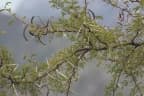
Vachellia karroo
Vachellia karroo
Safety & Hazards
None known
Cultivation Details
Vachellia karroo succeeds in subtropical to tropical areas where it is found at elevations from sea level to 1,000 metres[1]. It grows best where the mean annual temperature is in the range 12 - 40°c and the mean annual rainfall is between 200 - 1,500mm[1]. The plant is surprisingly hardy - mature plants can tolerate some frost[1], and plants have been grown successfully as far north as the British Isles. It is cultivated in Mediterranean climates, including California Prefers a sunny position. Prefers heavy black, hydromorphic cracking vertisols with high pH, or deep alluvial clay-loam soils in river valleys[1]. It sometimes does well on shale and even on acid soils[1]. Established plants are drought tolerant303]. Vachellia karroo is able to produce seeds prolifically from an early age; is resistant to fire; regenerates rapidly by means of sucker and forms dense thorny thickets that out compete native flora and are a source of potential injury to people and animals. The species can behave invasively in its native range, competing for space, water and nutrients with pasture grasses and thus replacing them - it is described as a weed of pasture land. It has been declared a noxious weed in several states of Australia and was previously a problem in New South Wales where it was the subject of an eradication programme[1, 2]. It is also included in the national weed list in South Africa[1]. The tree can tolerate fires - top growth can survive moderate fires and seeds will germinate freely after a fire to quickly colonize the newly-bare soil[1]. The flowers are fragrant[3]. The species has a mixed mating system. It exhibits a tendency towards out-crossing, as evidenced by the existence of trees that are entirely male. It is zoomophilus, principally insect pollinated because the strong colour of inflorescence and the heavy pollen grains attract insects[1]. Isolated plants bear no fruits[1]. The plant has an invasive root system, making it unsuitable for planting near buildings or paved pathways[1]. Considered to be a good indicator of fertile soils for crops and an indicator of surface or underground water[1]. Acacia karroo shows a wide range of variation, but not in such a way as to allow any infraspecific taxa to be recognized[4]. This species has a symbiotic relationship with certain soil bacteria, these bacteria form nodules on the roots and fix atmospheric nitrogen. Some of this nitrogen is utilized by the growing plant but some can also be used by other plants growing nearby[3].
Propagation
Seed - sow spring in a greenhouse. Prick out the seedlings into individual pots when they are large enough to handle and grow them on in the greenhouse for their first winter. Plant them out in late spring or early summer. Division in spring. Larger divisions can be planted out direct into their permanent positions. We have found that it is best to pot up smaller divisions and grow them on in light shade in a greenhouse or cold frame until they are growing away well. Plant them out in the summer or the following spring. Basal cuttings in late spring. Harvest the shoots with plenty of underground stem when they are about 8 - 10cm above the ground. Pot them up into individual pots and keep them in light shade in a cold frame or greenhouse until they are rooting well. Plant them out in the summer. Cite as: Temperate Plants Database, Ken Fern. temperate.theferns.info. 2026-02-21. <temperate.theferns.info/plant/Vachellia+karroo>
Pollinators
Insects
References
- [1]World Agroforesty Centre — http://www.worldagroforestry.org/ ↩︎An excellent online database of a huge range of trees giving very good information on each plant - its uses, ecology, identity, propagation, pests etc.
- [2]Invasive Species Compendium — http://www.cabi.org ↩︎An immense resource - in depth information on over 900 species of invasive plants (it also has information on animals, fungi etc).
- [3]The New RHS Dictionary of Gardening. 1992. — Huxley. A. · MacMillan Press · 1992 · ISBN 0-333-47494-5 ↩︎Excellent and very comprehensive, though it contains a number of silly mistakes. Readable yet also very detailed.
- [4]Flora Zambesiaca — http://apps.kew.org/efloras/fz/intro.html ↩︎An excellent online flora of plants from the Zambezi River basin. It lists a number of the plant uses as well as the habitats and botanical descriptions of the plants.
- [5]Dictionary of Economic Plants. — Uphof. J. C. Th. · Weinheim · 1959 · ISBN - ↩︎An excellent and very comprehensive guide but it only gives very short descriptions of the uses without any details of how to utilize the plants. Not for the casual reader.