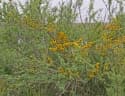
Vachellia farnesiana
Vachellia farnesiana
Safety & Hazards
The seeds, containing an unnamed alkaloid, are used to kill rabid dogs in Brazil[1].
Cultivation Details
Originally tropical, Vachellia farnesiana can succeed from the warm temperate zone to tropical areas, where it is naturalized at elevations up to 400 metres and cultivated up to 1,200 metres[2, 3]. It is particularly well adapted to arid and semi-arid grasslands and wastelands[4]. It grows best in areas where annual daytime temperatures are within the range 20 - 32°c, but can tolerate 7 - 42°c[5]. It prefers a mean annual rainfall in the range 400 - 1,400mm, but tolerates 150 - 4,000mm[5]. It prefers a minimum temperature no lower than 7°c[6]. Whilst this species is not very tolerant of cold, being damaged by even a few degrees of frost, the variety Vachellia farnesiana cavenia (now treated as a distinct species - see separate entry) seems to be more resistant to both drought and frost; and is said to be able to withstand short periods with temperatures falling to around -5°c[1]. Prefers a light sandy loam and a very sunny position sheltered from strong winds[7, 8, 9]. Plants can grow well in pure sand[1]. Most species in this genus become chlorotic on limey soils, though this species is said to have some tolerance[10]. Established plants are very drought tolerant[10, 11, 12]. The species and its cultivars are highly adaptable, and are reported to exhibit tolerance to drought, high pH, low pH, salty soils, both sands and clays[1, 4]. Plants tolerate a pH range from 5.0 to 8.0[1]. A fast-growing plant[2]. In a suitable climate, the trees begin to flower from their third year[12]. The flowers are sweetly fragrant. Young trees produce up to 1 kilo of flowers a year[13]. A well-managed mature plant 10 years old can yield 9 kg of flowers each year[12]. Although damaged by fire, the plant usually resprouts quickly from the base[14]. The plant responds well to coppicing[PFAF]. The leaves are peculiarly sensitive to changes of weather. When a cloud obscures the sun the opposite leaflets close together and so remain until the sky brightens. They also close at night, the plant appearing to sleep until the sun rises[15]. This species has a symbiotic relationship with certain soil bacteria, these bacteria form nodules on the roots and fix atmospheric nitrogen. Some of this nitrogen is utilized by the growing plant but some can also be used by other plants growing nearby[1].
Propagation
Seed - best sown as soon as it is ripe in a sunny position in a warm greenhouse[7]. Stored seed should be scarified, pre-soaked for 12 hours in warm water and then sown in a warm greenhouse in early spring. The seed germinates in 3 - 4 weeks at 25°c[16]. As soon as the seedlings are large enough to handle, prick them out into individual pots and grow them on in a sunny position in the greenhouse for their first winter. Plant them out in late spring or early summer, after the last expected frosts, and consider giving them some protection from the cold for their first winter outdoors. Cuttings of half-ripe wood with a heel, mid summer in individual pots in a frame[17]. Overwinter in a greenhouse for the first winter and plant out in their permanent positions in late spring or early summer. Fair percentage[17]. Cite as: Temperate Plants Database, Ken Fern. temperate.theferns.info. 2026-02-21. <temperate.theferns.info/plant/Vachellia+farnesiana>
Pollinators
Insects
References
- [1]Handbook of Energy Crops — Duke. J. · - · 1983 · https://hort.purdue.edu/newcrop/duke_energy/dukeindex.html · ISBN - ↩︎Published only on the Internet, excellent information on a wide range of both temperate and tropical plants.
- [2]Tropical and Subtropical Trees - A Worldwide Encyclopaedic Guide. — Barwick. M. · Thames & Hudson, London · 2004 · ISBN 0-500-51181-0 ↩︎A superb book, very concise and well written, giving a wealth of information on 400 or more species including descriptions, habitat, cultivation details and plant uses. A wealth of colour photographs bring each plant vividly to life.
- [3]Flora Malesiana Series 1 — Various · Nationaal Herbarium Nederiand, Universiteit Leiden branch · http://www.archive.org ↩︎A massive treatment of the plants of the Malaysian Archipelago. Much of it has been made available to download from the Internet
- [4]Invasive Species Compendium — http://www.cabi.org ↩︎An immense resource - in depth information on over 900 species of invasive plants (it also has information on animals, fungi etc).
- [5]Ecocrop — http://ecocrop.fao.org/ecocrop/srv/en/home ↩︎Basic information on a wide range of useful plants, plus details of environmental needs where available.
- [6]Encyclopaedia of Herbs and their Uses. — Bown. D. · Dorling Kindersley, London. · 1995 · ISBN 0-7513-020-31 ↩︎A very well presented and informative book on herbs from around the globe. Plenty in it for both the casual reader and the serious student. Just one main quibble is the silly way of having two separate entries for each plant.
- [7]RHS Dictionary of Plants plus Supplement. 1956 — F. Chittendon. · Oxford University Press · 1951 · ISBN - ↩︎Comprehensive listing of species and how to grow them. Somewhat outdated, it has been replaced in 1992 by a new dictionary (see [ 200 ]).
- [8]Shrubs for the Milder Counties. — Arnold-Forster. ↩︎Trees and shrubs that grow well in Cornwall and other mild areas of Britain. Fairly good, a standard reference book.
- [9]Flowers of the Mediterranean. — Polunin. O. and Huxley. A. · Hogarth Press · 1987 · ISBN 0-7012-0784-1 ↩︎A very readable pocket flora that is well illustrated. Gives some information on plant uses.
- [10]The New RHS Dictionary of Gardening. 1992. — Huxley. A. · MacMillan Press · 1992 · ISBN 0-333-47494-5 ↩︎Excellent and very comprehensive, though it contains a number of silly mistakes. Readable yet also very detailed.
- [11]Trees of North Texas — Vines. R.A. · University of Texas Press. · 1982 · ISBN 0292780206 ↩︎A readable guide to the area, it contains descriptions of the plants and their habitats with quite a bit of information on plant uses.
- [12]Scented Flora of the World. — Genders. R. · Robert Hale. London. · 1994 · ISBN 0-7090-5440-8 ↩︎An excellent, comprehensive book on scented plants giving a few other plant uses and brief cultivation details. There are no illustrations.
- [13]Plant Resources of Southeast Asia — http://proseanet.org/ ↩︎Lots of information on the uses of the plants of SE Asia.
- [14]Pacific Island Ecosystems at Risk — http://www.hear.org/pier/scientificnames/index.html ↩︎A very good website detailing weed species that have been introduced into the Pacific Islands.
- [15]The Useful Plants of the Island of Guam — Safford W.E. · Smithsonian Institute; Washington. · 1905 · http://www.biodiversitylibrary.org/ ↩︎A very comprehensive, if rather dated, guide to the plants of Guam. It can be downloaded from the Internet.
- [16]Growing from Seed. Volume 1. — Rice. G. (Editor) · Thompson and Morgan. · 1987 · ISBN - ↩︎Very readable magazine with lots of information on propagation.
- [17]Propagation of Trees, Shrubs and Conifers. — Sheat. W. G. · MacMillan and Co · 1948 · ISBN - ↩︎A bit dated but a good book on propagation techniques with specific details for a wide range of plants.
- [18]Brazilian Trees. Volume 2. 4th Edition. — Lorenzi. H. · Instituto Plantarum De Estudos Da Flora; Brazil. · 2002 · ISBN 85-86714-15-1 ↩︎Information on 350 species of Brazilian trees. Stunning photographs of each species, brief details on the plant, its uses and how to grow it from seed. A superb work, with the minor irritation that the translation from Portuguese is not of the best.
- [19]The Complete Trees of N. America. Field Guide and Natural History. — Elias. T. · Van Nostrand Reinhold Co. · 1980 · ISBN 0442238622 ↩︎A very good concise guide. Gives habitats, good descriptions, maps showing distribution and a few of the uses. It also includes the many shrubs that occasionally reach tree proportions.
- [20]Flora of Australia — http://www.anbg.gov.au/abrs/abif/flora/ ↩︎The full information from the Flora of Australia - on-line. An excellent resource.
- [21]Plants and People of Nepal — Manandhar. N. P. · Timber Press. Oregon. · 2002 · ISBN 0-88192-527-6 ↩︎Excellent book, covering over 1,500 species of useful plants from Nepal together with information on the geography and peoples of Nepal. Good descriptions of the plants with terse notes on their uses.
- [22]Cornucopia II — Facciola. S. · Kampong Publications, California. · 1998 · ISBN 0-9628087-2-5 ↩︎The second edition of an excellent guide to the edible uses of plants, though it does not give any details of cultivation etc.
- [23]Protein Quality and Antinutritional Factors of Wild Legume Seeds from the Sonoran Desert — Vázquez-Moreno L. & Robles-Burgueňo M.R. · 1996 ↩︎
- [24]Glossary of Indian Medicinal Plants (Including the Supplement). — Chopra. R. N., Nayar. S. L. and Chopra. I. C. · Council of Scientific and Industrial Research, New Delhi. · 1986 · ISBN - ↩︎Very terse details of medicinal uses of plants with a wide range of references and details of research into the plants chemistry. Not for the casual reader.
- [25]Dictionary of Economic Plants. — Uphof. J. C. Th. · Weinheim · 1959 · ISBN - ↩︎An excellent and very comprehensive guide but it only gives very short descriptions of the uses without any details of how to utilize the plants. Not for the casual reader.
- [26]Manual of the Trees of N. America. — Sargent. C. S. · Dover Publications Inc. New York. · 1965 · http://www.biodiversitylibrary.org/ · ISBN 0-486-20278-X ↩︎Two volumes, a comprehensive listing of N. American trees though a bit out of date now. Good details on habitats, some details on plant uses. Not really for the casual reader. It can be downloaded from the internet.
- [27]Common Trees of Puerto Rico and the Virgin Islands — Little E.L.; Wadsworth F.H. · USDA, Forest Service; Washington. · 1964 ↩︎Contains detailed information, and usually an illustration, on 250 tree species, including both native and exotic species.
- [PFAF]Plants for a Future — pfaf.org ↩︎